

Among the senior Iranian officials who have been especially active on social media since the start of the war is Mohammad Bagher Ghalibaf, the speaker of parliament. On Thursday, he again used a series of posts on X to belittle US and Israeli strikes. On Wednesday, he warned on his X account of a coming “storm” following the killing of senior Iranian figures. Hours earlier, he wrote: “The Iranian people have thwarted all the enemy’s plans. They are angry and frustrated with the Iranian people and seek to hide their defeats on the ground by attacking infrastructure. Of course, this means suicide for them. The ‘eye for an eye’ equation remains in effect and a new level of conflict has begun.”
Gallery
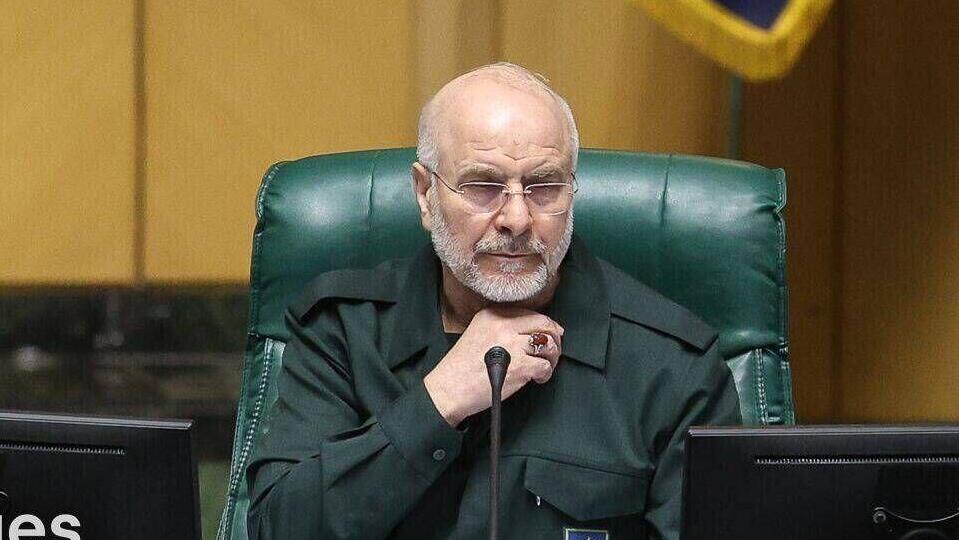
Iranian parliament speaker Mohammad Bagher Ghalibaf in Islamic Revolutionary Guard Corps uniform
He also published a post about Iran’s women’s national soccer team, which returned home after controversy and reports that some players had sought political asylum in Australia. He said the players are daughters of Iran and that the Iranian people embrace them, adding they did not succumb to “temptation and intimidation” by anti-Iranian elements. A day earlier, he warned, among other things, that the situation in the Strait of Hormuz would not return to what it was before the war and that “victory is near.”
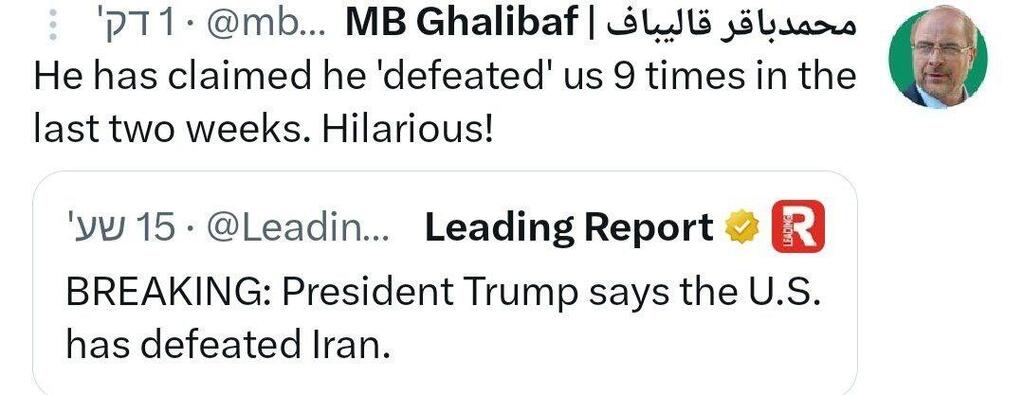
Ghalibaf on Trump
Largely through social media, Ghalibaf has positioned himself among Iran’s senior officials leading the country’s propaganda efforts. Following the killing of Ali Larijani, secretary of Iran’s Supreme National Security Council, Ghalibaf’s name has surfaced in media reports as a possible successor, alongside Saeed Jalili and others. No confirmed appointment has been announced.
In an interview with the Qatari newspaper “Al-Araby Al-Jadeed,” published on the 16th of the month, Ghalibaf said the war would end only when there are guarantees it will not resume. He declared: “We will continue to fight until the enemy truly regrets its aggression, and until appropriate political and security conditions are created globally and regionally, and the threat of war genuinely ends.” He added that Tehran seeks to sign agreements and security guarantees with neighboring Arab states to strengthen regional stability. “We did not expect our neighbors’ territory to be used to attack Iran, which forced us to defend ourselves. I believe no one believes American claims about destroying Iran’s offensive capabilities.”
“We have enough missiles and drones, and the technology is domestic. We can produce them at a higher rate and at a much lower cost than the enemy’s interceptors. We believe the war will significantly change regional relations. We will not return to the conditions that existed before it.” He also said Iran had prepared for a long war.
On the 15th of the month, he wrote that Trump had claimed to have defeated Iran nine times in two weeks, calling it “laughable.” The following day, he clarified: “We are definitely not seeking a ceasefire. Israel views the cycle as ‘war, negotiation, ceasefire, then war again’ to entrench its dominance. We will break this cycle.”
In recent days, Ghalibaf also spoke with Lebanese parliament speaker Nabih Berri, telling him that Iran’s strikes would continue and would “make Trump and Netanyahu regret.” According to reports, he expressed solidarity with Lebanon, while Berri offered condolences over the killing of Iran’s supreme leader, Ali Khamenei.
Chants of “death to America, death to Israel” in Iran’s parliament session


In early February, Iranian lawmakers donned Islamic Revolutionary Guard Corps uniforms and chanted slogans against Europe and “death to America, death to Israel,” in response to the European Union’s decision to designate the IRGC as a terrorist organization. As parliament speaker, Ghalibaf also wore a uniform at the event.
Born in 1961, Ghalibaf has extensive military, managerial and political experience. He joined the Revolutionary Guards at a young age and stood out during the Iran-Iraq war. He later commanded the Guards’ air force and helped develop missile programs. He also served in Iran’s internal security apparatus, where he was reported to have taken a hardline approach to protests. He served as Tehran’s mayor from 2005 to 2017 and has been parliament speaker since 2020. He previously ran for president several times but lost. Ghalibaf was born in Mashhad to a conservative, middle-class family. According to Al Jazeera, while considered a conservative, he has supported some reformist ideas. Reports say he married in 1983, in a ceremony conducted by Iran’s former supreme leader, Ruhollah Khomeini.