


Prime Minister Benjamin Netanyahu warned Wednesday that a government dependent on Arab parties would be unable to confront the threat of radical Islam, accusing the parties of supporting terrorism in his first video statement since last week's election.
Netanyahu, who has not appeared publicly since election night, released the recorded statement as President Isaac Herzog began consultations with parliamentary factions to determine who should receive the mandate to form the next government.
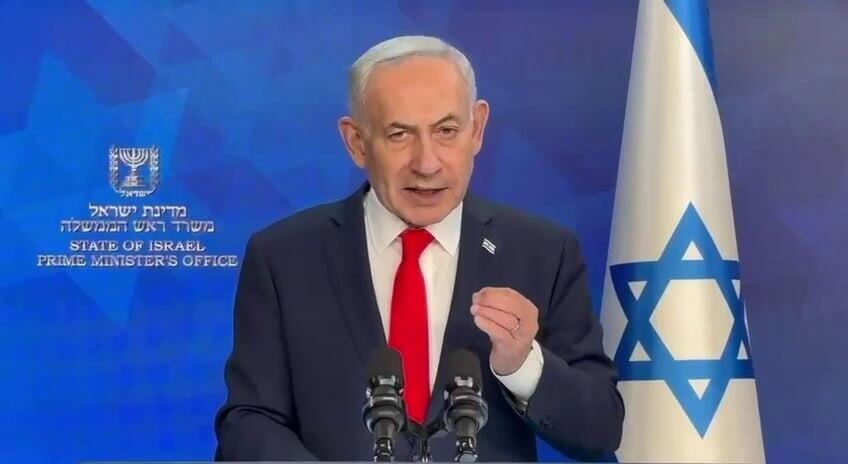
Prime Minister Benjamin Netanyahu
The prime minister, whose Likud party is seeking to retain power despite the election setback, called for a broad national coalition under his leadership and renewed allegations that foreign countries had attempted to influence the election results.
"Radical Islam is the challenge tearing countries in Europe apart today, and it is the challenge threatening us as well," Netanyahu said. "It threatens us from outside through Iran and its proxies, and it threatens us from within through Islamist parties that support terrorism."
He accused the Arab parties of seeking to erase Israel's Jewish identity and undermine its ability to defend itself, arguing that a government relying on their parliamentary support would pose a danger to the country.
"The one government that certainly cannot confront the threat of radical Islam is a government dependent on radical Islam, on these Islamist parties that reject the very existence of a Jewish state," Netanyahu said.
He cited statements by representatives of the Arab parties, including remarks praising martyrdom, describing Hamas as a charitable organization and dedicating electoral achievements to members of Hamas' Nukhba force imprisoned in Israel.
"Not only would such a government fail to fight our enemies, it would simply tear us apart from within," Netanyahu said. "Our very existence is at stake."
Netanyahu argued that only a broad coalition led by Likud could address the country's security challenges.
"There is a government that can confront this challenge: a broad national government led by Likud, under my leadership, that includes all components of the national camp and all Zionist parties willing to join," he said.
He accused leaders of the opposition bloc of prioritizing political interests over national security by rejecting a coalition with Likud and pursuing a minority government dependent on Arab lawmakers.
"They are working to establish a narrow minority government, a government that relies on these supporters of terrorism," Netanyahu said.
He also accused opposition leaders of setting conditions designed to rule out the possibility of forming a broad national government.
"They prefer their political interests over the national interest," he said.
Opposition parties seeking to replace Netanyahu have said they would not form a government dependent on Arab parties. However, it remains unclear how they could assemble a parliamentary majority without at least some support from Arab lawmakers.
The dispute has emerged as a central obstacle in coalition negotiations, with Yashar! leader Gadi Eisenkot seeking to secure the presidential mandate to form a government.
Netanyahu also returned to allegations of foreign interference in the election, claims he has repeatedly raised in written statements since the vote.
"There are serious suspicions of foreign countries intervening with enormous sums of money to influence the election results in the State of Israel," he said.
Netanyahu said Central Elections Committee chairman Justice Noam Sohlberg had instructed the Shin Bet domestic security agency to open a security investigation and remove obstacles to the inquiry.
"He is right. We must get to the full truth, without a cover-up and without delay," Netanyahu said.
Sohlberg, who formally presented the election results to Herzog earlier Wednesday, warned against efforts to undermine confidence in the electoral process.
"In recent days, voices have been heard seeking to cast doubt on the election results and challenge their validity. This is a real danger," Sohlberg said.
He emphasized that the peaceful transfer of power was a fundamental principle of democracy.
Netanyahu, however, insisted that investigating the allegations was essential to protecting the democratic process.
"The integrity of elections is the foundation of democracy," he said. "We must protect it, and we must protect our country."
The statement marked Netanyahu's first recorded public address since Tuesday of last week, following several written statements questioning the election results.
Another prominent political figure who had remained out of public view since the election, Shas chairman Aryeh Deri, also issued his first statement Wednesday evening, announcing that he would remain at the helm of the ultra-Orthodox party.
Deri's announcement followed reports that he had considered stepping down after the election. Earlier Wednesday, Shas representatives told Herzog that the party's Council of Torah Sages continued to support Deri's leadership.