

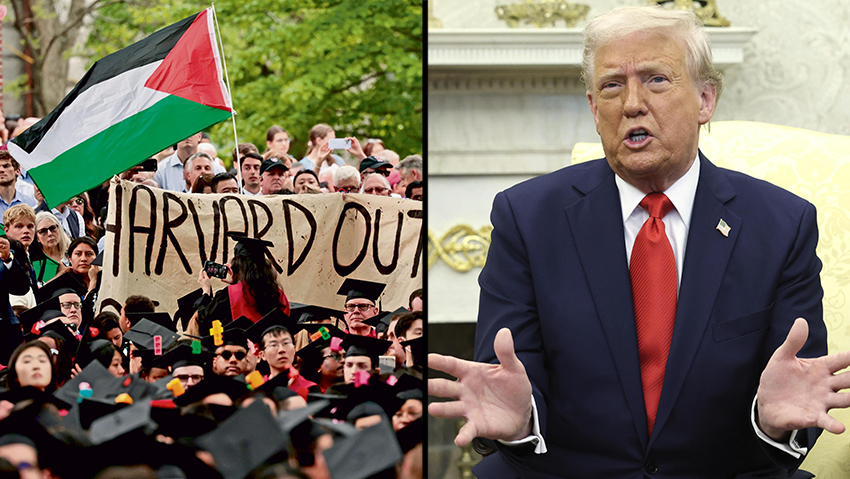
The Trump administration initiated its most severe action yet against Harvard University on Tuesday evening, ordering all federal agencies to immediately terminate existing contracts with the university—valued at approximately $100 million—and halt any future collaborations. This decision is part of a series of unprecedented measures by President Donald Trump against Harvard since April, including freezing $3.2 billion in research grants, attempting to block the admission of international students and proposing an annual $850 million tax on its endowment income, the largest in the United States.
The directive was issued in a letter from the U.S. General Services Administration (GSA) last week, instructing agencies such as the Department of Homeland Security (DHS) and the National Institutes of Health (NIH) to cancel contracts with Harvard and transfer them to alternative providers. Among the contracts to be canceled is a $25,800 training program for senior DHS officials, part of Harvard’s public sector management initiatives for high-ranking officials, decision-makers and team leaders. Another example is a $49,858 research contract on the effects of coffee consumption, conducted as part of NIH-funded studies on nutrition and caffeine.
According to the administration, the decision impacts approximately 30 contracts between Harvard and nine federal agencies, including collaborations with the Department of Energy, the Environmental Protection Agency, the Department of Transportation, and medical research entities. Some of these contracts had already been frozen earlier. In exceptional cases, extensions will be granted to facilitate a gradual transition to other providers.
The administration described the move as a "complete severance of business relations between the U.S. government and Harvard University." Trump stated on his social media platform that he is considering reallocating the funds "from an antisemitic institution like Harvard to vocational schools across the country—a necessary investment that would be far more beneficial."
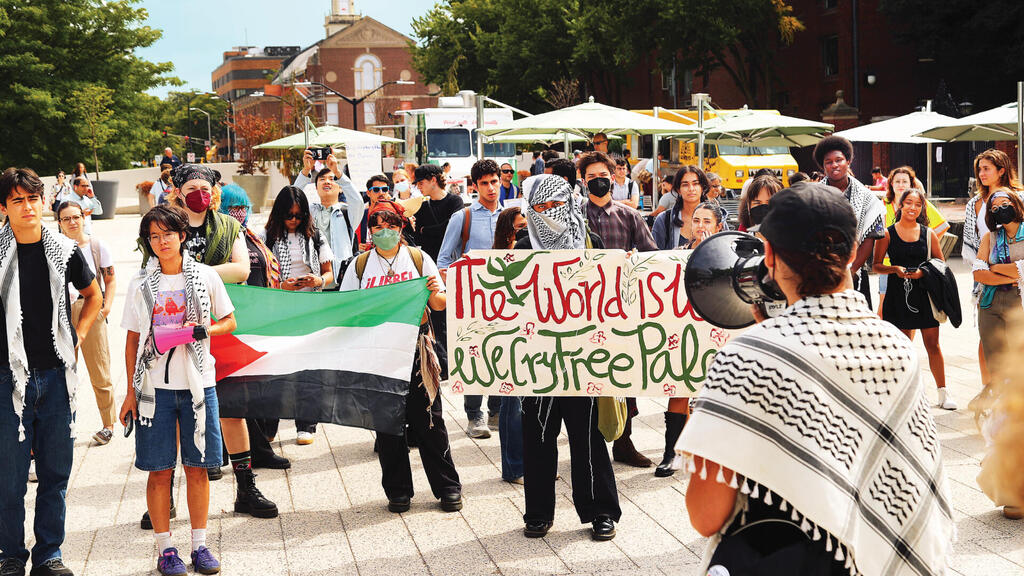
Pro-Palestinian demonstration at Harvard
(Photo: Boston Globe, Getty Images)
The conflict between the Trump administration and Harvard, as well as other universities, stems from two main grievances. First, during the intense pro-Palestinian and anti-Israel protests on campuses following the October 7 terrorist attacks and the outbreak of war between Israel and Hamas, these institutions allegedly failed to take firm action against protesters, allowing antisemitism to flourish and creating a hostile environment for Jewish and Israeli students. Second, the administration criticized the universities’ "diversity, equity, and inclusion" (DEI) programs, which prioritize underrepresented groups, particularly marginalized minorities, in education and leadership roles. The administration views these programs as extreme and discriminatory against individuals outside of these groups.
These grievances were also reflected in the letter announcing the new measures against Harvard. The letter claimed that the decision was due to "Harvard’s lack of commitment to national values of equality and non-discrimination" and its continued use of racial criteria in admissions, contrary to a 2023 Supreme Court ruling. The administration further accused Harvard of antisemitism, citing, among other examples, a scholarship awarded to a theology student accused of assaulting an Israeli student during a pro-Palestinian protest on campus in 2023. Although the case was resolved through a plea deal without criminal conviction, the administration sees it as further evidence that the university fails to meet required standards of tolerance.
Harvard President Professor Alan Garber rejected the accusations, calling the administration’s actions a blatant attempt to interfere with the independent management of an academic institution and politicize higher education.
"This is an illegal act that endangers the future of thousands of students and researchers and poses a direct threat to freedom of speech and academia in the U.S.," Garber wrote in a public response. He added, "If the funding is redirected to vocational schools, it will mean the complete cancellation of the research funded by these grants—not because it is unnecessary, but because the administration seeks to punish the institution conducting it."

(Photo: AP)
In response to the measures, Harvard has initiated two federal legal proceedings: One to restore its frozen federal funding and another to challenge the decision to bar it from admitting international students. Recently, the university received temporary relief when federal judge Allison Burroughs, considered to have liberal views, ordered a temporary suspension of the visa restrictions, at least until July. However, another hearing is scheduled this week in federal court in Boston, and the fate of thousands of international students depends on the outcome.
The escalating conflict coincides with Harvard’s graduation week, during which approximately 9,000 students are set to receive their degrees. Many of them, particularly international students, are uncertain about their ability to remain in the U.S. Harvard has around 6,800 international students, comprising 27% of its student body, and some are already considering immediate departure. It is estimated that about 160 of these students are Israeli.
Get the Ynetnews app on your smartphone: Google Play: https://bit.ly/4eJ37pE | Apple App Store: https://bit.ly/3ZL7iNv
"I’m here with three kids, and I don’t know whether to enroll them for next year or not," said Omri Atar, an Israeli student in the executive program at Harvard’s Kennedy School of Government. "It’s a very stressful situation. Even though I’m finishing my studies next week, work visas are also affected. All the plans people made are collapsing."
"It’s not just about leaving—it’s about selling everything: Furniture, cars, rental agreements, all under pressure. We’re not the faces the administration is targeting, but we’re the first to suffer," according to Atar.
While there is criticism of Harvard’s handling of antisemitism, students and faculty also feel vulnerable to an administration that seeks to punish an entire institution to make a political statement. "If Trump really wants to fight antisemitism, I support that," Atar said, "but we need to ask: does this approach truly help the fight, or does it just distract from the real issue?"