

On the morning of Oct. 7, 16 elite Hamas Nukhba operatives mistakenly diverted from their original target — a Home Front Command base and the IDF's Unit 8200 at the Urim military compound — and instead entered Ein HaBesor, a large farming community in Israel’s western Negev home to more than 1,600 residents.
The moshav’s civilian emergency squad, made up of trained and determined local volunteers, managed to repel a potentially devastating attack. The clash, which has since been dubbed the “20-minute battle,” ended with two injured Israelis, both members of the emergency response team.
Documentation of the Ein HaBesor battle: the fighting and the escape of the terrorists


In the year leading up to the October massacre, Ein HaBesor had faced dozens of criminal break-ins and agricultural thefts, exposing the weakening grip of law enforcement in Israel’s periphery. In response, the community formed a highly capable standby squad composed of residents — trained, experienced and prepared. On the day war broke out, that squad faced a Hamas unit superior in number and weaponry — and won.
Although some squad members had access to weapons stored in the moshav, others were required to leave their rifles at a regional army base, due to regulations. The Hamas operatives arrived in a Toyota pickup truck armed with RPGs — at least one of which was fired but hit a nearby tree — as well as a Dragunov sniper rifle, PK machine gun and tactical radios connected to the unit's Hamas command post. Two terrorists also arrived on a motorcycle.
The gunfight lasted just 20 minutes. That same morning, the Hamas squad also looted a gas station near Kibbutz Magen. After failing to overtake Ein HaBesor, the terrorists took up positions at a nearby junction and opened fire on Israeli reinforcements. A joint IDF and Border Police force engaged them and eventually pushed them back. At least two Hamas operatives were killed in Ein HaBesor, with additional casualties suspected, although the IDF has not confirmed how many were ultimately eliminated.
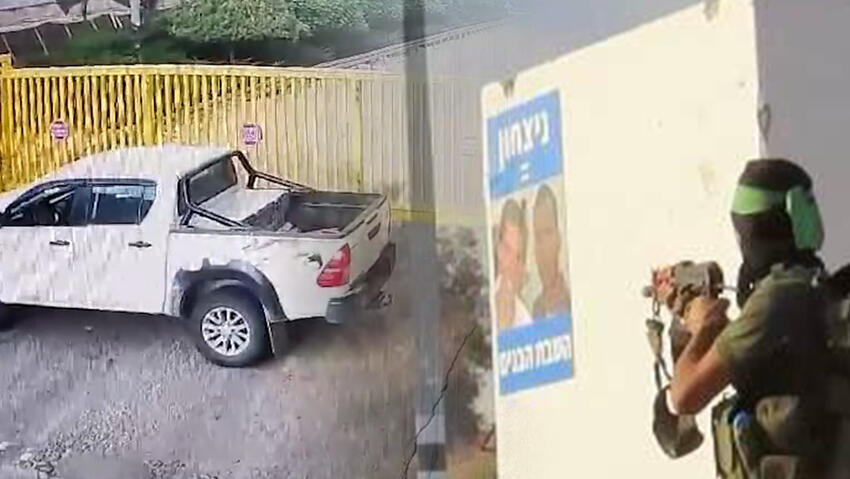
The entrance to the moshav, on the morning of the massacre
A military investigation praised the quick and coordinated response by the residents. “The IDF failed to defend Ein HaBesor,” the report concluded. “The defense mounted by the moshav’s emergency squad and residents repelled the attackers, forced their retreat and prevented far greater harm.”
The report noted that the evacuation of the wounded and subsequent evacuation of residents were carried out independently by the community, and in an exemplary manner.
The village security coordinator (Ravshatz), his two deputies and the rest of the team fought “efficiently and courageously,” the report stated. Residents evacuated their wounded neighbors under fire, then established a makeshift operations center in one of the homes to coordinate defense, manage communications and keep the community informed.
The IDF noted that Ein HaBesor’s residents were among the first to return to their homes after the attack.
This marks the final report in a series of 44 investigations into the Oct. 7 battles at military bases and communities surrounding Gaza. A separate probe into fighting along the roads in the area is still ongoing. That investigation, led by then-Southern Command chief Maj. Gen. Yaron Finkelman — who has since stepped down in light of the failures — is expected to conclude soon.
In parallel, findings from the review led by retired Maj. Gen. Sami Turgeman, appointed to examine the army’s entire inquiry process, are also set to be released. Turgeman’s team has focused less on the individual battle reports and more on the structural failures at the Southern Command, General Staff, and their coordination with Israel’s political leadership.