

For days, analysts puzzled over how Israel managed to bypass Qatar’s advanced air defenses in Tuesday’s strike on a villa in Doha. A report Friday in The Wall Street Journal offered what may be at least a partial answer: Israeli warplanes fired ballistic missiles into space over Saudi Arabia before hitting their target.
According to the report, 12 Israeli Air Force jets — eight F-15s and four F-35s — carried out the strike. No senior Hamas leaders are believed to have been killed, but the sophistication of the attack has drawn worldwide attention alongside the diplomatic fallout for Israel.
Israeli airstrike on Hamas headquarters in Doha, Qatar


Gallery
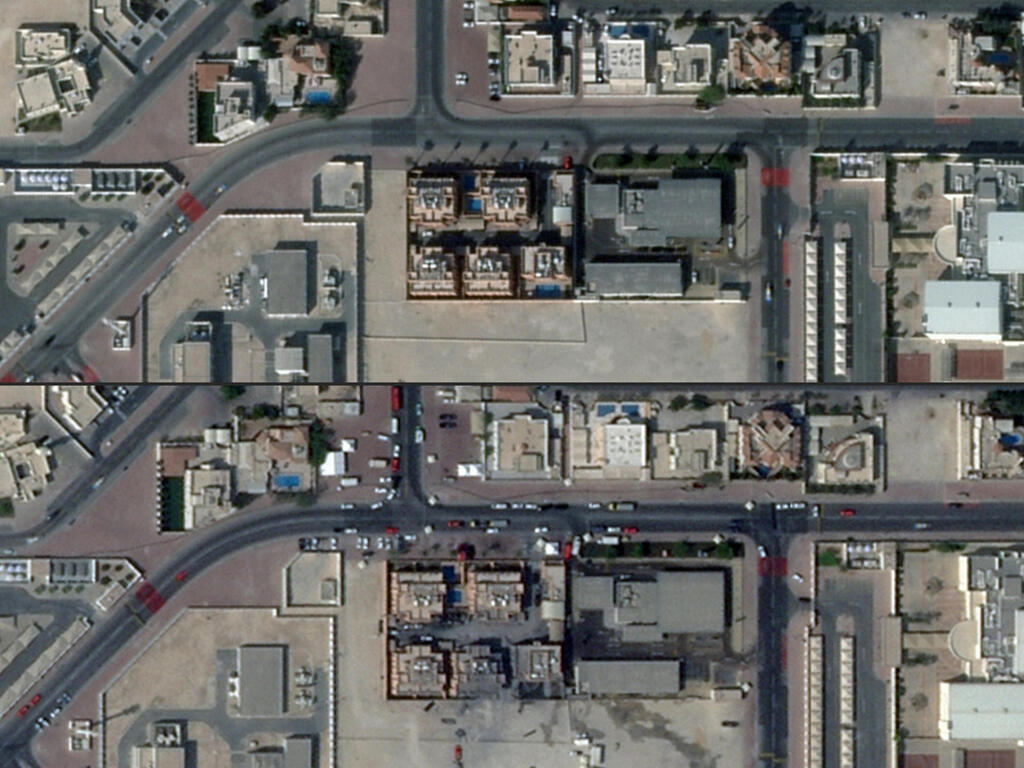
Before and after satellite images of the villa that was struck
(Photo: © 2025 PLANET LABS PBC / AFP)
It remains unclear which type of ballistic missile was used. U.S. officials cited by the Journal said the weapons likely traveled about 1,500 kilometers (930 miles) from the Red Sea, across Saudi airspace, before striking the villa in Doha.
Israel has never publicly acknowledged deploying such missiles, but defense publications have long reported that it possesses multiple models capable of air launch. Among them are the Anchor missile, originally developed by Rafael as a test target for the Arrow missile defense system; the Rampage, produced by Elbit Systems and Israel Aerospace Industries; and Rocks, another Rafael system reportedly derived from the Anchor.
Unlike cruise missiles, which are slower but maneuverable, ballistic missiles are typically launched on fixed trajectories and are far harder for dense air defense networks to intercept. Air-launched ballistic missiles, however, offer additional advantages: they avoid the vulnerability of known ground launch sites and can strike with extreme speed.
Past reports have suggested the Rampage could be launched from fighter jets at ranges of about 150 kilometers (95 miles), complicating detection and interception. If the missiles in Tuesday’s strike were fired from as far as the Red Sea, as the Journal reported, they may have belonged to the Anchor family — whose full range has not been publicly disclosed but has been referenced in connection with Arrow system tests.
Aftermath of Israeli airstrike on Hamas headquarters in Doha, Qatar
(Video: Reuters)

Aftermath of Israeli airstrike on Hamas headquarters in Doha, Qatar
(Photo: Ibraheem Abu Mustafa/Reuters)
According to Ynet war correspondent Ron Ben-Yishai, due to their velocity, such weapons can cause massive damage even without explosive warheads, relying instead on the sheer kinetic impact.
“The main advantage of an [air-launched ballistic missiles] over an [air-launched cruise missiles] is speed to penetrate defenses,” Jeffrey Lewis, director of the East Asia Nonproliferation Program at the James Martin Centre for Nonproliferation Studies at the Middlebury Institute of International Studies in California, told Reuters in November 2024. “The downside — accuracy — looks to have been largely solved.”
Exceptional weapons
Ground-based ballistic missile systems are widely deployed by militaries around the world, and even by terrorist groups such as Yemen’s Houthi rebels. Cruise missiles are also common. But ballistic missiles launched from aircraft remain rare — reportedly fielded by only a handful of militaries, including Russia, China and Israel.
Air-launched ballistic missiles (ALBMs) are carried by fighter jets or bombers, giving them flexibility to be launched from unpredictable positions. “They can come from any direction and make defense much harder,” Uzi Rubin, a twice-recipient of Israel’s Defense Prize and the founding head of the Arrow missile defense program, has said in the past.

Israeli airstrike on Hamas headquarters in Doha, Qatar
The United States tested such a weapon, the AGM-183 hypersonic missile, but the project lost funding in the 2025 defense budget and was effectively canceled. With a large arsenal of long-range cruise missiles and other strike systems, Washington has shown little appetite to invest in air-launched ballistic technology. A U.S. Air Force official told Reuters that the system was never operationally deployed.
Still, defense industry experts note that many countries with advanced precision-guided weapons could adapt existing technologies to produce such missiles. “It’s a smart way of combining guidance, warheads and rocket motors to create a new weapon that offers far greater capabilities — and at a reasonable cost,” one senior industry figure told Reuters.
The Pentagon leak
Hints of Israeli interest in the field surfaced in 2024, before the war with Iran. Pentagon documents leaked that year suggested Israel was working with two systems: one dubbed Golden Horizon, never before publicly mentioned, and Rocks, a Rafael-made missile believed to be derived from the earlier Anchor model.
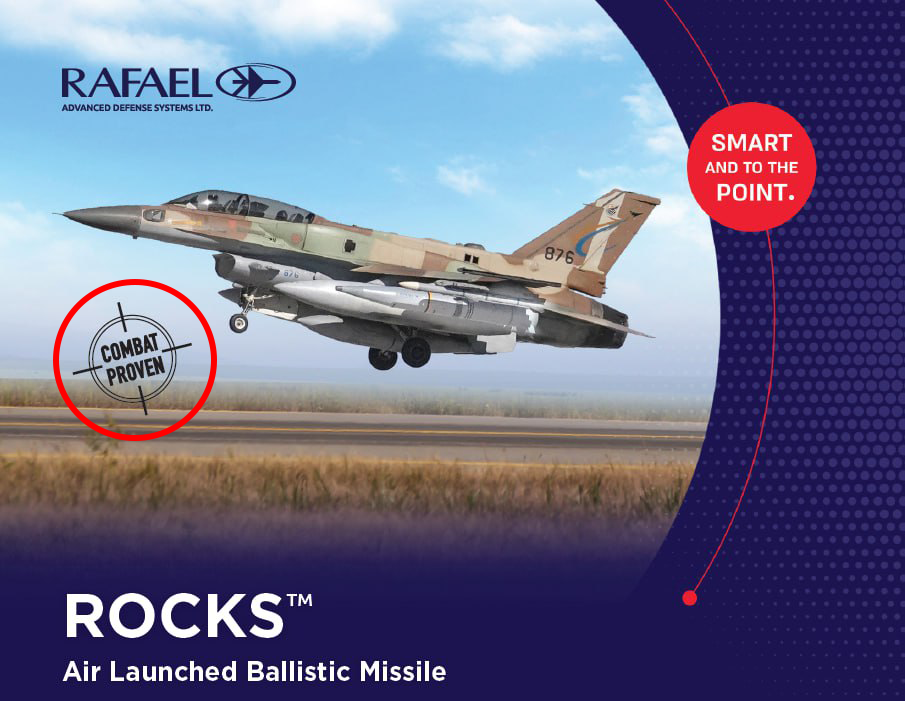
The ROCKS air-launched ballistic missile system
(Illustration: Rafael)
Rafael unveiled the Rocks missile in 2019, describing it as an air-to-surface weapon launched from “extended standoff ranges,” well outside enemy air defense coverage, flying a supersonic trajectory to the target. The company says the design minimizes exposure of the launching aircraft to enemy threats and improves strike success rates.
According to Rafael, the Rocks can hit high-value fixed or relocatable targets, even in heavily defended environments where electronic countermeasures are in play. The company adds that it is “combat-proven,” suggesting it has already been used operationally. The missile is advertised as capable of destroying both surface and subterranean targets.