

Time and again in recent weeks, the United States has appeared poised to launch a significant attack on Iran, only for it not to happen. Nearly every time, U.S. President Donald Trump announces a breakthrough in negotiations, Iran denies it and both sides return to square one. That pattern played out again Monday evening, when Trump reversed course once more and accused Iran of being “unbelievably duplicitous.”
Hours later, Trump said Iran faced “decapitation” if it failed to reach an agreement ending the conflict between the two countries. “I think we're going to maybe get something, but I want to give them every last chance before decapitation,” Trump told reporters, reiterating his threat to launch a major attack on Iran.
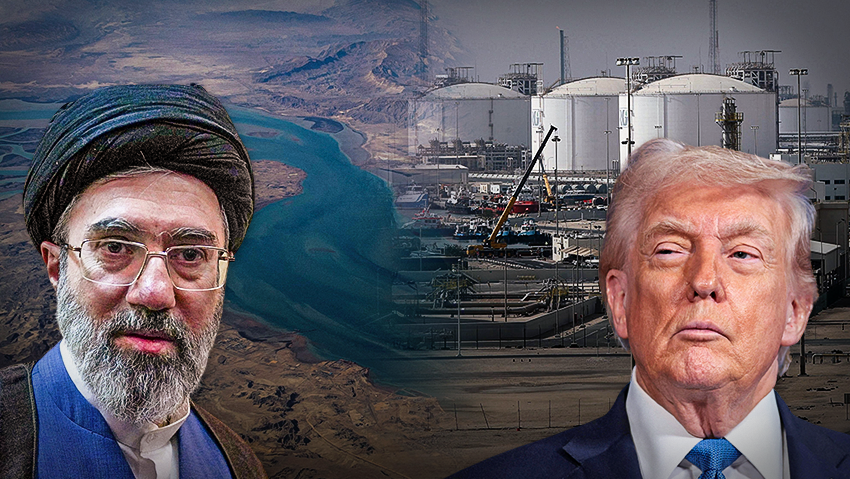
Gulf officials: Iran seeks to convince the U.S. that rejecting its demands over the Strait of Hormuz would be more costly
(Photo: Hamed Jafarnejad/ISNA/WANA via Reuters, Reuters/Jonathan Ernst, Reuters/Stringer, AFP)
Trump said negotiations were already underway and described them as Tehran’s final opportunity to secure a favorable agreement. “They are going on right now,” he said when asked about the status of the talks, adding that the discussions were taking place at the request of Iran, Saudi Arabia, the United Arab Emirates, Qatar and others.
“This is a last chance for them to sign a good document,” he said, referring to Iran.
Trump aboard Air Force One: There is a deal on Hormuz
(Credit: The White House)


“They are going on right now,” Trump said when asked about the negotiations, adding that the discussions were taking place at the request of Iran, Saudi Arabia, the United Arab Emirates, Qatar and others. “This is a last chance for them to sign a good document,” he said, referring to Iran.
Gulf officials believe Iran’s strategy is based on the assumption that it can endure the current situation longer than the United States by applying pressure in the Strait of Hormuz and against energy infrastructure across the Middle East.
Rather than seeking a military victory, Tehran is pursuing a strategy of calibrated escalation intended to broaden the conflict without provoking a full-scale war. Gulf officials told Reuters that the goal is to convince the United States and its allies that containing the crisis would be more costly than meeting Iran’s demands concerning the Strait of Hormuz.
In addition to disrupting traffic through the strait, Iran has made clear that further escalation would bring additional pressure capable of disrupting global trade.
One Gulf official said Iran’s approach reflects its belief that “they can get more” in negotiations. What is seen as Trump’s hesitation to resume fighting is viewed in Iran as an opportunity.
“The Iranians believe that by widening the war and increasing the pressure, he will eventually give in,” the Gulf official said. “Trump thinks he can hit the Iranians hard and bring them to the negotiating table, but they won't bend.”
That perception also underpins Tehran’s negotiating strategy. While Trump announces talks with Iran, Tehran denies they are taking place.
A senior Iranian official said the government had concluded that previous attempts to show flexibility only led to greater pressure from Washington, reinforcing the view that leverage must be created before meaningful negotiations can begin. Tehran believes Trump interprets concessions as weakness and responds only to pressure, the official said.
A contest of endurance
Alan Eyre, a former U.S. diplomat and Iran expert, said Tehran is pursuing a deterrence strategy intended to force Washington to lift its blockade and halt military strikes. “They don't want the U.S. to dictate the pace of events,” he said.
At the center of the dispute is the future administration of the Strait of Hormuz.
Oman has presented Iran with a Gulf-backed proposal for managing the waterway, including voluntary user fees, according to regional sources. Tehran, however, is seeking administrative authority over the strait and the ability to charge vessels service fees.
Washington has rejected any payment and insists that Hormuz remain an international waterway free of Iranian control.
Meanwhile, Iran’s campaign has produced a result that reflects the logic of its strategy. As the threats have expanded beyond Hormuz, regional and Western powers have increasingly focused on protecting trade routes and energy infrastructure rather than intensifying pressure on Iran.
The emerging Saudi-led maritime coalition illustrates that shift. Gulf sources describe it as a defensive framework focused on escorting commercial vessels, sharing intelligence and protecting shipping lanes.
For Tehran, this dynamic represents a measure of success. Iran cannot directly match U.S. military power, but it can still impose costs by forcing governments and navies into a defensive posture.
Every new threat, whether in Hormuz, the Bab el-Mandeb strait connecting the Red Sea to the Gulf of Aden or elsewhere, increases the resources needed to keep global trade moving.
The contest is now essentially one of endurance. Iranian leaders appear to believe they can withstand economic pressure longer than the U.S.-led coalition can tolerate repeated disruptions to global trade and energy markets.
The strategy also has a diplomatic objective. By demonstrating its ability to widen the crisis when necessary, Tehran hopes to shape the terms of any eventual negotiations.
Trump, meanwhile, attacked the Iranian leadership Monday evening, writing that “they ask for a meeting, some would say 'beg,' talks begin, with more scheduled in the immediate future, and they say, openly and proudly, that they’re not having any discussions, that nothing is being talked about, and they’re only dealing with 'Oman.'”
In a post on his Truth Social platform, Trump added that Iran then continues with its “usual blather” and claims it will exercise strong control over the Strait of Hormuz, “when it is already completely controlled by the United States Navy.”
“Because of our 'Blockade' or, as some say, 'The United States Wall of Steel!' nothing gets through to Iran, unless we want it to, and nothing will get through, unless a Deal, or Total Surrender, is accomplished,” Trump wrote.
“Whether Iran wants to admit it or not, we are, in fact, talking of a solution to a problem that they have caused, for decades,” he added. “It is very simple, Iran will never have a nuclear weapon!”
First published: 20:39, 08.03.26