

U.S. president Donald Trump and his adviser Steve Witkoff feared their efforts to end the fighting in the Gaza Strip might be undone by last month’s Israeli strike in Doha, but that incident actually gave Trump an additional edge over Prime Minister Benjamin Netanyahu and over Hamas leaders, who had became a liability for their hosts in Doha, the Wall Street Journal reported overnight between Saturday and Sunday.
According to the report, after the assassination attempt in Qatar the U.S. president and his aides redoubled their efforts, and after a few weeks of diplomatic contacts and frequent meetings between senior officials from Israel, Qatar and Saudi Arabia, Trump announced at the White House that he had a plan.
At the center of the American push to secure the deal, the Journal said, were sometimes tense meetings between Witkoff, the president’s son-in-law Jared Kushner, Strategic Affairs Minister Ron Dermer and senior officials from Qatar and Saudi Arabia, according to people involved in the talks.
Gallery
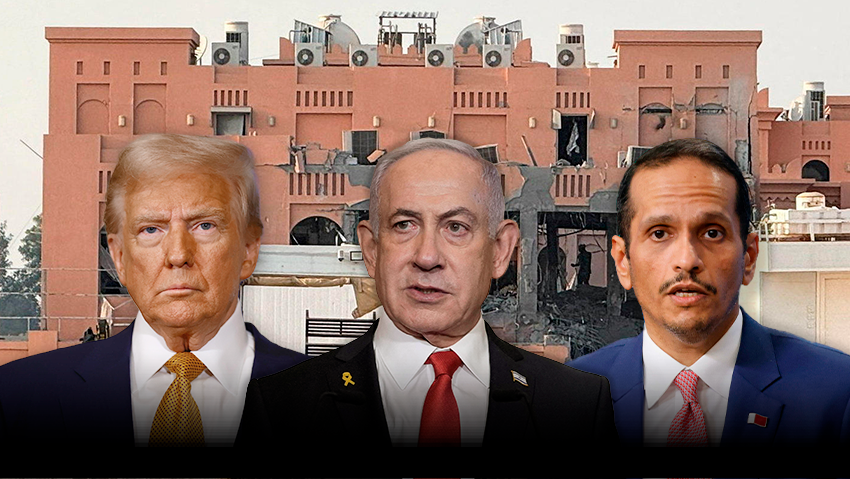
Mohammed Al-Thani, Prime Minister of Qatar; Prime Minister Benjamin Netanyahu; US President Donald Trump; IDF attack on Hamas in Doha
(Photos: Ibraheem Abu Mustafa/Reuters, Ludovic Marin/AFP, Oliver Contreras/AFP, Sarah Meyssonnier/Pool via AP)
Even before the strike in Doha, Witkoff and Kushner met with Dermer in Miami, but the Israeli minister said nothing or gave no hint about the assassination attempt that followed. The report said Witkoff and Kushner were upset by the Israeli action and by the lack of prior warning. “This is not the behavior of a friend,” Witkoff told Dermer afterward, the Journal quoted.
Trump was less polite than his aide as his frustration grew. “He’s f***ing me!” the U.S. president said of Netanyahu, according to people who heard him — a remark made in a conversation with senior advisers, including Secretary of State Marco Rubio. The conversation focused on how to respond to the unusual strike in Doha, and the Journal reported that the president used the curse word.
The report said Qatar severed all lines of communication with Israel — including intelligence sharing — and demanded an apology before it would return to the mediation table. Qatar’s prime minister flew to Washington and met with Vice President J.D. Vance and Secretary of State Marco Rubio, and that evening met Witkoff and the president himself at Trump Tower in New York.
Trump in a video statement: 'We are close to peace in the Middle East '
(Video: X platform)


A senior U.S. official told the Journal that after the failed assassination attempt the Americans were in “triage” mode, trying to soothe the Qataris and get talks back on track. Trump assured the Qatari prime minister that the U.S. had not been involved in any way and that Washington would act to ensure such an incident would not happen again.
A few days after that meeting, the Qatari prime minister proposed to Witkoff that Trump host a meeting of Arab and Muslim leaders on the U.S. peace plan for Gaza on the sidelines of the U.N. General Assembly. The Journal reported that Witkoff raised the idea with Trump, who agreed swiftly. Ahead of the meeting, Trump told Witkoff and Kushner his objective: “Use this moment to end the war. No partial deals, no more fighting, no more hostages, and start rebuilding Gaza.”
The American newspaper described how Trump effectively played a game of “chicken” among all the parties involved, pushing ahead with his plan despite Netanyahu’s objections — the prime minister refused an explicit reference to a Palestinian state, Hamas’ objections to disarmament, and Arab states’ insistence on a deal they could “sell” to their publics. The Journal said Trump moved forward by securing the parties’ public approvals while downplaying their reservations.
At a meeting between Trump and Arab leaders on September 23 he again expressed his desire to clinch a deal to end the war and asked Witkoff to outline the plan. The special envoy condensed Trump’s 21 points into roughly 10 main ideas without delving into details. The leaders received the plan positively, and later their suggestions were incorporated into the final language by Witkoff and Rubio.
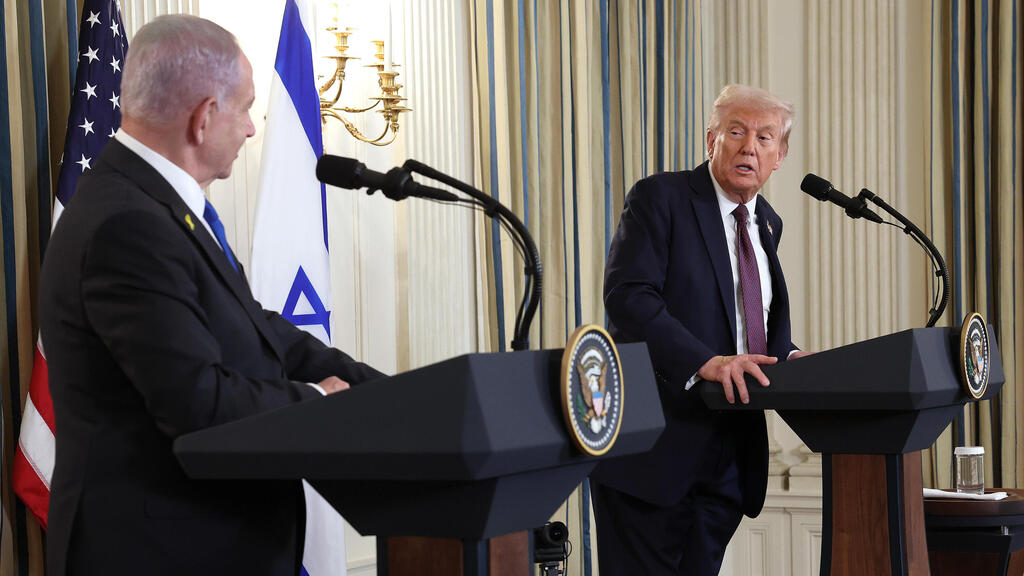
US President Donald Trump and Prime Minister Benjamin Netanyahu announce ceasefire plan at the White House
( צילום: Alex Wong/Getty Images)
Among other demands, Qatar insisted on ending the war and on a peace process that would include a Palestinian state. Egypt stressed that the Palestinian Authority must be involved in Gaza, backed by a U.N. decision. The Journal noted that these Arab states proposed that Hamas be required only to lay down its weapons rather than have them destroyed, in an attempt to preserve the group’s dignity.
Later, Israel’s objections to elements of the plan led to the removal of most clauses proposed by the Arab leaders. The Journal reported that Witkoff, Kushner, Dermer and Netanyahu discussed the plan over the weekend the prime minister spent in the U.S., in a series of hours-long meetings that led Netanyahu to cancel some scheduled events. Amid the intensive talks, Netanyahu was described as appearing “pale and tired” in a recorded video he sent to a Jewish News Syndicate event, which he had to skip.
The paper also reported that UAE Foreign Minister Abdullah bin Zayed met with Netanyahu for about an hour and told him it was time to end the war. After talks with Israel, Arab leaders were surprised to find most of their proposed changes had been removed and that a number of edits they opposed were implemented, including a “watering down” of references to a Palestinian state. They warned Trump that the result was not the plan they had agreed to, but the U.S. president pushed ahead.
After the plan was revealed publicly, the Muslim countries jointly declared their support while continuing to emphasize their insistence on a full Israeli withdrawal from Gaza and a commitment to a Palestinian state. The Journal said among the “victories” Arab leaders achieved in the plan were the abandonment of Trump’s proposal to relocate Gaza’s population to other countries during reconstruction and Netanyahu’s apology to Qatar. Trump reportedly told the prime minister that “apologies are good for the soul.”
Finally, the Journal reported that while Trump publicly insisted on brief negotiations, privately he was willing “to let talks continue.” Thus, while some members of the Arab negotiating team described Hamas’ response to the plan as “no,” Trump declared on social media: “I believe they are ready for peace!”