

Freed hostage Ilana Gritzewsky arrived at the 62nd session of the UN Human Rights Council at the Palace of Nations in Geneva to remind the forum of what many in the organization, Israel says, have sought to forget: the sexual violence committed against victims of the October 7 massacre and against hostages held in Gaza.
“I am very nervous,” Gritzewsky said before her testimony. “Every time I speak, the wounds open in front of people. It is very hard, but I survived, and October 7 is something the world needs to understand and not forget. I have to speak for those who no longer have a voice, so they understand what our soldiers are fighting for day and night.”
‘Please look at me’: ex-hostage confronts UN official over silence on Hamas sexual violence
(Video: UN TV)


Gritzewsky, who said this was her first media interview since the release from captivity of her partner, Matan Zangauker, described the difficulty of coping with the public attention that has followed her efforts to expose the atrocities of the massacre and captivity. She said she hopes eventually to return to a “normal” life and build a home.
She was accompanied in Geneva by Meirav Lapidot, who has tried to shield her as much as possible from shocks and triggers. The two were brought to the UN by UN Watch, the Geneva-based organization founded in 1993 that monitors whether UN debates and decisions align with the world body’s own founding principles.
UN Watch has long criticized what it describes as the disproportionate amount of time and number of resolutions the UN devotes to Israel compared with the rest of the world. Since the Human Rights Council was established in 2006 and through the end of 2025, it has issued 112 condemnations of Israel, slightly fewer than half the condemnations issued against all other countries combined.
Daniel Meron, Israel’s ambassador to the UN in Geneva, said that since October 7, “there has been a concentrated BDS effort in the Human Rights Council to turn victims of sexual violence into the accused themselves.”
“That is why it is so important that Ilana, a captivity survivor, speak and expose the false narrative, especially before ‘Special Rapporteur’ Reem Alsalem, who spreads lies and refuses to acknowledge what Israeli women went through,” he said.
Alsalem, 50, has served since 2021 as the UN special rapporteur on violence against women and girls, its causes and consequences. She previously wrote online that she was “amazed how fast misinformation and disinformation spread like wildfire,” while citing remarks by Francesca Albanese, the UN special rapporteur on the Palestinian territories, who said the Israeli army had failed to prove claims about Hamas crimes, including beheadings and rape.
Alsalem, who was born in Egypt, lives in Jordan and has previously worked at the UN, is a trained lawyer and experienced diplomat. At Tuesday’s session, she opened by discussing a visit to Kuwait to examine progress on women’s rights there. In her view, “they are doing a great job.”
Hillel Neuer, executive director of UN Watch, said the session reflected a deeper absurdity.
“There is something absurd in the fact that the report of the UN envoy charged with combating violence against women becomes a document that erases Hamas’ victims,” he said. “While Reem Alsalem accuses Israel of genocide, Ilana stands here to testify. Israeli women were raped, attacked and kidnapped, and the world must not look away.”
The report submitted to the council refers three times to Iran and Sudan, twice to Afghanistan and once each to Myanmar and Lebanon. By contrast, “Palestinian suffering” is mentioned 11 times. It contains no mention of the atrocities of October 7 or the hardships endured by residents of northern and southern Israel.
A report of this kind may legitimately examine the suffering of mothers and children in Gaza and the Palestinian territories. But in this case, Israeli critics say, many of the sources cited in the report do not rely on rigorously verified data, but on organizations known for anti-Israel political bias. Its conclusions are also broad: passing special laws to protect mothers and children in every country, strengthening protections during crises, improving reporting on violations of their rights and other principles that are difficult to implement in countries at war, and even in established democracies.
Gritzewsky’s statement appeared to come as a surprise to Alsalem, who, at least officially, had not been notified in advance of her presence. During Gritzewsky’s remarks, Alsalem did not look toward her and instead focused on the computer screen in front of her, her expression fixed. The atmosphere in the hall was tense, as even those who have refused to hear about Hamas’ atrocities could not remain indifferent.
Gritzewsky spoke in detail about the trauma she endured on the day of the massacre and in captivity in Gaza, and sharply criticized the UN.
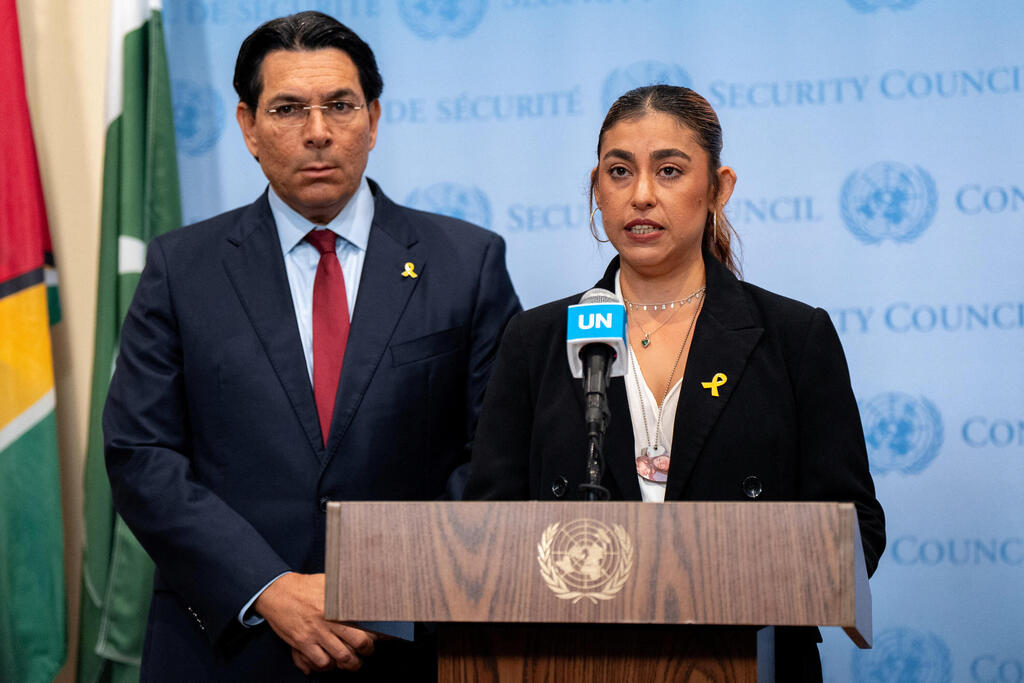
Gritzewsky at the UNSC last year
(Photo: REUTERS/Angelina Katsanis)
“Special Rapporteur, your report speaks of violence against women. Why is there no mention of Hamas?” she said. “On October 7, terrorists stormed our kibbutz, murdering, kidnapping and burning. They touched me and sexually abused me. I was beaten and mutilated before blacking out. I woke up half naked with seven terrorists standing over me, not knowing what happened to me in those lost moments.”
“I went through days of pain and horror in captivity,” she continued. “And even now, the feeling of being powerless and violated still lingers. I came back with a broken hip, a broken jaw and a scarred soul. People see my face and think that I am free. But freedom is not a switch. Trauma doesn’t vanish once you are released. Now, every air raid siren and every rocket from Iran throws me back into that hell.”
She then turned directly to Alsalem.
“On October 7 and in captivity, Jewish women were raped, abused and humiliated,” Gritzewsky said. “And you, Special Rapporteur, you chose silence and denial. Ms. Alsalem, you said there was no evidence of sexual violence on October 7. I’m standing here today not as a report, not as a statistic. I am a woman who survived. I am living proof of sexual violence by Hamas. When I, another Israeli woman, begged not to be raped, why were you silent? Please look at me. Do you believe us now? Will you apologize?”
At the end of her searing testimony, Gritzewsky was visibly shaking. Lapidot escorted her out as Gritzewsky leaned on her, while UN Watch staff surrounded and protected her. A security officer in the chamber also quickly offered her a chair and made sure the path was clear.
After the session, Gritzewsky told ynet that Alsalem did not use her right to respond immediately. Instead, she again praised Kuwait, Russia and Kyrgyzstan for their progress on women’s rights, explained the lack of reference to Ukraine by saying “the report was shortened by 1,000 words,” and appeared to choke up.
Alsalem eventually responded, referring to “violence on October 7 against Israeli women and girls” but not explicitly mentioning sexual violence.
“I refer you to the public statement on my website,” she said. “For three years, I have been asking to speak with survivors of October 7 and to visit Israel and Gaza. The government of Israel rejected my requests. So if the speaker wants to meet with me, I am always ready.”
At the end of the discussion, Alsalem quickly left the chamber with her head lowered.