

On January 1, the deadline set, at least declaratively, for Hezbollah to disarm expired. But despite threats from Israel and the United States, for now the routine of fighting on the northern front has been preserved, with numerous IDF enforcement strikes and quiet from the Lebanese terrorist organization, but little beyond that.
Behind the scenes, a shift has taken place in Israel’s order of priorities, with attention redirected in light of the protests in Iran and the possibility that the United States could decide to strike there.
The 'routine' airstrikes in southern Lebanon


About two weeks ago, the Lebanese army issued a predictable announcement, declaring that Hezbollah had been disarmed south of the Litani River in accordance with a plan approved by the Lebanese government. It claimed the only exception was the small areas under Israeli control inside Lebanese territory and said it continued work to clear tunnels and unexploded ordnance.
Here, the statement was expected but the claims were effectively rejected. “The ceasefire agreement clearly stipulates that Hezbollah must be fully disarmed. This is a necessary condition for Israel’s security and for Lebanon’s future. The steps taken by the Lebanese government and the Lebanese army in this direction are an encouraging beginning, but they are far from sufficient, as evidenced by Hezbollah’s efforts to rearm and rebuild its terrorist infrastructure with Iranian assistance,” the Prime Minister’s Office said.
In light of developments in Iran, Israel appears intent on maintaining the “routine of fighting” of enforcement strikes and ongoing attrition in Lebanon, without shifting the full weight of its focus there. Israel is also preparing for a scenario in which, if Iran attacks, there would this time be involvement from Lebanon, creating an opportunity to strike Hezbollah, with the understanding that such a blow could help advance its disarmament. Meanwhile, negotiations with Lebanon are continuing under U.S. mediation.
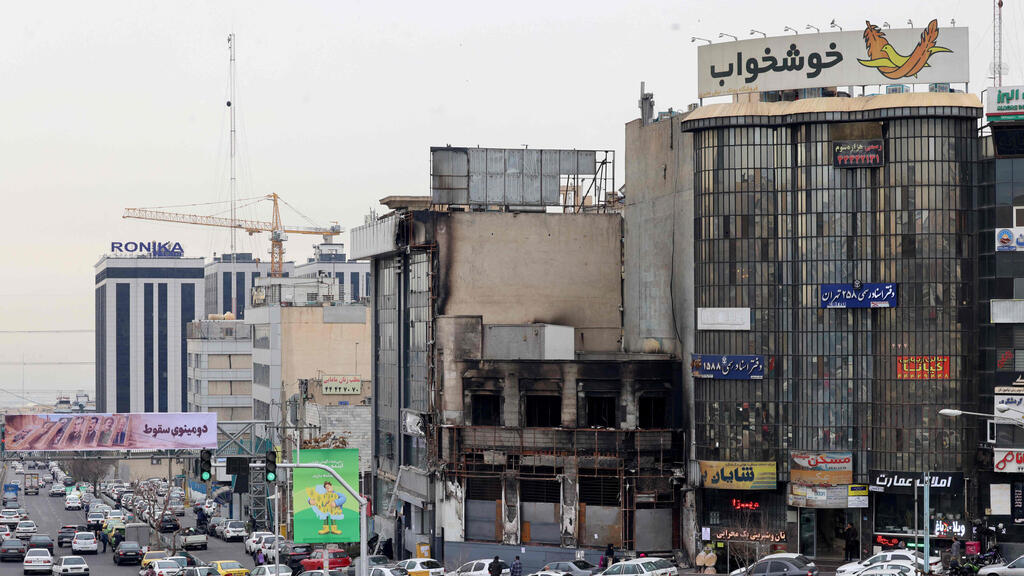
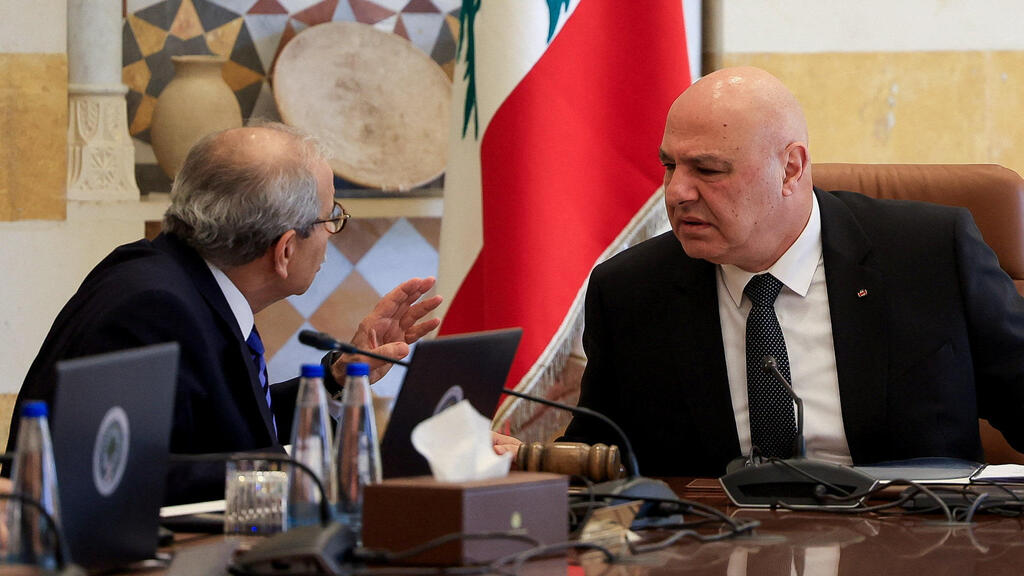
Lebanese President Joseph Aoun and Prime Minister Nawaf Salam
(Photo: REUTERS/Mohamed Azakir)
Israel has effectively reordered its priorities at this stage and views the various arenas as interconnected. It is likely that Iran will insist this time that Hezbollah take part, heightening alertness both on the northern front and with regard to the Houthis in Yemen. Still, everything depends on developments involving Iran. Another possibility is that if the United States chooses to strike Iran, Israel may seize the opportunity to hit Hezbollah in order to assist the Lebanese government in disarming the terrorist organization.
As part of the IDF’ enforcement strikes, reports in Lebanon said today that an Israeli drone struck a vehicle near the village of al-Ansar in the Baalbek area deep inside Lebanon. Shortly afterward, another strike was reported nearby, close to a hospital in the village of Dours in Baalbek. No casualties were reported.
Lebanon’s LBCI television network claimed the target was a military operative belonging to one of the Palestinian organizations and said this was the third time Israel had attempted to strike him over the past year, in different locations.
About two weeks ago, the IDF assessed that Hezbollah still possesses weapons south of the Litani River and that the pace of activity by the Lebanese army has been and remains slow and partial, despite reaching locations it was instructed to visit in order to collect Hezbollah weapons. ynet has learned that in recent months the IDF has increasingly discovered that the Lebanese army did not destroy the weapons it collected from Hezbollah but instead stored them in warehouses in Lebanon, despite firm Israeli opposition. The IDF assessed that the Lebanese army thus reached an interim arrangement with the Shiite terrorist organization, whereby Hezbollah agreed to “hand over” its weapons without their complete destruction.
The government in Beirut fears confronting the Shiite terrorist organization and plunging the country, which has suffered economic and social crises for several years, into civil war.
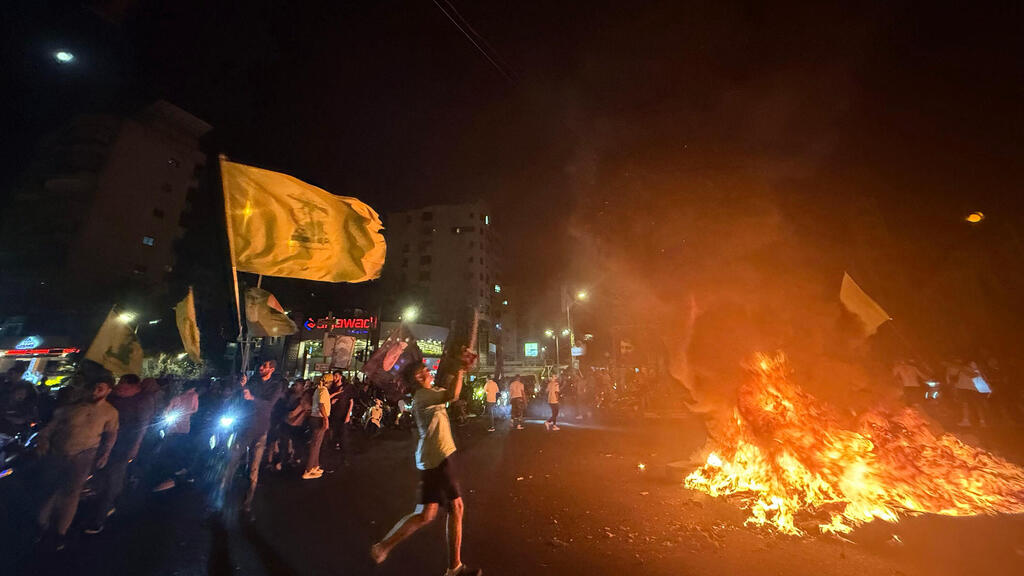
Hezbollah supporters in Beirut
(Photo: Ibrahim AMRO / AFP)
Senior Hezbollah figure Mahmoud Qamati warned last week that continued efforts to disarm the organization across the country would lead to chaos and possibly even civil war. In an interview with the Russian state media outlet RT, Qamati said the aspiration for a state monopoly on weapons north of the Litani River would be “the greatest crime the state has committed.”
Under the ceasefire with Israel, Lebanon committed to transferring all weapons to state control. Hezbollah insists the agreement applies only to southernmost Lebanon along the border with Israel and refuses to give up its weapons stockpiles in other areas.