

The U.S. military responded late Thursday for the first time since the start of the strikes in Iran, saying: “Our forces intercepted Iranian attacks and responded to attacks against U.S. destroyers in the Strait of Hormuz. The forces struck Iranian military facilities in self-defense.”
“We are not interested in escalation, but are prepared to defend our forces,” the statement added.
Documentation of air defense operating in western Tehran


The statement also said the U.S. military thwarted Iranian attacks Wednesday. “Iranian forces launched several missiles, drones and small boats as U.S. vessels passed through the international maritime passage. The U.S. military struck Iranian military facilities responsible for attacking U.S. forces, including missile and drone launch sites, command and control sites, and intelligence, surveillance and reconnaissance facilities.”
Iran’s Fars news agency, affiliated with the Revolutionary Guards, reported Thursday evening on explosions near the port of Bandar Abbas and on Qeshm Island in the Strait of Hormuz. The mysterious explosions in southern Iran come three days after Tehran fired missiles at the United Arab Emirates.
It was initially claimed that the explosions stemmed from activity by the Revolutionary Guards’ navy, but Fars later offered a different and more dramatic version, saying there had been “an exchange of fire between Iranian forces and the enemy.” According to that report, Bahman pier on Qeshm Island was hit. Meanwhile, Mehr news agency reported that “two hostile aircraft were destroyed in the skies over Bandar Abbas and Qeshm.”
Later, near 1 a.m. Iran’s Mehr news agency is reporting that sounds of explosions are now being heard along the coast of Sirik, in southern Iran.
Gallery
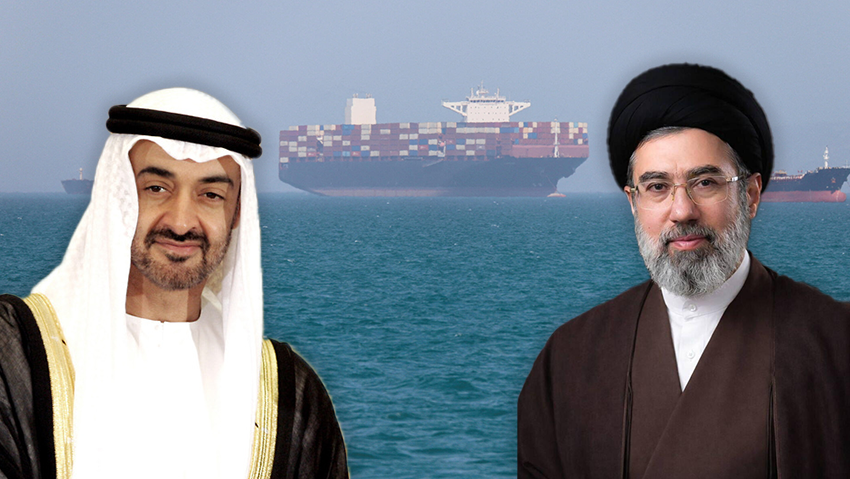
Bin Zayed and Khamenei: Emirates' response to Iranian missiles?
(Photos: AP, Amirhosein Khorgooi/ISNA/WANA (West Asia News Agency) via Reuters)
Israel denied any connection to the incidents in southern Iran, and two senior Iranian officials later accused the United Arab Emirates of carrying out the attack. Speaking to The New York Times, they hinted that it was revenge by Abu Dhabi for the Iranian attack against it three days earlier.
Later, however, Fox News reported that the strikes were actually carried out by the United States. A senior U.S. official clarified that the strikes on Qeshm Island and in Bandar Abbas “do not constitute a resumption of the war.” Fox News correspondent Jennifer Griffin hinted that the U.S. strikes were in fact a response to Iran’s attack on the UAE on Monday, though she did not say so explicitly and noted only that they came “after” it.
About two hours after the initial reports of explosions in Bandar Abbas, shortly before midnight Israel time, Iran also reported the activation of air defense systems in western Tehran. It was not immediately clear whether an attack had also taken place there. Fifteen minutes before midnight, Mehr reported another explosion in Bandar Abbas, and five minutes later another in Minab, near the Hormuz coast. Three minutes before midnight, explosions were reported again — this time in Abu Dhabi, the capital of the United Arab Emirates.
After exchanges of fire, U.S. President Donald Trump said: “No, no, the ceasefire is going. It’s in effect.” Trump described the retaliatory strikes against Iran as a “love tap,” said ABC reporter.
Later, President Donald Trump via Truth Social said the ceasefire remains in effect while Iranian officials reported a return to normal life despite a series of explosions and air incidents across the region, according to state media and officials.
Following the statement, the United Arab Emirates said early Friday that its air defense systems were intercepting missiles and drones amid reports of explosions in the region, according to official statements.
Iranian officials who spoke earlier with The New York Times accused the UAE, and Iran’s Tasnim news agency also hinted that Abu Dhabi was behind the explosions in Qeshm and Bandar Abbas: “Some sources claim the explosions are linked to a confrontation with small aircraft and a hostile Emirati action in Qeshm. This matter has not yet been confirmed or officially announced. If this matter is confirmed, the UAE will pay for the action,” Tasnim reported. “They will regret this,” Iranian army commander Amir Hatami threatened on X, without saying whom the threat was directed at.
At the same time, Iranian state broadcasting quoted a “military source” as saying: “Following an attack on an Iranian oil tanker by the U.S. military, the enemy in the Strait of Hormuz came under Iranian fire and was forced to flee after sustaining damage.” It remains unclear, however, whether this is connected to the attack on Qeshm Island, which is located in Hormuz. The U.S. military, it should be recalled, said Wednesday that as part of enforcing the blockade on Iranian ports, it attacked and disabled the Iranian oil tanker M/T Hasna using fire from an F/A-18 fighter jet that took off from the aircraft carrier USS Abraham Lincoln, after the vessel ignored its warnings and tried to break the blockade and dock at a port in Iran.
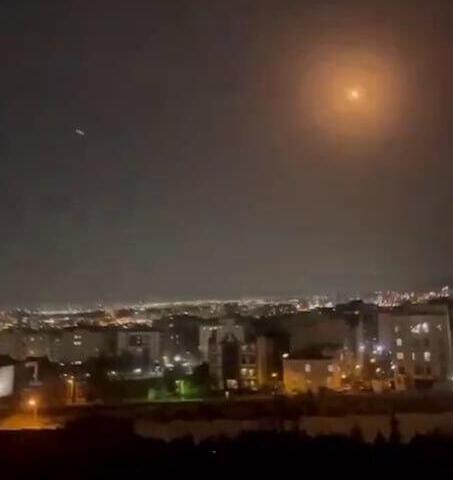
Air defense systems operating in western Tehran
Tasnim later cited sources claiming that the Iranian navy attacked three U.S. destroyers near the Strait of Hormuz. “The destroyers are fleeing toward the Gulf of Oman. The attack against them was carried out using missiles and suicide drones,” the Iranian report said.
The explosions near Bandar Abbas and Qeshm came three days after Iran fired missiles at its neighbors for the first time since the end of the war. According to the UAE Defense Ministry, 12 ballistic missiles, three cruise missiles and four drones were launched from Iran that day. This came after the start of Project Freedom, aimed at renewing ship traffic through the Strait of Hormuz, which U.S. President Donald Trump suspended Wednesday.
The Wall Street Journal reported Thursday evening that the Trump administration is considering renewing Project Freedom. Trump claimed he had suspended the plan because of progress in talks with Iran, but NBC reported overnight that the suspension also followed Saudi Arabia’s decision to prevent the U.S. military from using its bases and airspace. Now, according to the Journal, those restrictions, as well as similar restrictions imposed by Kuwait, have been lifted.
U.S. officials who spoke with the newspaper said it was unclear when the operation, under which the U.S. Navy would escort ships and tankers and protect them from Iranian attacks, would resume, but said it could happen in the coming days. However, a senior U.S. official later quoted by Al Jazeera denied the reports, saying preparations to renew Project Freedom were not underway.
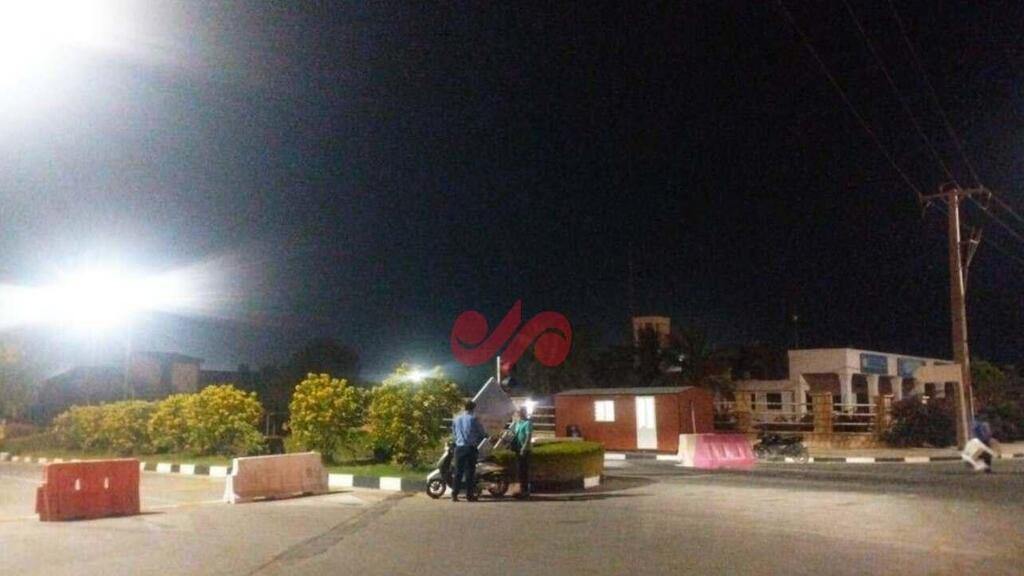
Bahman pier on Qeshm Island
According to the Journal, use of Saudi and Kuwaiti bases and the airspace of both countries is critical to the U.S. military’s ability to carry out the operation, and lifting the restrictions removes a major obstacle to resuming it. The report did not say how restarting the operation would affect negotiations with Iran, or whether the possibility of its renewal indicates difficulties in the talks.
Reuters reported the renewed hostilities cast further doubt on the durability of the fragile ceasefire that had largely held over the past month. The exchange of fire came as Washington awaited Iran’s response to a U.S. proposal intended to stop the fighting while postponing resolution of the most contentious issues, including Iran’s nuclear program.
According to sources and officials familiar with the discussions, the proposal does not include key U.S. demands that Iran halt its nuclear activities and reopen the Strait of Hormuz, which before the war handled about one-fifth of global oil and gas supplies.
Under the proposed framework, the process would proceed in three stages: a formal end to the war, resolution of the Strait of Hormuz crisis and a 30-day period of negotiations toward a broader agreement.
The Journal reported, citing Saudi officials, that Saudi Arabia and Kuwait imposed the restrictions on the use of their bases and airspace after U.S. officials played down the Iranian attacks across the Gulf earlier this week — carried out in response to the new U.S. operation — and declared them “below the threshold for resuming the war.” The officials added that Saudi Arabia and other Gulf states were also concerned the United States would not defend them if the escalation continued.
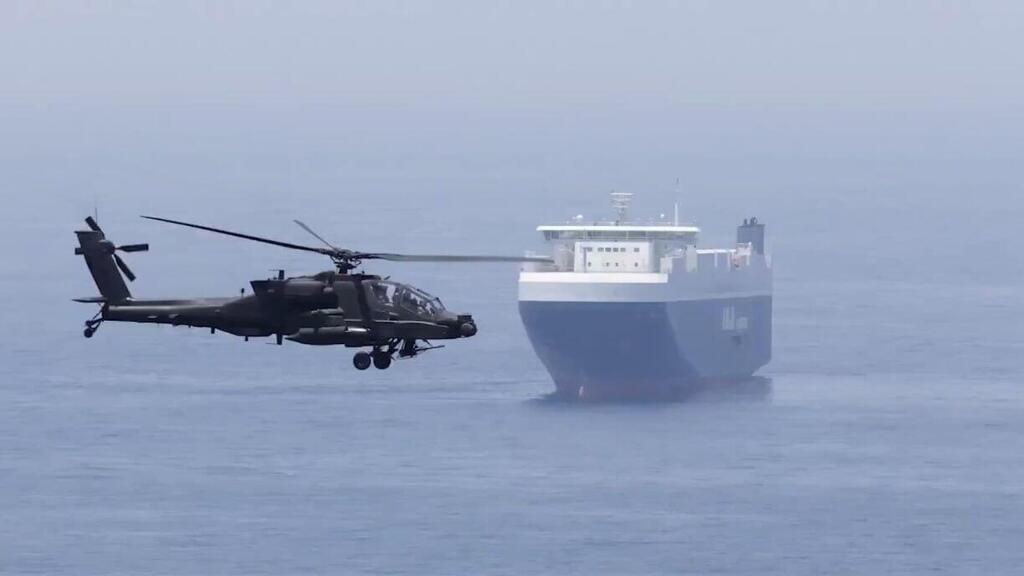
CENTCOM commander flies over Hormuz. Will Project Freedom be renewed?
(Photo: From the X page of U.S. Central Command)
Trump suspended the operation overnight between Tuesday and Wednesday, according to the report, after a phone call with Saudi Crown Prince Mohammed bin Salman, who voiced his concerns to the president and informed him of the decision to restrict U.S. use of his country’s bases and airspace. In the post announcing the suspension, Trump wrote that he had done so at the request of Pakistan — the mediator with Iran — and “other countries.” The Saudi restrictions were lifted, according to the report, after another call between Trump and bin Salman.
Trump said in his announcement suspending Project Freedom that advanced talks with Iran on an agreement are now underway. Axios reported Wednesday that the talks focus on an initial one-page memorandum of understanding with 14 points, in which the sides would declare an end to the war and the start of 30 days of negotiations aimed at reaching a detailed agreement on the various disputed issues, foremost among them the nuclear program.
The administration is reportedly awaiting Tehran’s response to its latest proposal. Iranian officials dismissed the reports with derision. One senior official described the Axios report as an “American wish list,” while Parliament Speaker Mohammad Bagher Ghalibaf wrote overnight on X: “Operation Trust Me Bro failed. Now back to routine with Operation Fauxios,” an apparent jab at the Axios report.
First published: 23:32, 05.07.26