


The diplomatic crisis between Israel and Turkey is reaching new heights, against the backdrop of a trilateral summit held in Jerusalem by Prime Minister Benjamin Netanyahu alongside the leaders of Greece and Cyprus — a meeting that sent an implicit message to Turkish President Recep Tayyip Erdoğan.
The summit, held Monday, is being portrayed in Turkey as an offensive move directed against Ankara. Reflecting that view, the pro-Erdoğan daily Yeni Şafak declared on its front page Wednesday that Israel should now be regarded as Turkey’s top threat.
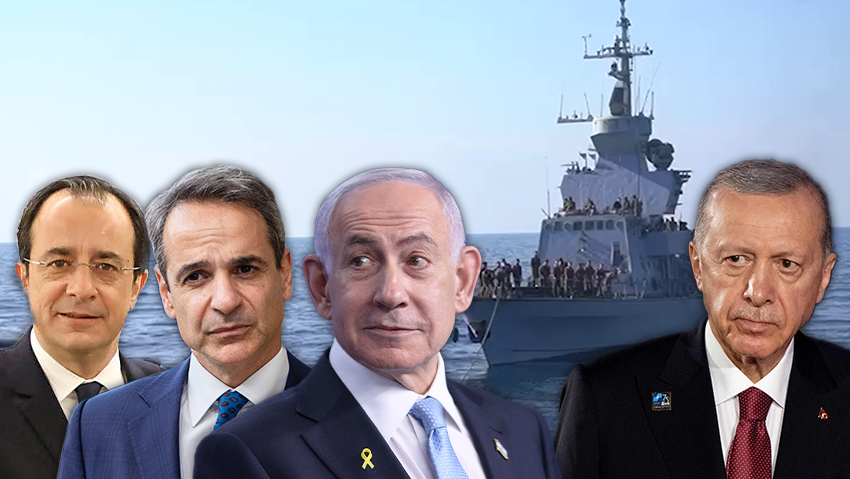
(Photo: Andrew Harnik/GETTY IMAGES NORTH AMERICA/AFP, Alex Kolomoisky, AFP PHOTO / HO / PIO, IDF Spokesperson)
The article linked the Jerusalem summit with clashes in Syria’s Aleppo region between regime forces and Kurdish fighters known as the Syrian Democratic Forces, or SDF. According to the report, Israel allegedly “activated” the Kurdish SDF during the summit in an effort to embarrass Turkey’s presence in Syria — a claim unsupported by evidence.
Yeni Şafak further asserted that all of Turkey’s security institutions now define Israel as the country’s primary threat, naming the Defense Ministry, the Foreign Ministry and the National Intelligence Organization, known by its Turkish acronym MIT. The paper said Israel has been elevated to the top of the agenda across these bodies. The framing represents an extraordinary escalation in Turkish rhetoric, particularly amid reports of a potential joint military force involving Israel, Greece and Cyprus, and following Erdoğan’s recent warning that Turkey would not allow its rights to be violated, delivered during a ceremony inaugurating a new submarine and naval vessels.
At the summit, Netanyahu appeared alongside Greek Prime Minister Kyriakos Mitsotakis and Cypriot President Nikos Christodoulides and issued a thinly veiled rebuke aimed at Erdoğan. He warned that those who dream of rebuilding empires and controlling the region’s lands should abandon such ambitions, stressing that Israel and its partners are committed and able to defend themselves, with cooperation strengthening those capabilities.
Behind the scenes, the United States continues to pressure Israel to accept Turkish involvement in Gaza’s reconstruction, particularly as part of an international stabilization force. Israel strongly opposes that role. A senior Israeli political official said it was clear Turkey would not be included in any such international force. Meanwhile, Turkey’s Foreign Ministry announced Wednesday that Foreign Minister Hakan Fidan met with senior Hamas officials in Ankara to discuss the second phase of the ceasefire agreement. Hamas representatives claimed they had fulfilled their obligations and that Israeli strikes were preventing progress to the next stage.
'Turkey is preparing for war'
Dr. Alon Liel, a former director-general of Israel’s Foreign Ministry and onetime chargé d’affaires in Ankara, warned that the growing military cooperation among Israel, Greece and Cyprus has placed Turkey in what he described as a state of panic and preparation for a future conflict with Israel.
Netanyahu's message to Erdogan and Iran
(Video: GPO)


Liel told ynet that Turkey is actively preparing for war, pointing to measures Ankara describes as strengthening air defenses and upgrading its air force, with significant budget allocations. He said Turkey is deeply concerned about the possibility of an Israeli strike and is treating the scenario with utmost seriousness. He cited Turkey’s efforts to modernize its air fleet, overhaul its aerial deployment, expand drone production and rely on strong naval and ground forces.
During the Jerusalem summit, Netanyahu announced that Israel, Greece and Cyprus had agreed to deepen their security cooperation. Liel cautioned that Turkey views the emerging alliance as an aggressive move. He argued that reaching an understanding with Turkey over Syria is essential to easing tensions. Without such an agreement, he warned, the first military clashes would likely occur on Syrian soil, where both countries maintain forces.
While he does not believe either side would directly attack the other’s territory, he said the absence of a trilateral or quadrilateral arrangement involving Syria and the United States could quickly lead to confrontations with Turkey.
Liel added that Turkey is significantly bolstering its air capabilities out of fear of an Israeli strike and that the formation of a military alliance inevitably prompts counteralliances. He said Ankara is likely to deepen ties with Azerbaijan and expand its presence in Syria. In that context, he stressed that Israel must safeguard its strategic relationship with Azerbaijan, noting that Turkey has already blocked Azerbaijani plans to deploy forces to Gaza. As for Washington, Liel assessed that, unlike in the past, the United States is no longer alarmed by tensions between Israel and Turkey.
Adding to the escalation, Hürriyet columnist Nedim Şener, a senior commentator close to the Turkish government, wrote Wednesday that Turkey now faces a common enemy in Syria - Israel - which he described in ideological terms, and what he called its proxy, the SDF Kurdish-led forces.
In Turkey, claims have circulated suggesting that the clashes in Aleppo during the Jerusalem summit were not coincidental but rather another signal orchestrated by Netanyahu. In practical terms, the claim is unfounded, but Turkish media are seeking to draw a connection to Israel and further frame it as an enemy.