


Just 150 meters separate the yellow line from crowded tent compounds, a busy street and an active market. Beyond them live hundreds of thousands of Palestinians, among them Hamas operatives trying to raise their heads from the ruins. On the Israeli side, inside the Strip, a different reality has already been built: permanent outposts, dining halls, gyms, guard posts and a operational space intended to keep the enemy as far as possible from soldiers and from communities near the Gaza border.
These days, the Board of Peace is poised to enter the Gaza Strip and is already setting policy, such as the request to hold fire, which Israel is graciously implementing. The American base established in the southern Strip, near Kibbutz Kerem Shalom, is already staffed by armed soldiers securing the facility. It was initially reported that the reconstruction process in the Strip would begin without the condition that Hamas be disarmed, but the Board of Peace later walked that back and said it would begin only after Hamas is disarmed.
Gallery
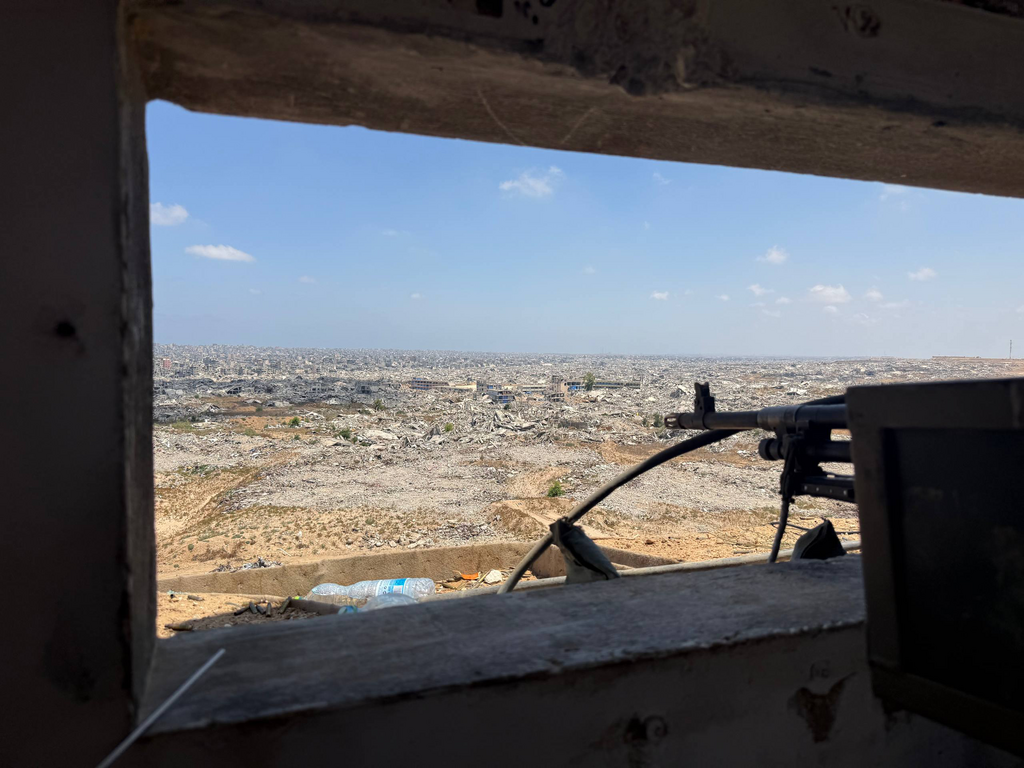
The guard post on the Yellow Line - only 150 meters from the Gaza population
(Photo: Roni Green Shaulov)
At the same time, discussions are taking place around the board’s 15-point plan and the possibility that the IDF will withdraw to the original yellow defensive line, rather than the new line to which it has pushed forward. As of now, the IDF holds about 70% of Gazan territory, and Prime Minister Benjamin Netanyahu made clear today that he has no intention of accepting the current plan, and that the IDF will not begin a withdrawal until Hamas disarms.
'Hamas is still working'
An IDF withdrawal now would mean a loss of depth for the forces on the ground. “We are in ‘Meteor’ opposite Gaza City, two kilometers from the city itself and another two kilometers from the residents in Israel, and in effect we are creating a buffer between the civilian and the enemy,” explained Lt. Col. G., commander of the Paratroopers’ 202nd Battalion. “The story here is to prevent enemy infiltration. To prevent the enemy from entrenching itself on the yellow line, to finish the work in everything related to the above-ground and underground effort. We are systematically destroying infrastructure. Every day we drill to locate tunnels.”
The IDF has established itself in outposts along “Ridge 70,” or, as they are called in the military, the “Meteors.” These outposts are spread roughly a kilometer and a half apart. Between them and the Palestinian population, the forces try to maintain a “dead zone” of between one and two kilometers, which the military calls a “maneuvering space” or “sterile area.”
The commanders on the ground are clear-eyed. They understand that the current hold on the defensive lines is temporary. “We know the enemy has underground infrastructure in Gaza City, in Shijaiyah. There are areas we have not destroyed. Hostages were held here in some of the places,” said Lt. Col. G., the battalion commander. He stressed that the IDF would act according to the instructions of the political echelon. “If it were up to me as a commander in the military, my aspiration is that we will succeed in reaching them someday. We entered, operated and disengaged backward. You will not see people here walking around armed, weapons, pickup trucks. We are gathering information with drones all day,” he said.
Lt. Col. G. described the daily struggle, saying: “Yesterday we saw the enemy with our own eyes, moving between buildings, walking among the ruins. When they come close, we often see them digging in the ground, coming out of buildings with sacks, walking around with bags, which means they are hiding weapons inside. So you create a kind of warning for them: ‘Come see that there is a drone above you — don’t be here. Move away.’ But they are entrenching themselves. You have not dismantled them yet. They are still working.”
Explosives from Air Force duds
Hamas is trying to recover and rebuild its strength, even if its means are more limited than before. “They take duds from air force bombs, handle them, restore them — and place an explosive charge on the route,” the battalion commander said. “They don’t have things like they had before, I don’t know, diving gear. That’s not there. The recovery is mainly recruiting people, the fact that they use the ground and raw materials and produce things.”
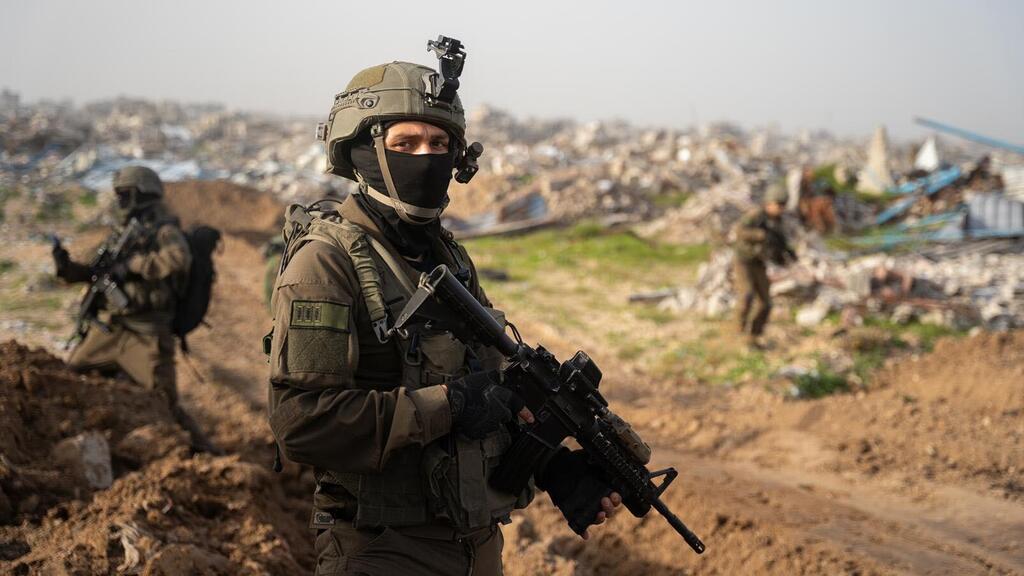
IDF forces operate in Gaza
(Photo: IDF Spokesperson's Unit)
According to him, “People say, ‘Hamas is entrenching itself’ — what does that mean? It takes a wire, connects it to an aircraft dud and places a charge. That is the entrenchment. And recruiting people. But there is no rocket threat here now. At least from what I know, and I am careful and put a question mark on everything.
“It could be that one day we wake up in the morning and there is the drone threat here, explosive drones. The centers of gravity, as far as Hamas is concerned, are elsewhere: the population and the underground,” he added. “Once we take the underground and know how to separate the population and move them away from essential assets such as the underground, the situation will change.”
As for the rules of engagement and conduct in the area, the battalion commander explained that the yellow line is not crossed. Still, he said, “There is also discretion here for the soldier and commanders regarding what actions you want to take. If you want to capture that person because he can provide you with intelligence value, or if you understand that he endangers your forces and you remove the threat. There is also a moral issue. This space between us allows me to carry out a suspect arrest procedure. If someone crosses, I track him with a drone, understand his intent, his capability. I also see what he is.”
'A slippery slope': The reservists’ criticism
Among reservists in the sector, the battalion commander’s approach, which sees risk management and the suspect arrest procedure as tools based on judgment and intelligence needs, is a real tactical danger. “We are stunned by the change in the rules of engagement recently,” a reserve officer serving in the sector recently told ynet. “The change from the simple order of neutralizing any enemy who crosses the yellow line toward us to a suspect arrest procedure that ends with a shot to the knees is the beginning of a slippery slope.”
According to him, “The command is complacent and thinks Hamas is deterred, but we see the organizing and know that the crossings of the yellow line are part of a system for testing our deployment. The enemy has intent, means and the ability to carry out significant offensive moves.”
'Destroyed and ground down'
Meanwhile, inside the territory under Israeli control in the Strip, the landscape has changed completely. Most of the buildings that stood here have been flattened entirely using an engineering method known on the ground as “destroyed and ground down.” This does not mean merely knocking down walls, but crushing the structures into small stones.
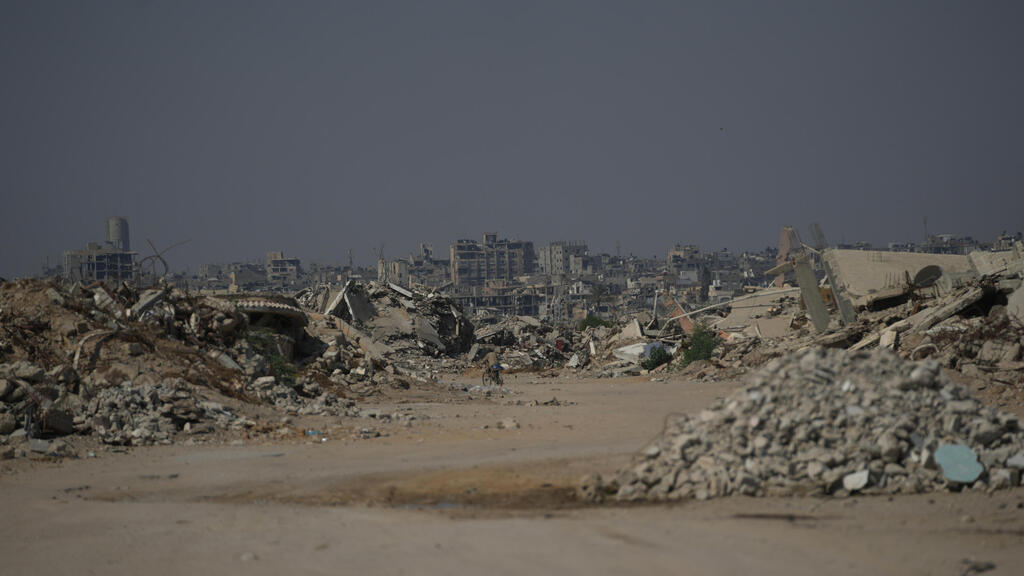
The ruins of buildings in Gaza
(Photo: Abdel Kareem Hana/AP)
“We come with bulldozers, go over the buildings, over the large skeletons and really create gravel, so that there will not be all the concealment and ruins. We flatten the area,” Lt. Col. G. explained. “We create protective embankments. You arrange the area so that if there is maneuvering here now, there will be better conditions, and if we now need to stand in defense, then the force going out will take cover.”
Alongside the flattening of the area, “statistical drilling” continues to locate tunnels in areas where there is examined intelligence or suspicion. “I know there are very significant routes coming out of the area that I still need to deal with,” the battalion commander stressed. “I don’t know, there may be more shafts we have not dealt with. There are ruins here, and fighting in ruins is a very big challenge.”
He made clear that identifying the enemy in the ruins does not rely on the classic appearance of guerrilla fighters. “I do not see with my eyes people walking around with weapons. I see suspects inside the population, people playing around a lot with the ground, people moving many sacks and bags, and it looks suspicious, and people walking around a lot in the skeletons of buildings and ‘incriminated’ places — so I know that if he is in that location, he is the enemy. The story is that you do not destroy an enemy behind the yellow line if you have not incriminated him.”
Not sinking into a security zone
Despite the operational routine, commanders on the ground are looking ahead and understand the limitations of the current defensive concept. “If I look at it systemically, we must not come to terms with remaining in some kind of security zone like this for 20 years, us here and them there,” Lt. Col. G. concluded. “The army now is offensive. It will not hold a lot of Meteors, or outposts, for all of Lebanon, Syria and the West Bank. This is a very big challenge in terms of manpower and mobilization. Therefore, the story here is how, in the end, you create offensive actions that serve preparation and prepare yourself for maneuvering.”
The battalion commander added that, as far as he is concerned, everything built here is not intended to defend the line itself. “We are protecting the civilians, not the yellow line, and we will do everything in our power to prevent infiltration,” he said. “What the soldiers are doing here is creating defense. The next thing is offensive actions. We are constantly moving very dynamically toward the area of the yellow line and preventing the enemy from reaching our direction.
"This happens every night, and that is how the enemy does not operate in our area. I am telling a civilian now, for example in Nahal Oz: They will not reach you. There is no chance, given the way we work here day to day.”