

Oman, the mediator caught between competing pressures, told European officials there is no possibility of returning to the situation in the Strait of Hormuz as it existed before the war, and that ships passing through the waterway may be required to pay fees, Bloomberg reported Friday, citing sources familiar with the matter.
According to those sources, Omani officials said their country would continue to uphold international maritime law, but added that payments could be imposed for services such as pollution treatment in the strait or assistance with navigation. It is not yet clear whether Oman intends for all such fees to be mandatory.
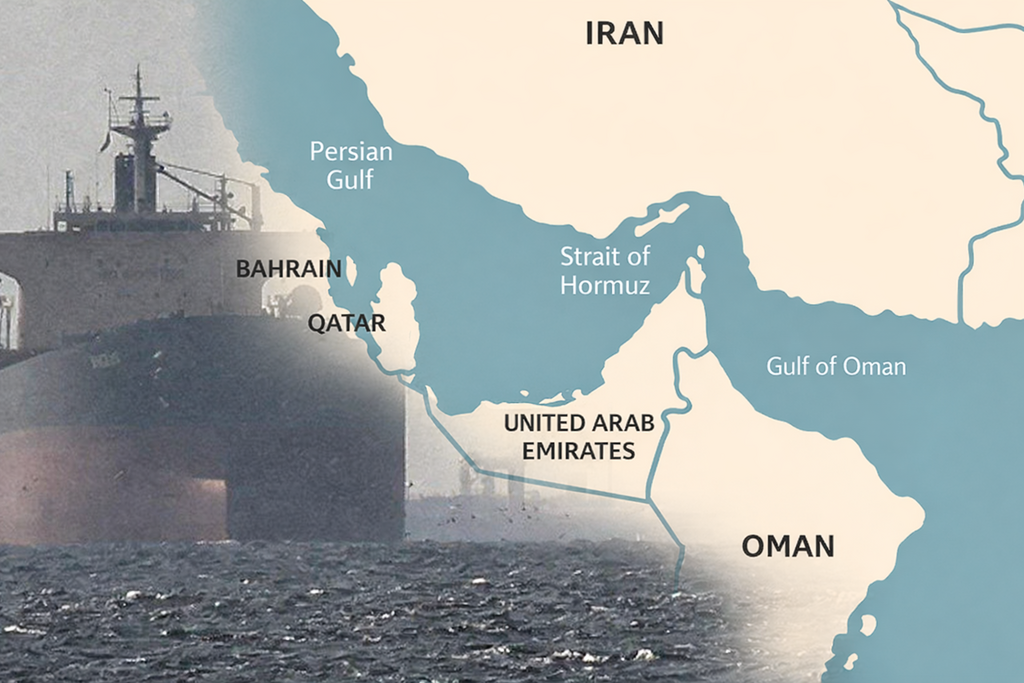
Strait of Hormuz
(:)
Oman, like Iran, is examining models used in other strategic shipping lanes around the world, including the Strait of Malacca between the Malay Peninsula and the Indonesian island of Sumatra, where no mandatory transit fees are imposed on vessels. The United States, European countries and Oman’s Gulf neighbors are increasingly concerned that the sultanate could advance, together with Iran, a system of fees or transit payments in the Strait of Hormuz.
The United States, Oman and other Gulf states have repeatedly stressed that the strait must remain open to navigation without fees. However, the sultanate faces a difficult position: it is working with Iran on establishing a mechanism to manage the waterway while also under pressure from Washington to reject any Iranian attempt to collect payments there and to keep the passage free-flowing.
Oman is an ally of the United States, but also maintains close ties with Iran. Because of its neutral stance in regional conflicts, it is sometimes referred to as the “Switzerland of the Middle East,” and it has previously served as a mediator between Washington and Tehran prior to the outbreak of the war.
Oman has issued mixed messages about the future of Hormuz. On Tuesday, it released a joint statement with Iran saying the two countries would discuss how to manage the shipping route and associated costs. Two days later, it signed a joint statement with the United States and the Gulf Cooperation Council rejecting all fees or attempts to take control of the strait.
The Gulf crisis
For decades, residents of the wealthy Gulf states watched regional wars unfold on television and social media. The fighting took place among their neighbors — in Yemen, Syria and Gaza — but not at home. That illusion was shattered by the war with Iran, which undermined the sense of security in countries that were attacked and forced them to reconsider their defense strategy. U.S. military bases on their soil, instead of protecting them, turned them into targets for thousands of Iranian missiles and drones.
Speaking to The New York Times, experts said that even as the fighting appears to have ended for now, despite public statements, many in the Gulf fear that the emerging agreement will not adequately address the threat Iran poses.
After their vulnerabilities were exposed, Gulf states have changed significantly since the war. Many are now determined to strengthen their military capabilities and invest more in weapons and defense systems. “The war left a big wound,” Khaled Al-Jaber, director general of the Middle East Council on Global Affairs, a research institute in Qatar, told the Times.
Images in recent months from Gulf cities such as Dubai and Doha — with powerful explosions and luxury towers set ablaze — were previously unthinkable for most residents. Unlike Israel, these countries were not prepared for war and do not have protected shelters. Although Gulf states succeeded in intercepting most of the Iranian missiles and drones, more than 30 people were killed and dozens were injured.
Mohammed Baharoon, head of a Dubai-based research institute, told The Times that the war created a dangerous precedent in the region, with actions by the United States and Israel producing a lenient approach toward the use of brute force.
In a recent column published in the Saudi newspaper Asharq Al-Awsat, journalist Abdulrahman Al-Rashed, considered close to the kingdom’s leadership, wrote that an agreement between the United States and Iran restores the Tehran regime to the status of a regional power. He said the economic benefits embedded in the deal “will make Iran a greater monster than it was before.”