


In recent weeks, a series of drone strikes have targeted military bases and oil and gas fields across Iraq—primarily in the Kurdistan region, including the provinces of Salah al-Din, Kirkuk, Erbil, Sulaymaniyah, and Duhok. The attacks have caused economic losses and forced several foreign oil companies to suspend operations. No group has claimed responsibility so far.
The prime suspects are Iran-backed Shiite militias operating in Iraq, though these groups have denied any involvement. At the same time, Israel’s name has also been linked to the incidents, amid Iraq’s ongoing internal and regional challenges.
Strikes on oil and gas fields in Iraq


On Sunday, the umbrella group known as the "Iraqi Resistance Coordination Committee" denied any role in the strikes. The group, which represents pro-Iranian militias in Iraq, stated: “The drone attacks on oil fields in the Kurdistan region are part of a score-settling conflict between oil companies and the regional government—not a cross-border dispute.
The Islamic Resistance in Iraq, in all its forms, has always avoided actions that harm the interests of the people or security forces, whether in the north or south of the country. The national interest is our priority. We advise the regional government to refrain from exporting its internal crises to the central government and instead focus on addressing the poverty and hardship faced by the Kurdish population.”
On Saturday, a senior official in the Kurdistan Regional Government revealed that the drones used in the recent attacks were launched from Iraq’s Kirkuk province. A day earlier, Iraqi military spokesperson Sabah al-Naaman announced the results of an investigation, confirming that all drones involved were of the same type and equipped with warheads manufactured outside Iraq. While he confirmed the drones were launched from within Iraq, he did not specify who was behind them.
The latest wave of attacks began on June 23, shortly after the end of the Israel-Iran war. On June 24, Iraq reported drone strikes on military bases across the country. The spokesperson for Iraq’s Joint Operations Command said at the time: “In a cowardly act, drones struck several Iraqi military bases, causing significant damage at the Taji base and the Imam Ali base in Dhi Qar province. Iraqi forces successfully intercepted additional attacks on four other sites. All of the targeted locations were under the control of Iraqi security forces and operated by Iraqi officers and personnel.”
The Iraqi prime minister, Mohammed Shia al-Sudani, ordered the formation of a high-level technical and intelligence committee to investigate the attacks and identify those responsible, vowing that the perpetrators would be punished. Yet attacks have continued.
According to a report on Thursday in the Qatari newspaper Al-Araby Al-Jadeed, the strikes have triggered political turmoil in Iraq. The report cited 11 drone attacks in under a week and noted that they come amid heightened tensions between Erbil and Baghdad, with no clear perpetrator identified. An Iraqi security official told the newspaper that authorities suspect a “third party” may be involved—suggesting Israel as the most likely actor, possibly operating through intermediaries or agents.
According to the official, “Israel seeks to sow internal chaos as an alternative to direct strikes, which the U.S. opposes. Jerusalem aims to damage the relationship between Baghdad and Erbil.” An Iraqi member of parliament told the paper Baghdad must “mobilize its intelligence services to confront the Middle East’s cancer”—a reference to Israel.
A commander from the Iran-backed Islamic Resistance in Iraq told the newspaper that "the factions are currently in no position to strike any facilities in Kurdistan or elsewhere, as such actions serve no purpose. The recent escalation has not targeted American interests, consulates, or military command centers—known resistance targets. Therefore, this appears to be an attempt to frame Iraqi militias for security failures, ultimately serving another party—most notably, the Israeli government."
Danny Citrinowicz, a fellow at the Iran Program of Israel’s Institute for National Security Studies (INSS) and a former head of the Iran desk in the IDF’s Research Division, said the developments in Iraq must be viewed within a broader regional context. “There’s growing concern in Iraq about being dragged into the Iran-Israel-U.S. conflict and becoming a battlefield,” he explained. “The Iraqi leadership, especially the prime minister, is deeply anxious. There’s also intense tension between Iran and the Kurds, due to accusations that the Kurds are cooperating with Israel and the U.S. and challenging Iranian influence. This has led to strained relations between Iran-backed Shiite militias in Iraq and the Kurdish region.”
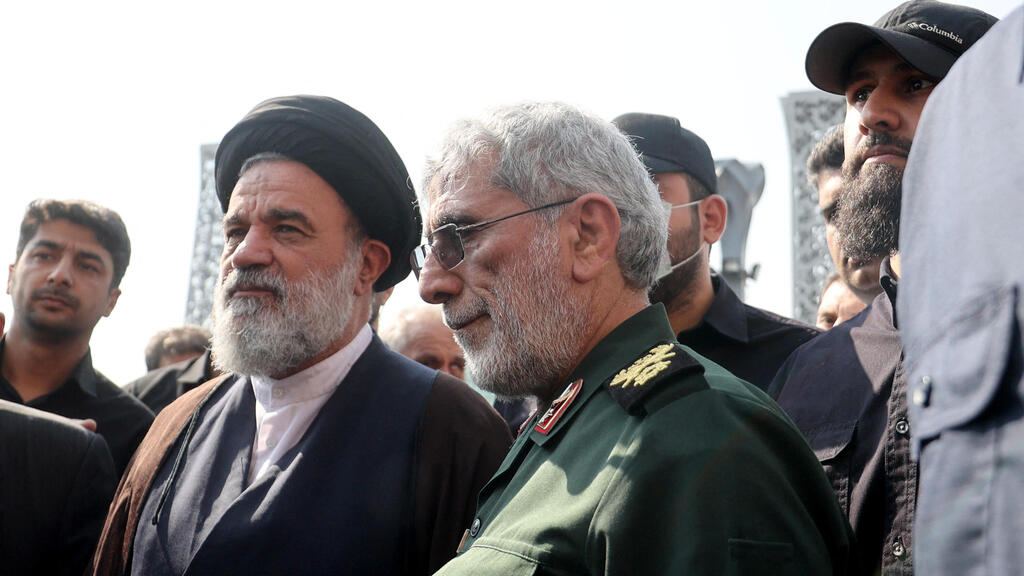
Esmail Qaani visits Iraq
(Photo: Majid Asgaripour/ (West Asia News Agency) via Reuters)
Citrinowicz added that the central government in Baghdad is also at odds with the Kurds over economic issues—chiefly the Kurds’ independent oil exports through Turkey. These disputes are intensifying ahead of Iraq’s upcoming parliamentary elections, he said, and are playing into the dynamics behind the attacks. “We don’t know who’s behind them, as no one has claimed responsibility. However, the main suspects remain the pro-Iranian militias, since the attacks have targeted the Kurds and caused significant damage. The drop in Kurdish oil exports also affects the Americans, as several oil fields are operated by U.S. companies, which increases pressure on the U.S. government to find a solution. That’s why we’re seeing strong efforts by the Iraqi government to appear proactive, even as the Shiite militias deny any role.”
He warned that the situation in Iraq is extremely volatile, touching on economic, social, and political fault lines. Baghdad fears a renewed confrontation with Iran and growing activity by Shiite militias. He also referenced internal Iranian tensions over reports of efforts to integrate the umbrella group of Iraqi militias, Hashd al-Shaabi, into the Iraqi army.
Get the Ynetnews app on your smartphone: Google Play: https://bit.ly/4eJ37pE | Apple App Store: https://bit.ly/3ZL7iNv
Al-Araby Al-Jadeed also reported that Iranian Quds Force commander Esmail Qaani visited Baghdad last Tuesday. According to Citrinowicz, the visit was likely linked to the recent developments. “He came to understand exactly what’s going on and possibly to push the militias toward building capabilities or challenging the U.S. presence in Iraq,” Citrinowicz said. “We don’t know for sure, but all of that is likely on the table. Tensions in Iraq are rising.”
He also warned against overlooking the connection between Yemen’s Houthis and Iraq’s pro-Iranian militias. While their operational cooperation has waned in recent months, the alliance remains significant.
During his visit to Baghdad, Qaani reportedly met with politicians, party leaders, and militia commanders. Sources told Al-Araby Al-Jadeed he warned them of possible Israeli strikes inside Iraq—targeting installations, personnel, headquarters, and bases—as part of what he described as Israel’s expanded regional campaign. Qaani is also said to have warned of Israeli infiltration into Iraqi state institutions. According to the report, Iranian and militia intelligence suggest that there are over 300 Israeli targets currently present in Iraq.
The report concluded that Israel seeks to inflame tensions between Baghdad and the Kurdistan region as a way of diverting attention from its alleged infiltration of Iraq’s government and security apparatus.