

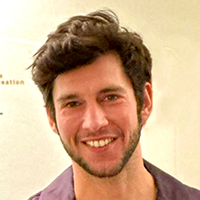
In 2007, former U.S. President Bill Clinton was invited to the University of Michigan’s commencement ceremony to receive an honorary degree and offer a few words of inspiration to the younger generation. But even the former president noticed that the person who stole the show that day was a young student delivering the graduation speech.
Clinton, who always knew how to nurture talent, pulled him aside immediately after the ceremony. He asked the young student why he was going into medicine when he clearly had such a real and natural gift for standing before an audience, and advised him to seriously consider a political career. The young man laughed: “With a name like mine, that probably won’t work.”
Dr. Abdul El-Sayed's 'I am dangerous' speech


That may have been the last time Dr. Abdul El-Sayed showed such modesty.
Now, ahead of one of the most passionate and expensive Democratic primaries ever, the name “Abdul El-Sayed” is not seen as a political obstacle. It is a superbrand. At 41, the epidemiologist, the son of Egyptian immigrants who spent summer vacations in Alexandria but grew up in the suburbs of Detroit, has become the doomsday weapon of America’s progressive left.
El-Sayed is running for the Democratic nomination for one of Michigan’s two Senate seats in the August 4 primary, and a victory would pave his way to the decisive battle in the November midterms, in which he hopes to become the first Muslim senator in U.S. history. Among supporters and critics alike, he has already been crowned “Michigan’s Obama.”
'I am dangerous': The speech that swept people up
With a bachelor’s degree with highest honors from the University of Michigan, a prestigious Rhodes Scholarship that led to a doctorate at Oxford University, and a medical degree from Columbia University, El-Sayed brings to the political stage a package that is very hard to ignore. His “I am dangerous” speech, which swept up tens of thousands and went viral, proved even to his critics that he is a politician in a different league, one who can electrify a crowd with seemingly no effort.
“If you’ve been following, you’ve probably noticed that they’ve started calling me ‘dangerous,’” he said in the speech. “I don’t know why someone would call a person who looks like me, with a name like mine, ‘dangerous.’ It’s an interesting choice of words."
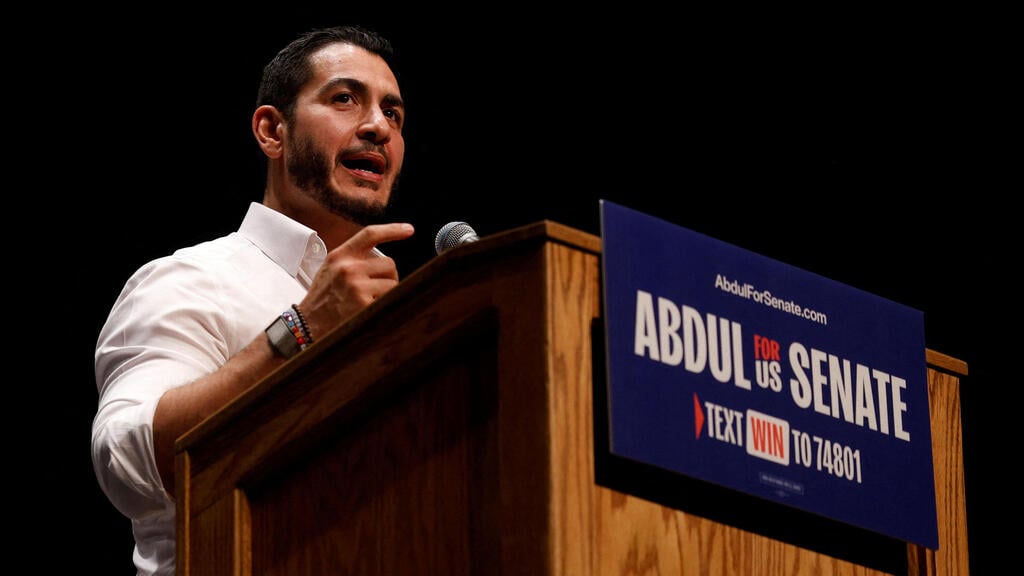
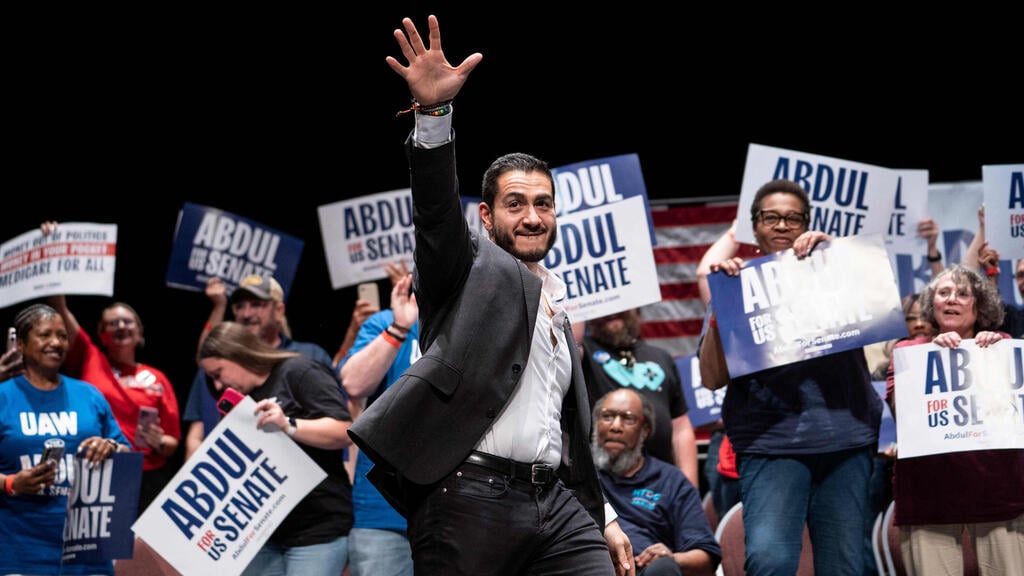
On the campaign trail
(Photo: Sarah Rice / Getty Images North America/ AFP)
"I'm not dangerous if you need government to work for you," he concluded in the same speech.
Many compare him to Zohran Mamdani, the New York mayor who has already proven his ability to build power inside the party. But El-Sayed recoils from that comparison. In his view, Mamdani may have the charm of a New York influencer, but he often gets entangled in pseudo-sophisticated arguments that contribute nothing.
In effect, El-Sayed sees himself as “Mamdani for advanced users.” He has real charisma, sharp eloquence and a verbal command reminiscent of Obama at his peak. He answers directly, fires precise arrows at the target, leaves no room for doubt and manages to leave even tough battlefields clean and unscathed.
That was the case, for example, when veteran CNN interviewer Jake Tapper asked about his refusal to comment on the assassination of Ali Khamenei, out of what El-Sayed described as “deep concern” over hurting the feelings of members of the Muslim community in Dearborn. Tapper wondered why a candidate for the U.S. Senate was so concerned about the feelings of supporters of a murderous ayatollah instead of standing with the national security interest.
An average candidate would have stammered or become defensive. El-Sayed used it to launch a counterattack.
“Why are you asking me about the ayatollah who was killed and not about our soldiers who were killed in a war we should never have fought?” he replied calmly, forcing Tapper to move on to the standard “America First” speech now shared by the deep left and right in America. He explained that he sees no point in sending bombs “to any country 6,000 miles from here” when people in Michigan cannot even afford health insurance or basic necessities, and that his tax dollars should stay at home.
A dirty political fight against 'a walking suit'
Despite his charisma and polished rhetoric, on the ground El-Sayed is waging a dirty political battle against his moderate rival, Rep. Haley Stevens, whom he describes as “a walking suit with a fat AIPAC bank account.”
At the moment, El-Sayed trails her by about 4 percentage points in the polls, but the race is competitive and he is gaining momentum that is keeping party leaders such as Chuck Schumer, whom he attacks at every opportunity, up at night.
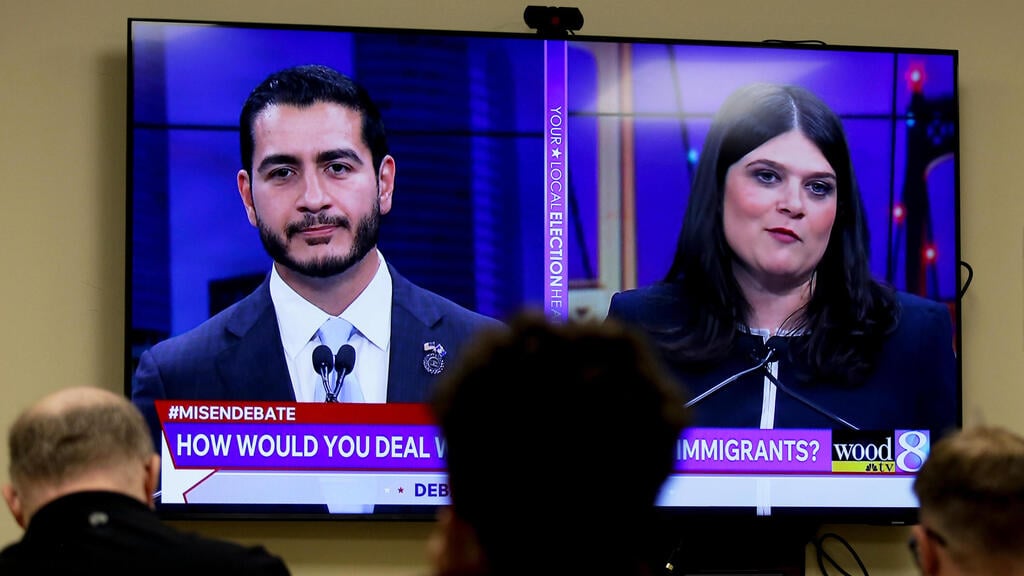
Dr. ABdul El-Sayed in debate against Rep. Haley Stevens
(Photo: Kristen Norman/AP)
The pro-Israel lobby AIPAC has put close to $30 million into saving Stevens. It is the largest investment it has ever made in a single race, and most voters are not aware of it. Its ads do not mention Israel, Gaza or AIPAC itself. They mainly present Stevens as a defender of Michigan’s auto industry.
Her campaign budget is 12 times larger than El-Sayed’s. He refuses, on principle, to take money from “polluting corporations and lobby groups.” Instead, he boasts of a ground campaign based on tens of thousands of volunteers and says the election will be decided in a battle of “the many versus the money.” Still, his campaign is backed by the pro-Palestinian lobby American Priorities, which was established as a counterweight to AIPAC.
Stevens herself is trying to walk a very thin political tightrope. On the one hand, she describes herself as “a proud pro-Israel Democrat,” and during a Hanukkah candle-lighting she said tearfully that “Israel comes to me in my dreams.” On the other hand, in an attempt to balance the growing criticism from the left in a state with an especially high percentage of Arab and Muslim voters, she sharply attacked Israel in one of the televised debates and accused Prime Minister Benjamin Netanyahu of being “a danger to Jews in the United States and around the world.”
Netanyahu fired back at her in a CNN interview, claiming she was “trying to excuse antisemitism,” creating a rather surreal situation in which a candidate backed by millions of dollars from AIPAC came under direct and public fire from Israel’s prime minister.
Progressive stars rally behind El-Sayed
While Stevens stumbles when asked directly about AIPAC donations — in one interview, she gave an 800-word answer without mentioning the organization even once — El-Sayed is enjoying the enthusiastic and aggressive mobilization of all the stars of the progressive left.
Alexandria Ocasio-Cortez, Sens. Chris Van Hollen, Elizabeth Warren and Bernie Sanders, whom El-Sayed calls “my favorite Jewish uncle,” and local Rep. Rashida Tlaib are crisscrossing Michigan at large and noisy rallies on his behalf. At a joint rally with Ocasio-Cortez, the two asked the crowd whether they were “ready for a little magic,” and even total cynics were briefly persuaded by the fluent message of politics free of money and special interests.
But when it comes to rhetoric toward Israel, El-Sayed becomes far more caustic. He often accuses the country of “apartheid” and “genocide,” and has stated without hesitation that the Israeli government is “evil” in exactly the same way as Hamas. He has sparked outrage among Michigan’s organized Jewish community by rejecting Israel’s right to exist as a Jewish state on the grounds that it “stands in complete contradiction to liberal values,” and has hosted campaign events with anti-Israel online personality Hasan Piker.
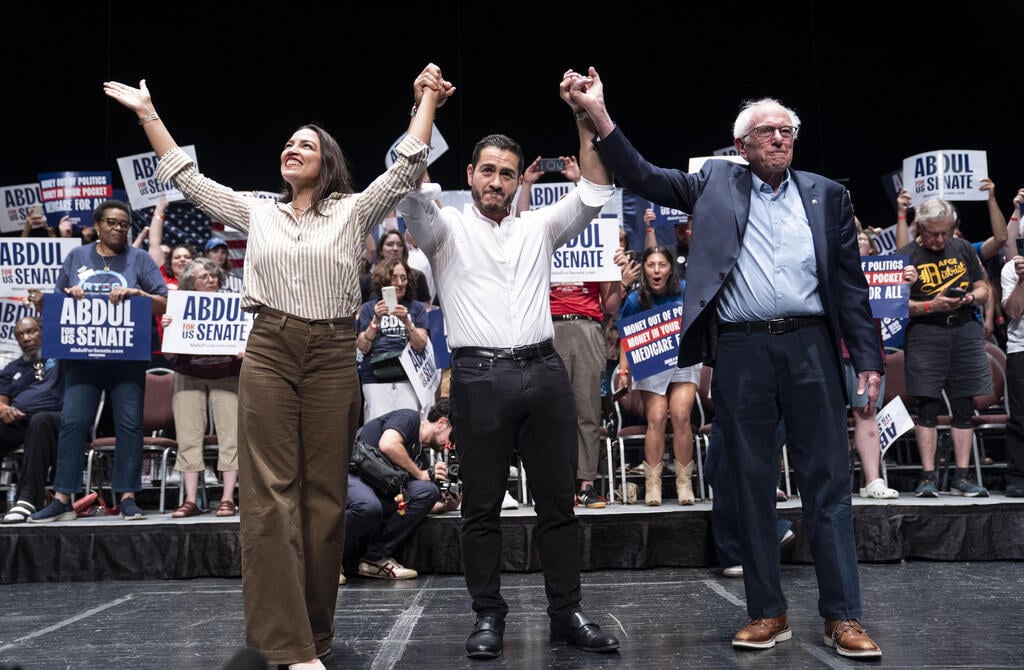
Dr. Abdul El-Sayed with Rep. Alexandia Orcasio-Cortez and Sen. Bernie Sanders
(Photo: Sarah Rice/Getty Images)
Despite its layer of academic sophistication, his campaign has not been free of scandals. He took a hard blow when a former staffer, a 24-year-old woman from Dearborn named Mariam Odeh, was arrested and accused of taking part in a campaign of threats and vandalism against Jewish leaders at the University of Michigan and the Jewish Federation of Detroit. Authorities accused Odeh and seven other students of “threatening to murder Jews under cover of night.”
El-Sayed said that “harming families and property is wrong,” but when he took the campaign stage immediately afterward, he claimed the pro-Palestinian activists had been prosecuted because of their political agenda, not because of their actions. He compared their treatment to the lenient approach the Trump administration has taken toward Capitol riot defendants.
After a car-ramming attack at a synagogue in West Bloomfield last year, when it emerged that the attacker had lost his family in Israeli strikes in Lebanon, El-Sayed published a video connecting the events and ending with the conclusion: “Hurt people hurt people.”
He does not soften his positions — and still wins Jewish support
What frustrates the organized Jewish community even more is the way El-Sayed manages to penetrate Jewish audiences in Michigan without softening his positions in the slightest.
Similar to what Mamdani did in New York, El-Sayed has adopted a strategy of “sharpen the anti-Zionist rhetoric — but show openness to dialogue and meetings with liberal Jewish communities.” He did not hesitate to take part in a Passover Seder at a progressive synagogue outside Detroit, which brought together a group of devoted supporters who call themselves “Jews for Abdul.”
Jewish congressman Andy Levin, who was himself ousted from Congress by Stevens in a previous primary after a well-funded AIPAC campaign, has stood by El-Sayed, publicly endorsing him alongside Bernie Sanders and arguing that his campaign is “an example of the Jewish spirit,” one of “building alliances instead of closing in on oneself.”
But unlike Mamdani, who rose on social media, El-Sayed has real credentials on the ground. As someone who grew up in Detroit’s affluent suburbs but spent summers with his family in Egypt, he says he understood from a young age what it meant to be “an Arab kid with a strange name” in post-9/11 America. That reality forced him to navigate between opposing worlds and pushed him to prove to everyone that even “a Muslim like him” could win a full merit scholarship to medical school, become captain of the university lacrosse team and become the youngest person ever to head the health department of a major U.S. city.
As Detroit’s health director, he dealt with the Flint River water contamination crisis in 2014, provided free eyeglasses to the city’s children and directly confronted insurance companies and major polluting energy corporations.
In 2017, at age 33 and still living with his wife in the basement of her parents’ home, he announced a run for governor. Sanders and Ocasio-Cortez mobilized for him then too. He promised to prove that a Muslim candidate could win a swing state, but ultimately lost the primary to Gretchen Whitmer. Eight years later, he is back more experienced, polished and politically dangerous.
Will 'the kid with the strange name' rewrite history?
This time, it is not only an internal battle over the soul of the Democratic Party. The winner of the primary will face Republican Mike Rogers in November in a race already defined as close. Michigan is not a Democratic stronghold. Trump won it in 2024, and in those same elections Rogers lost the Senate race to Elissa Slotkin by fewer than 20,000 votes, only about one-third of a percentage point.
In the November general election, Michigan’s second Senate representative will be chosen for the seat being vacated by retiring Democratic Sen. Gary Peters. For Democrats, holding that seat is an almost essential condition for any attempt to regain control of the Senate.
But El-Sayed’s record is apparently enough for him to display confidence on the debate stage and toy with his rivals.
“Let’s play a game,” he suddenly suggested in one of the recent debates, staring directly at the audience in the studio. “If you are standing on this stage and have never taken a contribution check from Blue Cross, raise your hand.” While his stunned rivals froze in place, El-Sayed proudly raised his hand alone, to applause and echoing laughter from the crowd, cementing his image as “the only fighter in the arena who is not for sale.”
El-Sayed is not alone. Across the Democratic Party, a new generation of candidates is already taking shape, copying from Mamdani the combination of a major ground campaign, command of social media, anti-Israel positions and nonstop attacks on the party establishment. Republicans have already mockingly dubbed them “mini-Mamdanis.”
In New York, all three candidates backed by the mayor won: Brad Lander unseated Dan Goldman, Darializa Avila Chevalier defeated Adriano Espaillat and Claire Valdez won the race for an open seat. In New Jersey, Dr. Adam Hamway, a plastic surgeon, U.S. military veteran and doctor who volunteered in Gaza, won a crowded primary against 12 rivals on his way to Congress. In Colorado, Melat Kiros, a 29-year-old democratic socialist, defeated Diana DeGette after nearly three decades in Washington.
But all those victories came in deep-blue districts, where winning the primary almost always guarantees a seat in Congress. El-Sayed is a far more ambitious and dangerous test: an attempt to take the progressive wave outside its safe strongholds and see whether it can win a swing state that Donald Trump carried just two years ago.
If “the kid with the strange name” from Detroit’s suburbs manages to win on August 4 despite the scandals, the death threats surrounding his campaign and the astronomical funding gap, he will rewrite Michigan’s political history and the future DNA of the entire Democratic Party.
Michigan first — and from there, perhaps as Bill Clinton foresaw, the rest of the United States.