


The U.S. State Department announced Friday evening that the ceasefire in Lebanon would be extended by 45 days. In practice, however, heavy fighting between Israel and Hezbollah continues in Lebanon, including FPV drones launches, targeted killings and attacks on IDF troops.
As in previous extensions, Israeli citizens learned about the ceasefire extension from the United States rather than from Israel’s political leadership. During earlier extensions, it was President Donald Trump who announced the updates.
Gallery

Opening of negotiations between Israel and Lebanon, mediated by the US
(Photo: Shmulik Almani, Embassy of Israel)
The announcement came after the fourth round of talks between Israeli and Lebanese representatives at the State Department. According to the statement, the aim is “to enable further progress.” The State Department is expected to host additional talks on Monday, June 2 and Tuesday, June 3. At the same time, a “security track” involving military delegations from both countries will open at the Pentagon on Thursday, May 29.
“We hope these discussions will advance lasting peace between the two countries, full recognition of each other's sovereignty and territorial integrity, and establishing genuine security along their shared border,” the American statement said.
Even before the official announcement, Hezbollah had not committed to complying with such an extension. A command source in the organization quoted by Qatar’s Al-Araby channel said that Hezbollah's position regarding any agreement to strengthen the ceasefire with Israel will be examined based on the facts.
Lebanese outlet Al-Mayadeen, which is affiliated with Hezbollah, reported that the group rejects direct negotiations in Washington and that the organization would determine its position regarding the ceasefire “based on the reality on the ground.” The report added that, in Hezbollah’s view, Israel has demonstrated a lack of commitment to any agreement. The channel also claimed that Hezbollah’s right to resist the “occupation” of southern Lebanon is not open for negotiation.
Fire Without Cease
The IDF Arabic-language spokesperson warned residents Friday evening to evacuate two buildings in the city of Tyre and stay at least 300 meters away from them.
The warning came after sirens sounded around 6 p.m. in several communities in the western Galilee, including Nahariya, following the infiltration of drones from Lebanon. One drone was intercepted while several others exploded in open areas. Fire and Rescue Services reported a blaze in agricultural fields near Rosh Hanikra caused by one of the drones. The fire was later brought under control.
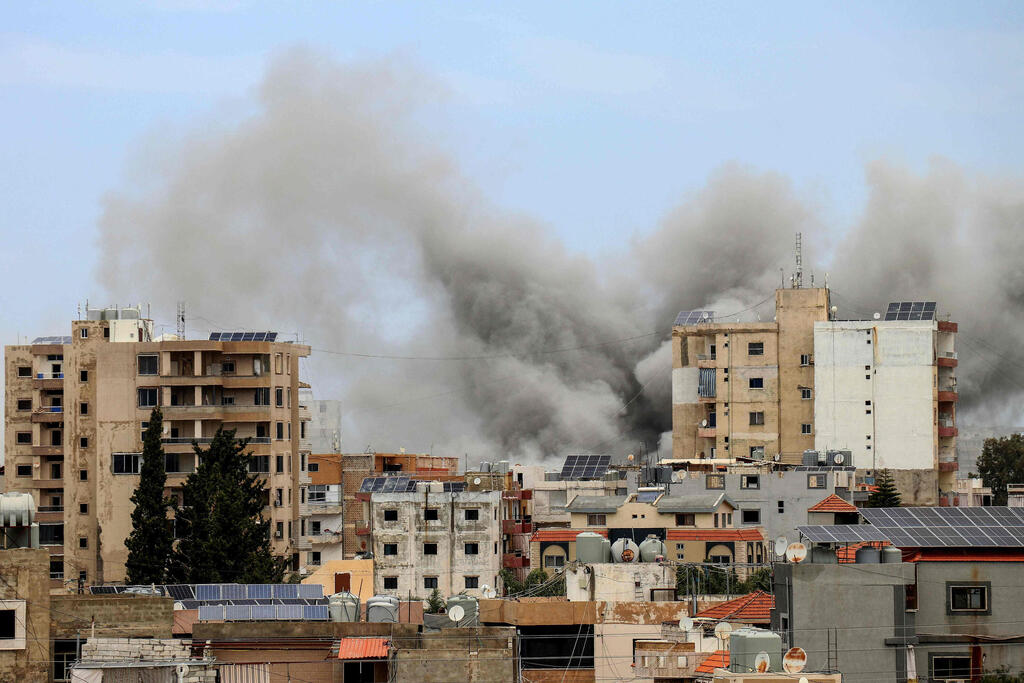
IDF strikes in Lebanon
(Photo: KAWANT HAJU / AFP)
Later, around 7 p.m., sirens sounded in and around Kiryat Shmona over fears of additional drone infiltrations. The IDF later said impacts were identified near Metula and Kiryat Shmona while the remaining drones were intercepted. No injuries were reported.
Hours earlier, the Israeli Air Force (IAF) intercepted Hezbollah explosive drones launched toward areas where IDF forces are operating in southern Lebanon. Earlier Friday, the IDF announced that Staff Sgt. Negev Dagan was killed Thursday in southern Lebanon after being hit by a mortar shell fired at troops near the Litani River.
Over the past 24 hours, Hezbollah has also launched drones and mortar shells at Israeli forces. The military further said Hezbollah attempted to shoot down an IAF aircraft with a small surface-to-air missile, but the attempt failed.
Lebanese reports since Friday morning did not mention unusual targets being struck, but did report intermittent bombardments in various villages in southern Lebanon and several targets in the Tyre area, whose evacuation the IDF ordered overnight.
Since the Israeli strike in Beirut last Wednesday, in which Hezbollah’s Radwan Force commander was killed, the IDF has avoided striking near the Lebanese capital because of the declared ceasefire between Israel and Lebanon.