


Some two weeks after Israel’s political-security cabinet approved the establishment of 19 new settlements in the West Bank, 14 Western countries, including Britain, Germany and France, issued a sharp condemnation on Wednesday night, marking another step in the growing international push for the establishment of a Palestinian state.
They said in the statement that “such unilateral actions, as part of a broader expansion of settlement policy in the West Bank, not only violate international law but also endanger stability.”
The joint statement was also signed by Belgium, Canada, Denmark, Italy, Iceland, Ireland, Japan, Malta, the Netherlands, Norway and Spain. The countries wrote that the decision “could undermine the implementation of the comprehensive plan for Gaza, the transition to its second phase, and the prospects for long-term peace and security in the region.”
They also reiterated their firm opposition to any form of annexation and settlement expansion, including approval of the E1 plan and thousands of new housing units. They called on Israel to reverse the decision, as well as all settlement expansion, in accordance with UN Security Council Resolution 2334.
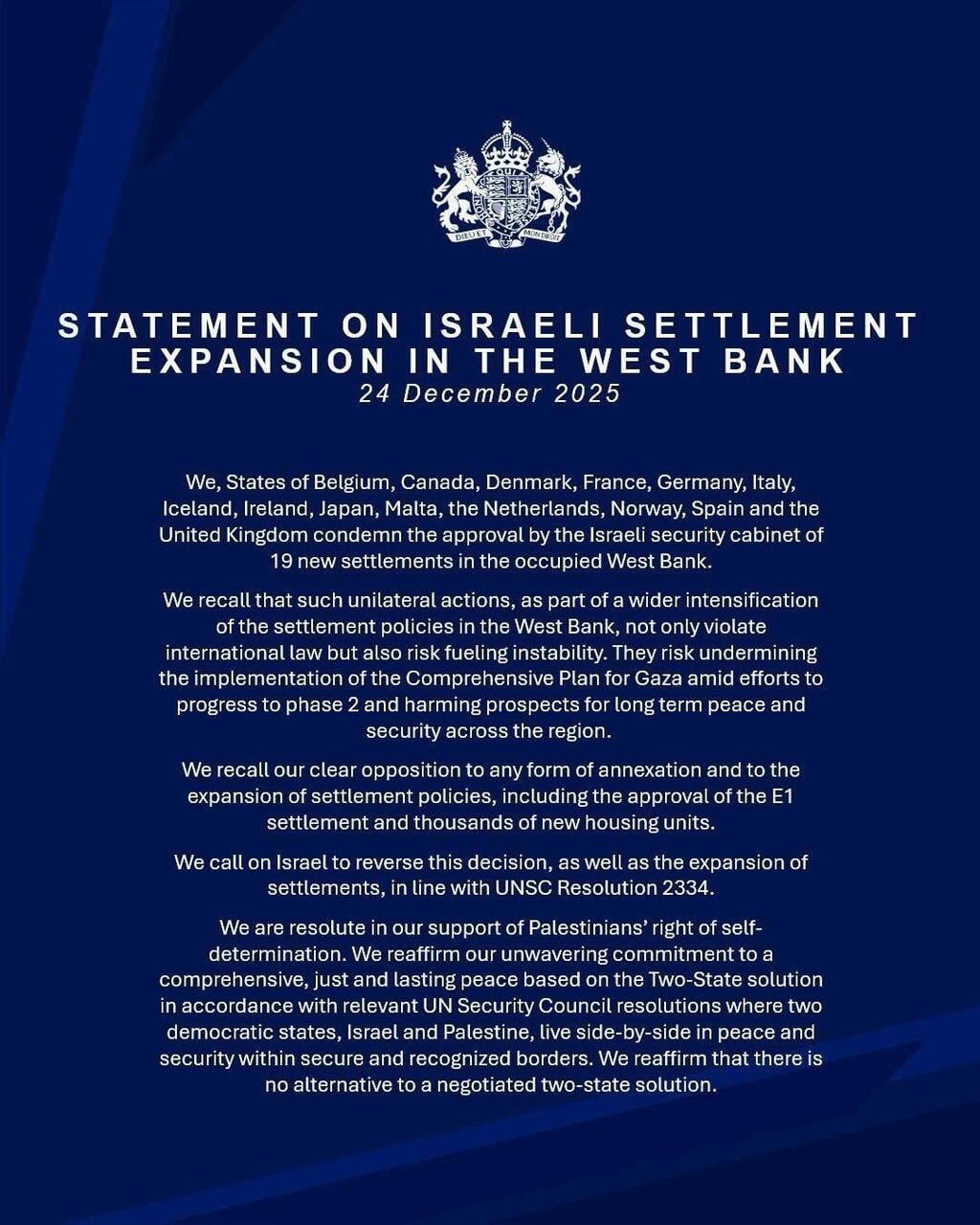
joint statement, as published in the British Foreign Secretary's X account
“We remain determined in our support for the Palestinian right to self-determination,” the statement said, reiterating “the commitment to a two-state solution – Israel and Palestine living side by side in peace and security within secure and recognized borders. There is no alternative to a negotiated two-state solution,” they stressed.
In response, Foreign Minister Gideon Saar strongly rejected “the statement issued by foreign countries regarding the cabinet’s decision on settlements in Judea and Samaria.” He accused the countries of attempting to limit “the right of Jews to live in the Land of Israel,” describing such calls as “morally flawed and discriminatory against Jews.”
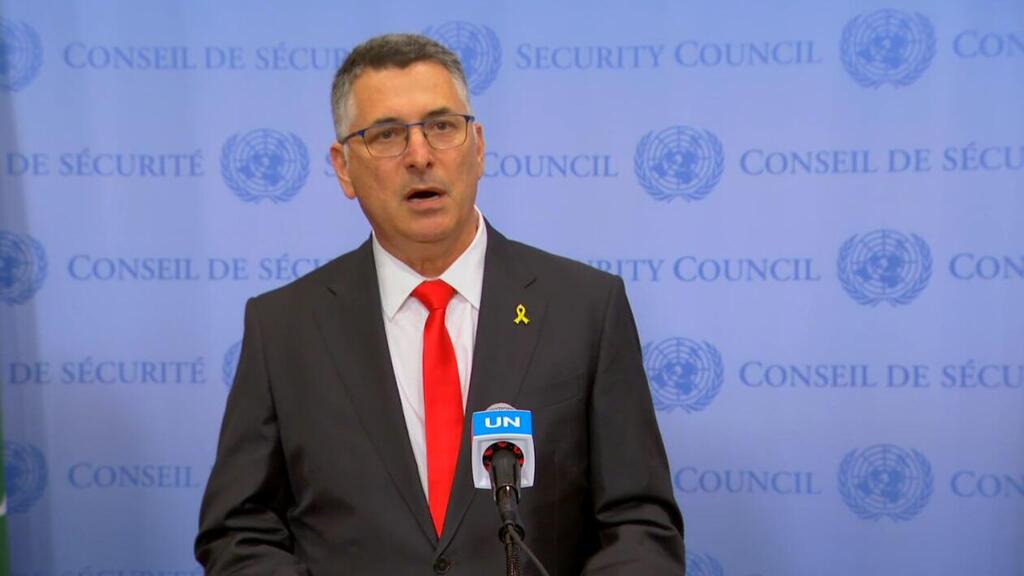
Foreign Minister Gideon Saar strongly rejected the statement
(Photo: UN Web TV)
Saar said the cabinet decision includes the establishment of 11 new settlements and the formalization of eight additional ones, and is intended, “among other things, to help address the security threats facing Israel.” He noted that all the settlements are located in Area C and on state land, and argued that Israel is acting in accordance with international law. The foreign minister pointed to the 1917 Balfour Declaration, which was incorporated into the British Mandate for Palestine and approved at the San Remo Conference in 1920.
“Under the Mandate, the right of the Jewish people to establish their national home extends over the entire territory of ‘Mandatory Palestine,’” he said, adding that these rights were preserved in Article 80 of the UN Charter. Saar also sharply criticized what he called the countries’ “blatant silence” regarding illegal construction by the Palestinian Authority in Area C, suggesting that the condemnation of Israel is selective and discriminatory.
Settlements evacuated during disengagement, veteran outposts to be legalized
The proposal submitted by Defense Minister Israel Katz and Finance Minister Bezalel Smotrich was approved unanimously by the cabinet about two weeks ago. Under the plan, the settlements of Ganim and Kadim in northern Samaria, which were evacuated during the 2005 disengagement, will be reestablished. Some of the sites approved by the cabinet are long-standing outposts that will now be formally legalized, while others are entirely new.

Defense Minister Yisrael Katz and Finance Minister Bezalel Smotrich on a joint tour of Judea and Samaria
(Photo: Elad Malka, Shira Keinan, Ministry of Defense)
In addition to Ganim and Kadim, the settlements include Kida, Esh Kodesh, Givat Harel (split from Givat HaRoeh), Mashuol, Kokhav HaShahar North, Nof Gilad, Shalem, Har Bezek, Rihanit, Rosh HaAyin East, Tamun, Pnei Kedem, Yatziv (Shadma), Ya’ar El Keren, Allenby, Yitav West and Nahal Doren. The move was coordinated in advance with the United States.
Last year, the Knesset plenum approved the repeal of the “Disengagement Law,” which officially allowed Israelis to remain in areas evacuated in northern Samaria. In May, the cabinet approved the establishment of 22 additional settlements in the West Bank, including in Binyamin, the Dead Sea area, the Jordan Valley, the Hebron Hills and Samaria. Among them are Homesh and Sa-Nur, which are also set to be reestablished.