

Lebanese President Joseph Aoun met on Wednesday in Beirut with senior Iranian official Ali Larijani, secretary of Iran’s Supreme National Security Council, as Lebanon’s government weighs disarming Hezbollah.
Aoun told Larijani that no group in Lebanon is allowed to possess weapons or rely on foreign support, warning against outside interference in Lebanese affairs. He said Lebanon is open to cooperation with Iran as long as Tehran respects Lebanese sovereignty and maintains mutual respect.
Pro-Hezbollah protest in Beirut over efforts to disarm terror group


“The friendship we want with Iran must include all Lebanese, not just one sector or group,” Aoun said. He added that recent Iranian comments about the government’s decision on Hezbollah were unhelpful and reiterated that only the Lebanese state and its security forces are responsible for protecting citizens.
Larijani said Iran does not interfere in Lebanon’s decision-making and warned foreign countries against issuing directives to Beirut. He emphasized Lebanon should value the “resistance,” including Hezbollah, which receives support from Tehran. Prior to his visit, Larijani reaffirmed Iran’s backing of Hezbollah and opposed any effort to disarm the group.
“If the Lebanese people suffer, we in Iran feel the pain as well and will stand by Lebanon’s citizens under all circumstances,” Larijani told reporters. He is also scheduled to meet Lebanese Prime Minister Nawaf Salam and Parliament Speaker Nabih Berri, a Hezbollah ally.
Hezbollah supporters have protested in Beirut against disarmament plans. The group’s secretary-general Naim Qassem says its weapons are necessary to defend against alleged Israeli aggression. Hezbollah has rejected the government’s plan to seize its arms, claiming it serves Israeli interests and leaves Lebanon exposed.
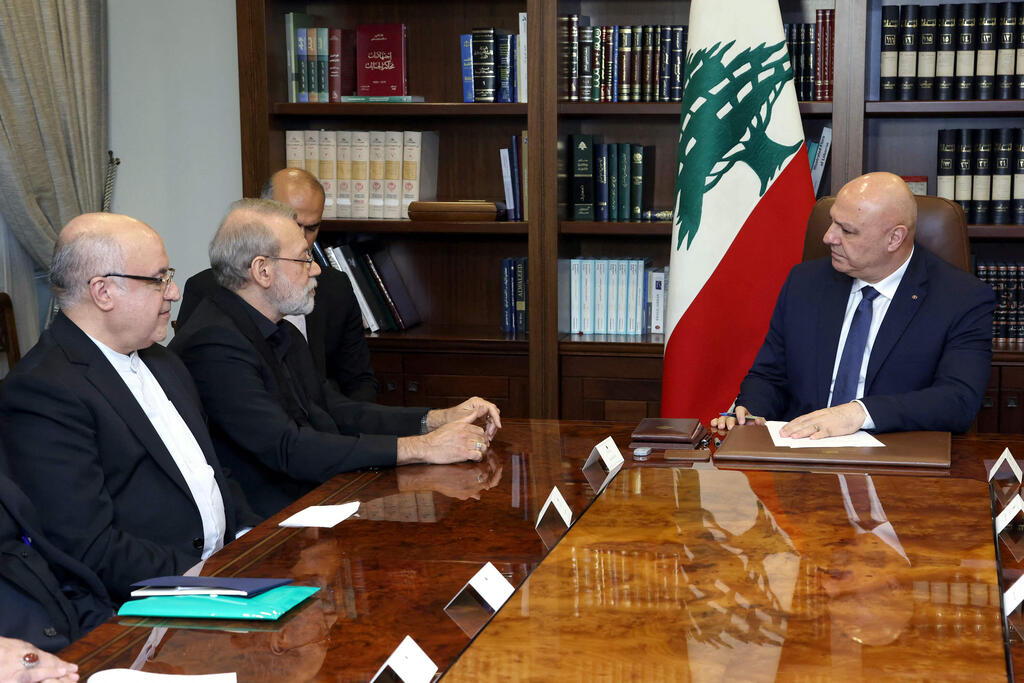
Lebanese President Joseph Aoun meeting with senior Iranian official Ali Larijani
(Photo: AFP PHOTO / LEBANESE PRESIDENCY / HANDOUT)
Last week, Iranian Foreign Minister Abbas Araghchi defended Hezbollah, saying the group’s battlefield success makes disarmament impossible. “They think after the last war in Lebanon, they can disarm Hezbollah but the positions of the group and its secretary-general remain strong,” he said.
Prime Minister Salam ordered the Lebanese army to develop a plan for exclusive state control of weapons by year's with cabinet review scheduled by August 31. The plan, backed by U.S. pressure, is linked to a ceasefire agreement with Israel that requires the army to enforce restrictions on Hezbollah south of the Litani River, raising questions about the group’s weapons north of the river.
Get the Ynetnews app on your smartphone: Google Play: https://bit.ly/4eJ37pE | Apple App Store: https://bit.ly/3ZL7iNv
Disarming Hezbollah would mark a historic shift. The group, the only armed faction to fight in Lebanon’s civil war 35 years ago, has never fully relinquished its weapons. Its decades-long military and political power has made public debate over disarmament sensitive. However, its weakening after last year’s conflict with Israel, including targeted strikes against senior leaders, has enabled Aoun, a former army chief, to pursue this initiative.
Aoun said all weapons must be under state control to restore international confidence. The U.S. has applied heavy pressure with envoy Thomas Barrack proposing a plan in June linking disarmament to continued ceasefire enforcement, Israeli withdrawal from strategic border positions and financial aid for Lebanon’s post-war reconstruction.