


Almost two years after the October 7 massacre: Britain, Canada, and Australia announced on Sunday afternoon their recognition of a Palestinian state.
British Prime Minister Keir Starmer mentioned the hostages in a video he released, calling Hamas a brutal terrorist organization, and adding: "This is not a reward for Hamas. Because Hamas will have no future, no role in the (Palestinian) government or no role in security. I have ordered sanctions to be imposed on more Hamas figures in the coming weeks." He added that "the hope for a two-state solution is fading - and that light must not be allowed to go out."
British Prime Minister Keir Starmer announces the UK's recognition of a Palestinian state


Canada's statement said that the country believed that a Palestinian state would be established in the future, but that the possibility had been eroded by Hamas and the Israeli government. The Canadian statement cited, among other things, the October 7 massacre carried out by Hamas - and the subsequent acceleration of settlement construction and the increase in violence against Palestinians; the construction plan in E1 and the vote in the Knesset to annex the West Bank; and "the Israeli government’s contribution to the humanitarian disaster in Gaza, including by impeding access to food and other essential humanitarian supplies."
Australia declared that, by recognizing a Palestinian state, it "recognizes the legitimate and long-standing aspirations of the Palestinian people for a state of their own," the statement said. Australia noted that the international community had set demands for the Palestinian Authority - including commitments from PA President Mahmoud Abbas to hold democratic elections and implement reforms. Australia also noted that Hamas has no place in a Palestinian state, and that further steps - such as opening embassies - would be considered as the Palestinian Authority met its commitments.

In July Starmer demanded that Israel agree to a cease-fire in Gaza, rule out any annexation in the West Bank, and commit to a long-term peace process leading to a two-state solution. Israel declined to give those assurances.
Estimates are that another nine to 11 countries will recognize a Palestinian state during the U.N. General Assembly this week. Those expected are France, Canada, Australia, Portugal, Belgium, Malta, San Marino, Andorra and Luxembourg. Two other countries are uncertain: New Zealand, which typically follows Australia’s lead, and Finland.
The countries expected to recognize a Palestinian state this week are not the first to do so — they would join 148 states that have already recognized Palestine over the years — a move that historically has not changed the situation on the ground. What is different this time is that three G7 powers would be among them: France, Britain and Canada. That is a major diplomatic gain for the Palestinians. On the other hand four G7 members are not expected to recognize: the United States, Japan, Germany and Italy — a notable diplomatic win for Israel.
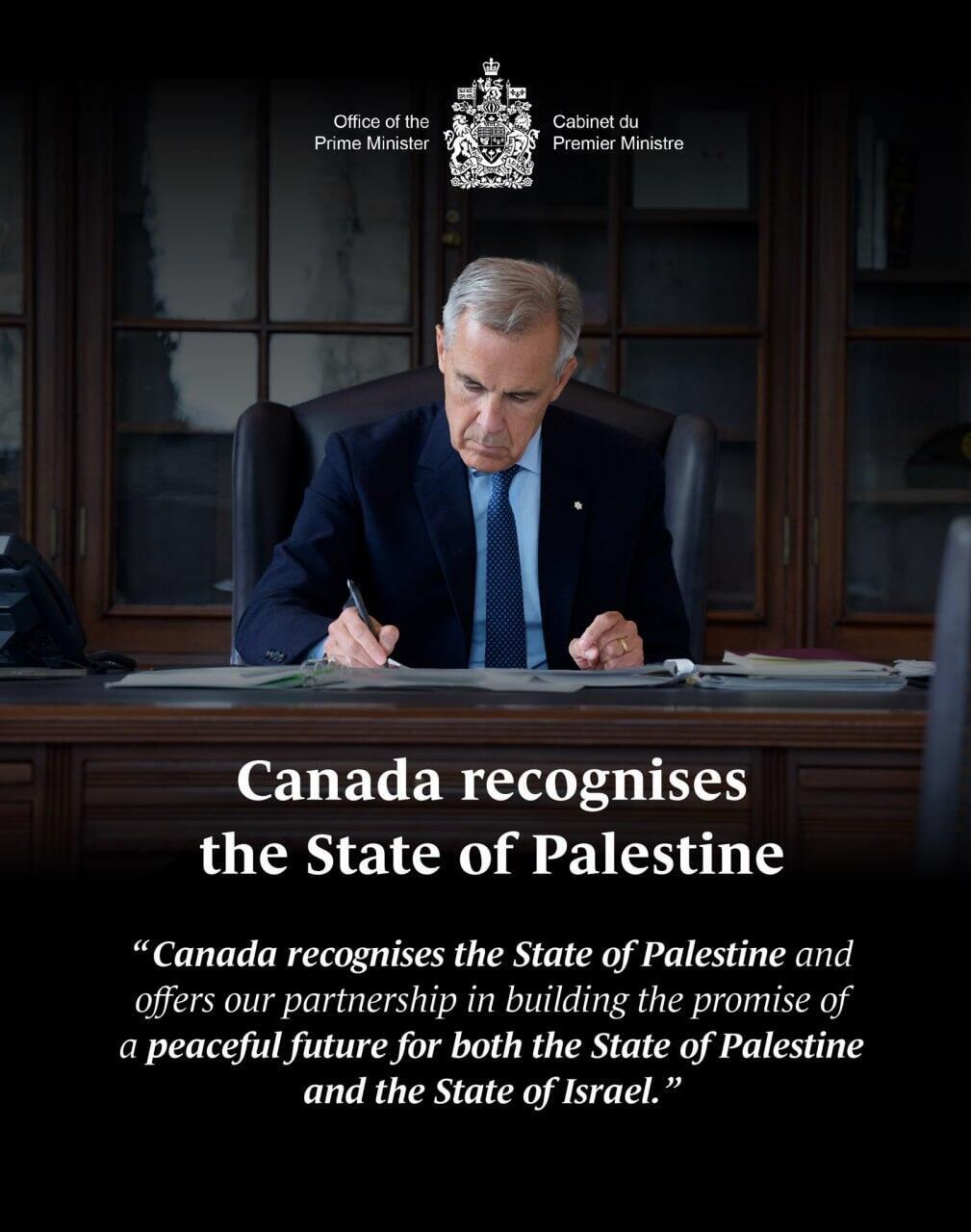
Prime Minister Mark Carney announcve's Canada's recognition of a Palestinian state
British recognition may not be popular at home. A Telegraph poll found nearly nine in 10 Britons oppose Prime Minister Keir Starmer’s planned recognition of a Palestinian state. Only 13% of Britons support unconditional recognition now, as Starmer plans, and that figure falls to 11% among his own Labour voters. A majority — 51% — oppose recognition while Hamas still controls Gaza and hostages have not been released.