


Israel is closely watching the unfolding protests in Iran, with experts on Iranian affairs saying, “If there was ever a real chance for the Iranian people to topple the regime, it’s now.”
According to analysts, the current wave of unrest is exceptional in its scale, geographic spread and the degree to which fear of authorities has been overcome.
Protests across Iran


For the first time, demonstrators also appear to have a leader: exiled Crown Prince Reza Pahlavi, who is directing messages daily from abroad. Unlike previous rounds of unrest, such as the 2022 Mahsa Amini protests sparked by modesty laws, the current demonstrations are openly calling for regime change and the restoration of the monarchy.
Over a million people are believed to have taken part in the protests so far, which appear to be more organized and show signs of coordination among participants challenging the regime.
A senior Israeli official familiar with developments in Iran said he had never seen such widespread and determined calls for the return of the monarchy, coming not only from major cities, including religious strongholds like Mashhad and Qom, but also from small, lesser-known towns. While the regime remains brutally repressive and indifferent to civilian lives, Israeli experts are more encouraged and optimistic than ever.
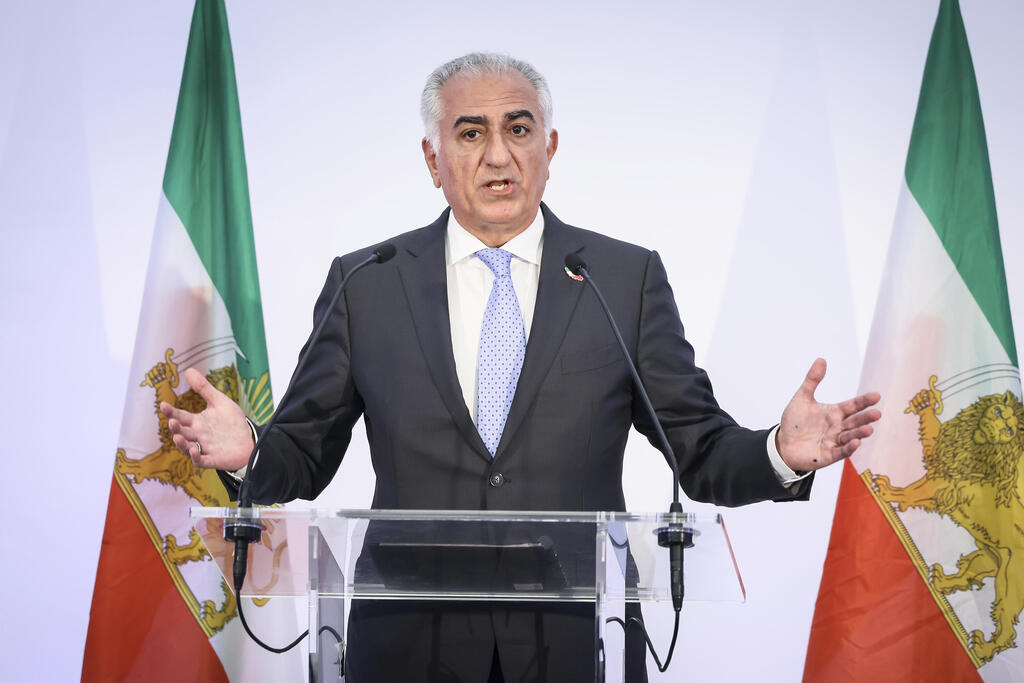
Protesters have also received encouragement from figures such as U.S. President Donald Trump and Elon Musk, whose platform X changed the Iran flag emoji to the pre-1979 monarchist version featuring the Lion and Sun emblem.
The growing intensity of the protests was underscored by the Iranian regime’s complete internet blackout starting Thursday evening, which continued through Friday and Saturday. The regime has previously used this tactic during major demonstrations, often enabling the regime to carry out violent crackdowns shielded from public view. Reports also indicate a disruption of phone lines.
Despite these efforts to silence communications, footage has surfaced in the West showing protesters setting fire to regime symbols, including the Iranian state broadcasting building in Isfahan.
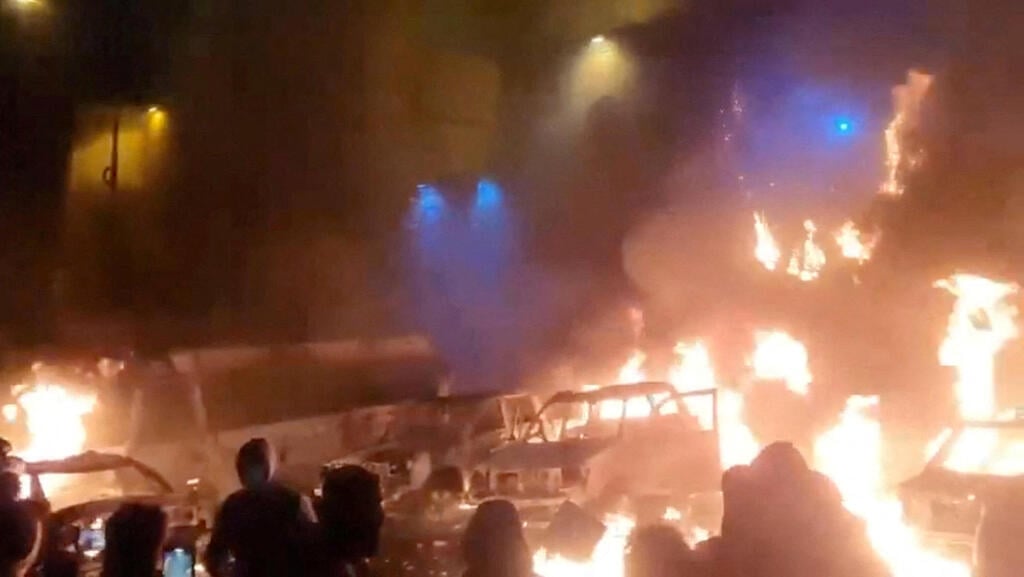
Protests in Tehran
(Photo: Social Media/via REUTERS)
Observers note that, as in past uprisings, the full extent of the violence and repression is likely to emerge only after internet restrictions are lifted.
Western governments fear that the shutdown of internet and phone services is a recipe for mass killings carried out under the cover of darkness. Indeed, reports from Tehran spoke of dozens of people killed in the city.
An Iranian who managed to communicate with The Guardian despite the internet blackout, using text messages sent via Starlink, told the British newspaper: “We’re standing up for a revolution, but we need help. Snipers have been stationed behind the Tajrish Arg area,” an affluent neighborhood in Tehran. He said he had seen “hundreds of bodies” across the city of people shot by security forces. The Guardian, which stressed it could not independently verify the claims, added that another activist in Tehran said he had witnessed a “very high number” of people killed by live fire from security forces.
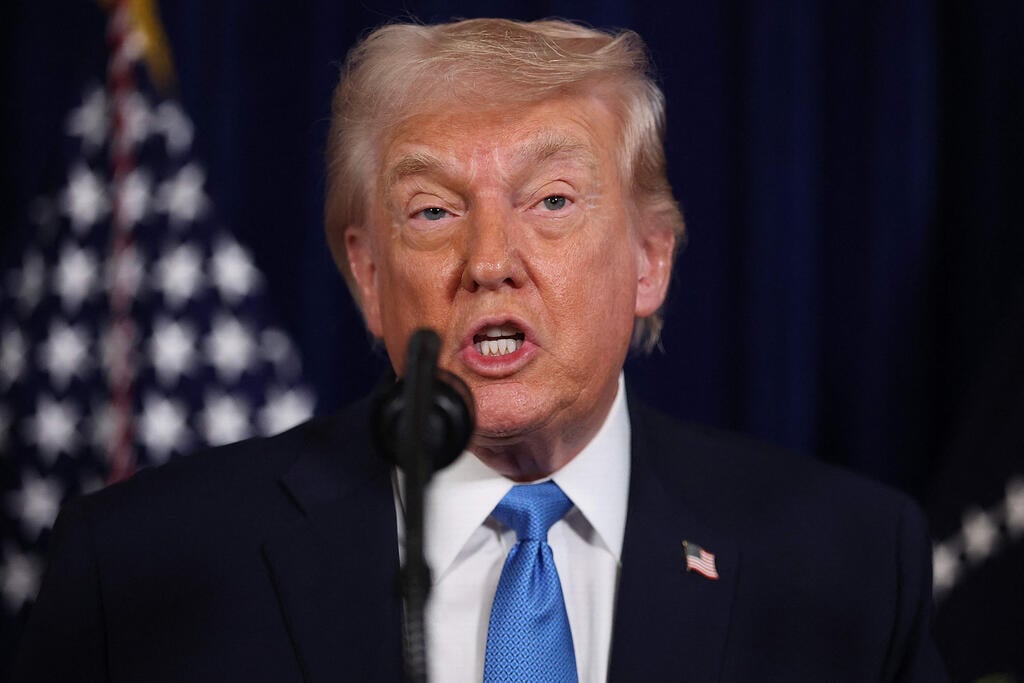
Donald Trump
(Photo: JOE RAEDLE / GETTY IMAGES NORTH AMERICA / AFP)
The internet shutdown is intended to prevent videos documenting massacres from reaching the West, particularly to avoid angering Donald Trump, who has warned that Iran would pay a heavy price if it harms protesters. Protesters’ eyes, as well as those of Western governments, are fixed on Trump. There is growing speculation over whether the U.S. president will stand by his promise to protect demonstrators, but what is clear is that his warnings have rattled Iran’s clerical leadership.
Israeli officials assess that the unrest in Iran and its expansion pose a serious threat to the regime’s stability. The greater the regime’s fear for its survival, the higher the risk of miscalculation, prompting Israel to exercise extreme caution in public statements.
Meanwhile, amid the possibility of another future confrontation between Israel and Iran, many Israelis over the past day received threatening SMS messages in broken English reading, “We are coming. Look at the sky in the midnight.”

Text message sent en masse to Israeli phones
The National Cyber Directorate said the messages were part of an “unidentified” influence campaign and not the result of any device hacking, but rather mass-distributed spam. The public was instructed to ignore the messages, block the sending number and refrain from forwarding them.
Iran’s judiciary chief warned that anyone participating in the unrest would face the death penalty, while Iran’s Supreme National Security Council said security forces and the judiciary would show zero tolerance toward rioters. The council claimed the protests were orchestrated by Israel and the United States.
According to reports, the Islamic Revolutionary Guard Corps is expected to begin taking charge of suppressing the demonstrations, a step seen as an escalation, given that until now the primary forces involved were internal security units, assisted by the Basij militia.
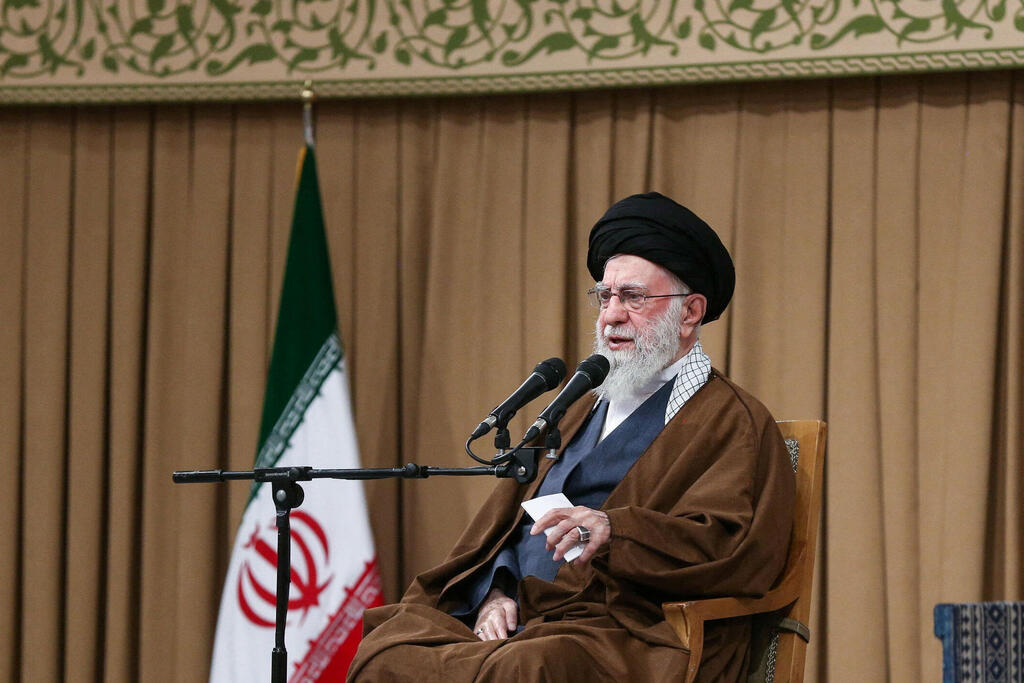
Iranian Supreme Leader Ayatollah Ali Khamenei
(Photo: KHAMENEI.IR / AFP, West Asia News Agency)/Handout via REUTERS)
Supreme Leader Ayatollah Ali Khamenei addressed the protests in a speech in Tehran, saying a group of “saboteurs” had destroyed a building to please the U.S. president. “We will not surrender to saboteurs and will not retreat in the face of vandalism,” Khamenei said. “The youth must maintain readiness and unity, and together we will defeat the enemy.”
He also took a swipe at Trump, saying that if the U.S. president is capable, he should first try to run his own country, adding that he hopes Trump will be removed from office.
“There is no doubt this is a dramatic and highly violent event, including in major cities, especially Tehran, which in my view poses the most serious threat to the regime’s stability since the 1979 revolution," said Raz Zimmt, an Iran expert at the Institute for National Security Studies. "There’s no longer much point in estimating the number of protesters or the scope of the protest centers, but it’s clear this is an exceptionally broad movement.”
“Two of the conditions we’ve previously identified as necessary for the emergence of a meaningful revolutionary moment, mass participation and the involvement of diverse sectors, are already partially present,” Zimmt explained. “What still appears to be missing is significant participation from key economic sectors, such as oil industry workers. It’s also worth noting the lack of organization and leadership within the protest movement, though that is less critical at this stage and more relevant later, when a governing alternative must be formed.”
“The third condition, and in my view the most crucial right now, concerns the behavior of the regime’s enforcement and suppression mechanisms, particularly any signs of fractures or dysfunction within them, such as defections, operational fatigue or reluctance to carry out repression. So far, we’ve seen no indication of that. The political elite also continues to present a united front, at least outwardly (it’s unclear what’s happening behind closed doors, for example, in the Supreme National Security Council).”
Zimmt said the current situation could best be described as a “prolonged revolutionary moment,” one that may continue for months and develop along several key paths:
Effective suppression by the regime, followed by a return to a kind of “emergency routine,” with sporadic protests or a lull until the next wave. This is currently the regime’s preferred outcome, though ironically it could lead to further escalation or provoke Trump to act on his threats of intervention.
Escalating and expanding protests, combined with emerging cracks in the repression apparatus, potentially posing a serious threat to regime stability, and ultimately, leading to its collapse.
Recognition by Iran’s leadership or parts of it that the unrest is uncontainable, leading to one of two scenarios: a takeover by elements within the political-military elite, possibly involving the forced or voluntary removal of the supreme leader and the establishment of a military-led government (temporary or permanent, depending on circumstances); or a dramatic policy reversal, such as agreeing to U.S. demands in exchange for a deal and lifting of sanctions. However, Zimmt considers this second outcome of scenario 3 unlikely as long as Khamenei remains in power.
“In any case,” he concluded, “even the third option, in either form, offers no guarantee of stability, at least not in the short term.”