

“Israel Is the largest American aircraft carrier that cannot be sunk” (Alexander Haig, secretary of state under President Ronald Reagan)
Americans are even more enthusiastic about military capabilities than Israelis. For many in the United States, the country’s most important superiority is not economic or scientific, but military. The U.S. defense budget for 2026 stands at $1.01 trillion, about 40% of total global military spending (according to globalfirepower.com) and more than the combined military budgets of the next 10 countries.
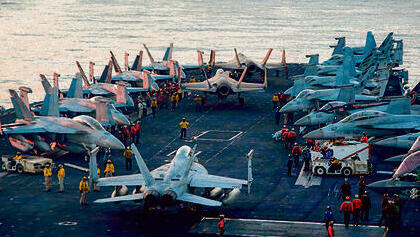
By comparison, China, in second place, spends about $303 billion; and Russia, in third, about $212 billion. Iran ranks 36th, with just over $9 billion. Donald Trump has already announced that he wants to raise the budget to $1.5 trillion next year—and somehow the United States still finds itself worried that its stockpile of interceptor missiles may not be sufficient for a prolonged war against Iran.
All of this is happening even though no military rival can truly challenge the United States. Some of that money could have been redirected to ease the daily lives of “Joe the Plumber,” yet American citizens themselves are not demanding it.
From the Tomahawk missiles that filled television screens during the Gulf War in the 1990s, to B-2 bombers and the MOAB—the “Mother of All Bombs” used in Afghanistan—everything looks like a movie that justifies a bucket of popcorn. And above all, Americans love aircraft carriers.
It is no coincidence that so many American films feature footage of aircraft carriers. They are enormous, spectacular; modern fighter jets roar overhead while the blue ocean surrounds them. When President George W. Bush decided to announce to America that “the mission is accomplished” in Iraq, he landed in a pilot’s suit on the aircraft carrier USS Abraham Lincoln.
The speech beneath the “Mission Accomplished” banner—remembered as a historic embarrassment—was delivered on May 1, 2003. Afterward, about 3,400 more American soldiers were killed in Iraq before the official end of the war in 2011. Since then, American politicians have learned not to give speeches on aircraft carriers, because whatever is said atop that enormous and “cool” military platform remains in memory forever.
Master of landings
The U.S. Navy has 11 nuclear-powered aircraft carriers in active service—more than the navies of China, Britain, India, France, Italy and Spain combined. However, only about half are deployed at any given time; the rest are in port or undergoing maintenance.
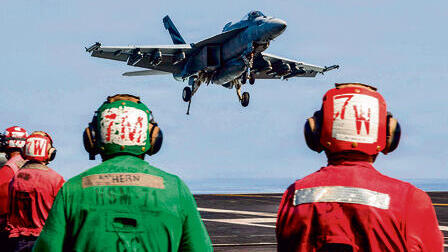
(Photo: AFP)
Admiral Samuel J. Paparo, commander of the U.S. Indo-Pacific Command, who has logged more than 1,000 carrier landings, explained:
“Aircraft carriers are essential combat platforms. They allow the projection of air power around the world without the limitations of basing rights or geopolitical borders. They can be positioned anywhere in international waters, enabling rapid response without the support of a host nation. Unlike fixed airfields, which are always vulnerable and require significant protection, aircraft carriers can maneuver across the oceans, making them challenging targets. That is why America’s adversaries work so hard to try to strike them.”
Gerald Ford was a gray, unremarkable president who never won an election. He served two and a half years after Richard Nixon resigned because of Watergate. In 1976 Ford lost to Jimmy Carter, partly because he had pardoned Nixon.
Still, Ford’s name is now attached to the most expensive military platform ever built. In the eyes of the Bush administration—which bestowed the name in 2007—Ford’s service in the Navy during World War II overshadowed the dullness of his later political career.
The first-generation Nimitz-class carriers cost about $4.5 billion each. The Gerald R. Ford cost about $18 billion.
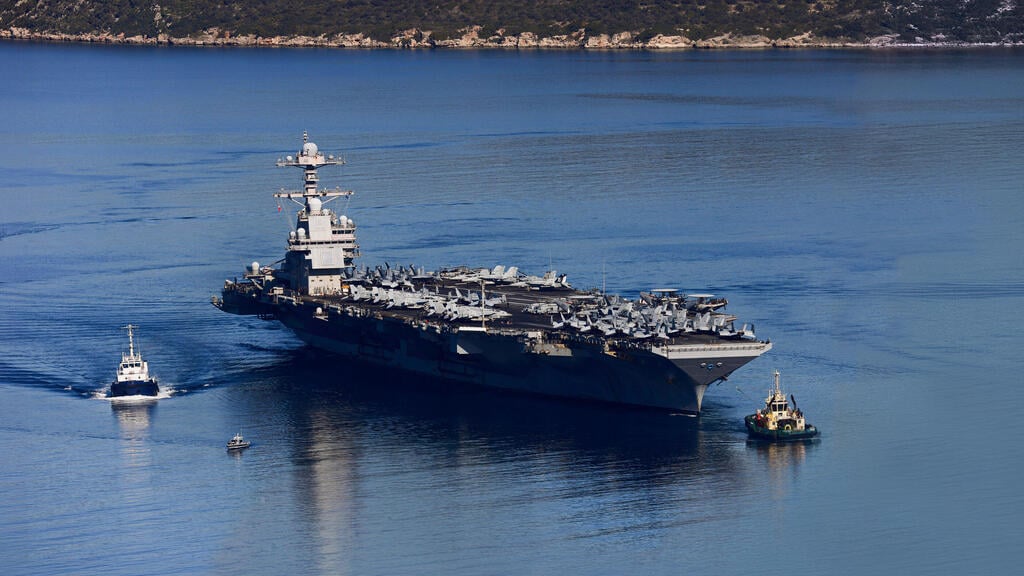
The USS Gerald R. Ford: Unlike the Lincoln, the Ford has not yet been upgraded to allow it to carry F-35 stealth fighters
(Photo: Giannis Angelakis/AP)
It carries about 4,500 personnel and 75–90 aircraft. It can launch 160 sorties per day under normal conditions and surge to 270 sorties. Onboard is a full hospital—operating room, intensive care unit, pharmacy, and laboratory—with 11 doctors and 30 medics.
It can sail 90 days without refueling or resupply, at speeds exceeding 30 knots (about 56 km/h).
The Ford operates with all its identification systems turned off, making it invisible to civilian tracking websites. It measures 337 meters long, with a 78-meter flight deck, making it the largest warship ever built.
Apparently, however, not enough money remained to build a plumbing system capable of withstanding the assault of 4,500 sailors after meals. The solution: periodic acid flushes costing about $400,000 each time.
When the Ford was commissioned in 2017, Trump declared: “This will be an extraordinary addition to the fleet. There’s nothing like it anywhere in the world. It represents the future of naval aviation.”
Its first combat deployment came in 2023, shortly before October 7. Immediately afterward it was sent to the Middle East, where it remained for eight months, helping provide defensive coverage and missile interceptions for Israel while launching aircraft for U.S. strikes against Iranian proxy groups and the Houthis in Yemen.
Last October it was sent to the Caribbean, in the middle of a planned six-month deployment to Europe, when the Trump administration threatened war with Venezuela. And last month the Pentagon again dispatched the ship to the Middle East, as part of a massive naval buildup in the Mediterranean and Arabian Sea ahead of the war with Iran.
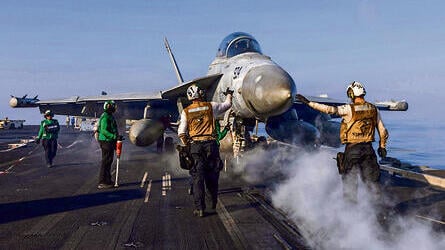
(Photo: US Navy, via REUTERS)
The U.S. Navy typically schedules six-month deployments and tries to avoid leaving ships at sea longer than seven months. Yet the Ford is now entering its ninth month of its current deployment. Crew members told The New York Times that morale on board dropped when the deployment was first extended—and fell even further when orders came to return to the Middle East.
Although the Ford is the most advanced carrier, it is actually the older USS Abraham Lincoln that is doing most of the work in the current war.
Commissioned in 1989, the Lincoln belongs to the older Nimitz class. It carries about 5,680 personnel and is currently operating in the Arabian Sea south of Iran.
The U.S. Central Command (CENTCOM) released footage showing F-18F and F-35F fighter jets taking off and landing from the Lincoln, which has been upgraded to carry the newer stealth aircraft. Ironically, the Ford, whose construction was completed before the F-35 design was finalized, has not yet undergone the upgrades needed to host them.
Last weekend Iranian officials claimed they had successfully launched four ballistic missiles that directly struck the Lincoln. The Americans quickly denied the claim. CENTCOM wrote on Twitter: “The Lincoln was not hit. The missiles launched did not even come close.”
From Noah’s Ark to the Enterprise
In 1910, a daring pilot named Eugene Burton Ely tied a bicycle wheel to his chest as a flotation device and took off in a plane called the Pusher from a temporary deck built on the bow of the U.S. warship Birmingham. Somehow he managed to land on shore after a flight of less than five kilometers.
A year later Ely landed on the ship Pennsylvania in San Francisco Bay. Twenty-two ropes with sandbags were stretched across the deck, forming the first aircraft arresting system in history.
The ship’s captain described Ely’s feat as: “The most important landing of a bird since the dove returned to Noah’s Ark.”
Two days before his 25th birthday, Ely crashed during an air show in Georgia. Spectators rushed the wreckage and took whatever they could—including his gloves and tie.
To this day, every F-18F that lands on a carrier is stopped by the same brilliant principle Ely pioneered: a metal hook catching cables stretched across the deck.
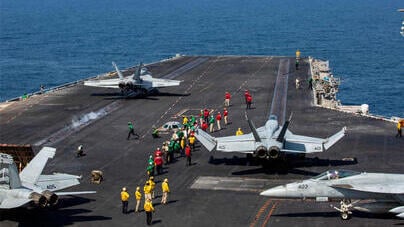
(Photo: US Navy, via Reuters)
That invention has not fundamentally changed in 115 years, though aircraft carriers themselves have evolved dramatically—culminating in the modern form represented by the Gerald Ford.
Yet in recent years the efficiency of the American carrier production line has declined.
During a congressional hearing last year, Navy leaders warned that delays in construction, growing external threats, and insufficient budgets are undermining American dominance—precisely as China is advancing at sea.
The new USS John F. Kennedy was supposed to enter service in July 2025, but only a few weeks ago began its first sea trials. Delivery to the Navy is now planned for March 2027, and its cost has risen from $11.3 billion in 2018 to $13.2 billion.
Meanwhile, the USS Nimitz, the oldest carrier, will retire this coming May. For nearly a year the U.S. Navy will have 10 carriers instead of 11.
The USS Enterprise, the first carrier in 60 years not named after a person, is also severely delayed and will not join the fleet before 2030.
Another concern raised by commanders is complacency about the supposed invulnerability of aircraft carriers.
Since World War II, no aircraft carrier has been sunk in real combat. But current debate within military circles asks whether modern technologies—such as the anti-ship ballistic missiles China possesses—could once again make carriers vulnerable.
In the 1960s, the Soviet Union concluded that large aircraft carriers had no place in the nuclear age, partly because of their vulnerability to nuclear-armed missiles. Later the Russians built larger carriers—but never with the same enthusiasm as the Americans.
Admiral Paparo wrote: “China’s fourth- and fifth-generation aircraft and long-range weapons deeply challenge America’s ability. We face an increasingly chaotic and messy world. The United States must maintain naval superiority to achieve superiority on land.”
Former Navy commander John Patch warned: “Analysts tend to ignore or minimize the vulnerability of aircraft carriers. Because they symbolize American global power and prestige, they are prime targets for both unconventional and conventional adversaries. The sudden and unexpected loss of an aircraft carrier would shock both the military establishment and the American psyche—perhaps the military equivalent of the collapse of the Twin Towers on September 11.”
War and peace
Americans like to surround aircraft carriers with the aura of a guardian angel that saves the world and promotes peace rather than war.
Most of the time this sounds ridiculous—but there are examples.
Admiral Paparo wrote: “An aircraft carrier with 5,000 sailors of goodwill has enormous value in strengthening ties between people. Their speed and capacity allow them to respond effectively to humanitarian crises. In December 2004, when an earthquake and tsunami devastated parts of Indonesia and other Indian Ocean countries, the crew of the Abraham Lincoln was the first force to arrive and provide aid. In 2011, when an earthquake and tsunami struck Japan and caused the Fukushima nuclear disaster, the Ronald Reagan served as a floating base for relief supplies and refueled Japanese helicopters for weeks.”
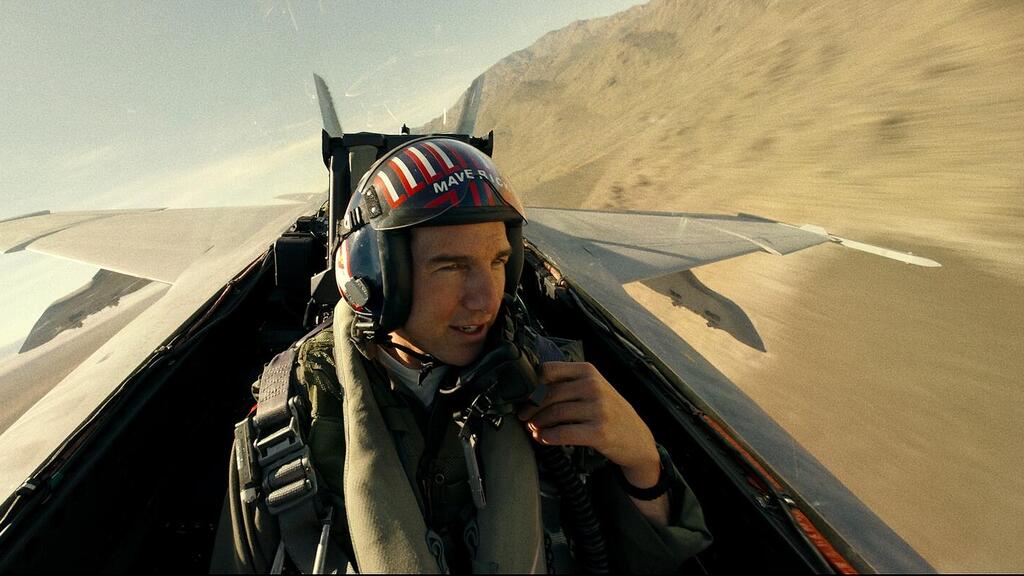
Photo: From 'Top Gun: Maverick'
Of course, Hollywood loves aircraft carriers the most. Dozens of films have been shot around these massive vessels.
“Top Gun: Maverick” (2022) is perhaps the most famous recent example and was filmed partly aboard the USS Theodore Roosevelt and USS Abraham Lincoln.
The U.S. military was happy to cooperate with a piece of propaganda that was also an exciting movie. But when director Joseph Kosinski captured something on a private camera that he was not supposed to film, the camera was immediately confiscated.
On the other hand, officers aboard the carrier that served as a movie set were surely amused when the fictional Darkstar aircraft built for the film looked so realistic that China moved spy satellites in order to photograph it.
First published: 15:48, 03.09.26