

Iranian Foreign Minister Abbas Araqchi laid out Iran’s demands and objections to U.S. positions Saturday before leaving Pakistan with his delegation, as Islamabad pushed to end a war with direct consequences for Israel and the wider region.
Araqchi met Pakistani Prime Minister Shehbaz Sharif and other senior officials in Islamabad before his delegation flew out of the capital with a military jet escort, Pakistani government sources said. It was not immediately clear whether Araqchi would return to Pakistan.
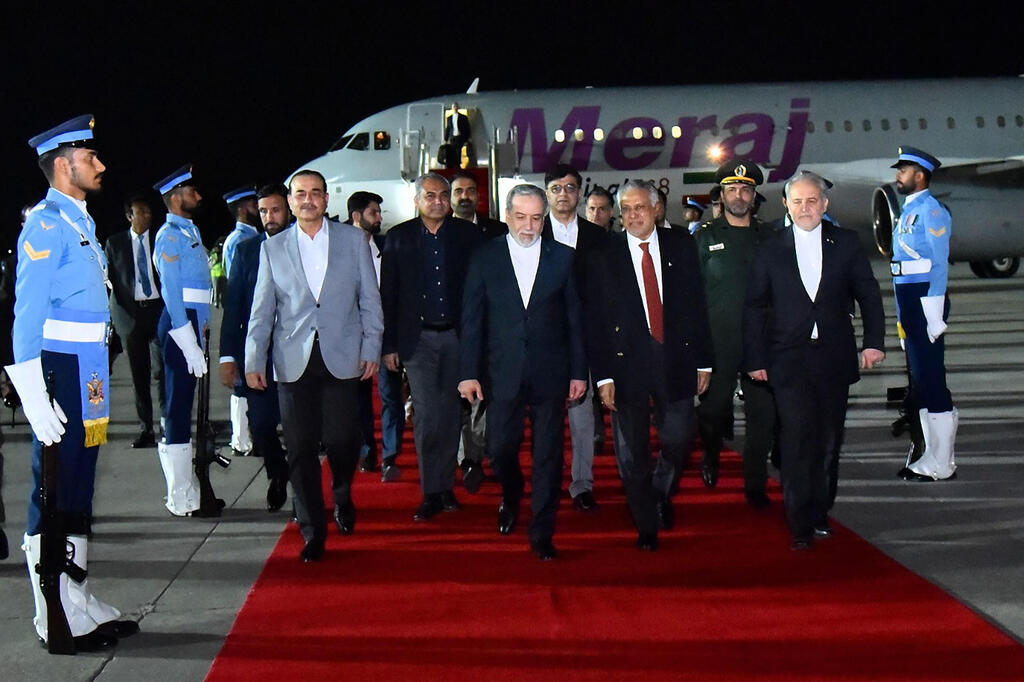
(Photo: AFP PHOTO /Pakistan's Prime Minister Office)
The White House had said President Donald Trump’s special envoy Steve Witkoff and son-in-law Jared Kushner would travel to Islamabad on Saturday. Iran has ruled out direct talks with U.S. representatives, saying its concerns would be conveyed through Pakistan.
Araqchi said he presented Iran’s “principled positions” on the ceasefire and on ending what Tehran calls the imposed war against it. An Iranian diplomatic source said Iran would not accept “maximalist demands.”
Washington and Tehran remain at an impasse. Iran has largely closed the Strait of Hormuz, which normally carries about one-fifth of global oil and liquefied natural gas shipments, while the U.S. continues to block Iran’s oil exports.
U.S. Defense Secretary Pete Hegseth said Iran still had a chance to reach a deal, saying Tehran must abandon any nuclear weapon effort in “meaningful and verifiable ways.”
Trump said Friday that Iran planned to make an offer aimed at satisfying U.S. demands, though he said he did not know its details. White House press secretary Karoline Leavitt said Washington had seen progress from Iran in recent days and hoped for more.
Days after Trump extended the ceasefire, international flights resumed Saturday from Tehran’s Imam Khomeini International Airport, Iranian media reported. Passengers departed for Medina, Muscat and Istanbul, with operations expected to expand.
Iranian airspace had been largely closed since the start of the war, forcing tens of thousands of flights to be canceled, rerouted or rescheduled across the region.
Oil prices surged this week, with Brent crude up 16%, amid uncertainty over the talks and renewed violence. Shipping data showed only five ships crossed the Strait of Hormuz in the previous 24 hours, compared with about 130 a day before the war.
Iranian state media said Tehran was in “firm control” of the strait, while Iran’s top military command said it would respond if U.S. forces continued what it called a “blockade and piracy” in the region.