

Israel faces the prospect of another election after updated exit polls early Wednesday showed neither Prime Minister Benjamin Netanyahu nor his main rival Gadi Eisenkot with a clear path to a parliamentary majority, leaving the country confronting a prolonged political deadlock.
The projections, including overnight revisions, reinforced what had become increasingly apparent during the election campaign: Neither political bloc appears capable of securing the 61 seats needed to control the 120-member Knesset.
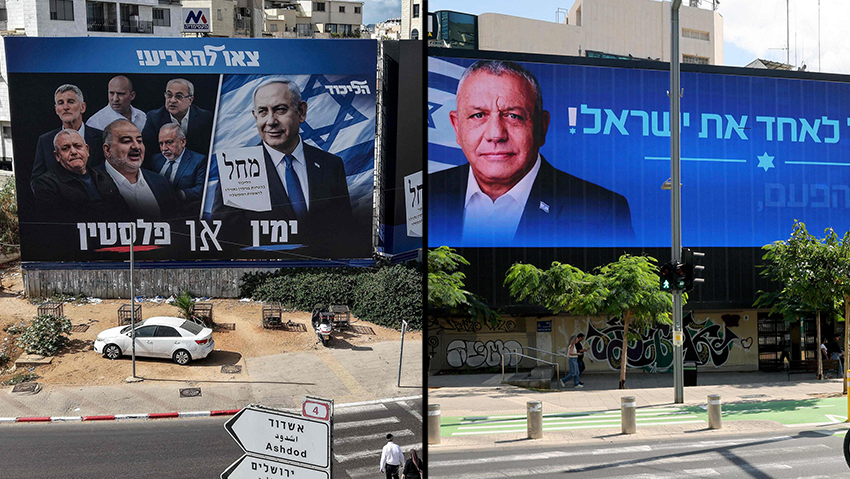
Likud and Yashar! campaign billboards
(Photo: Jack GUEZ / AFP)
Several scenarios remain possible, including another election, a national unity government, a Netanyahu-led coalition supported by defectors from the opposition and a minority government headed by Eisenkot.
But the possibility of an Eisenkot minority government, which appeared viable when the first exit polls were released at 10 p.m. Tuesday, has diminished significantly following overnight updates. One revised projection showed Netanyahu's bloc holding a substantial advantage over the opposition.
The unexpectedly strong showing by Arab parties has complicated coalition calculations for both sides, leaving neither Netanyahu nor Eisenkot with an apparent path to a majority without their involvement or support.
Scenario 1: Another election
A return to the polls may be the most likely outcome, although it could also be the most damaging for Israel, particularly as the country continues to face security tensions on several fronts.
The large number of seats projected for Arab parties has left both major political blocs struggling to assemble a governing majority without cooperating with them — a prospect that several party leaders have publicly rejected.
President Isaac Herzog could attempt to broker a compromise to prevent another election, potentially with assistance from political figures and international actors.
Under Israel's parliamentary system, the president consults with party representatives after an election and assigns a lawmaker the task of forming a government, generally choosing the candidate considered most capable of securing parliamentary support.
If those efforts fail, Israel could face another election, with Netanyahu remaining in office as caretaker prime minister until a new government is formed.
That would give Netanyahu a significant advantage by allowing him to retain the premiership despite the absence of a new parliamentary majority.
Some figures in the opposition's pro-change bloc also fear that Netanyahu could seek to escalate security tensions to complicate efforts to replace him or pressure rival parties into joining an emergency government.
Those concerns reflect the opposition's suspicions rather than any established plan by Netanyahu.
Scenario 2: A national unity government led by Netanyahu
A unity government headed by Netanyahu remains possible, but only if several political leaders abandon explicit campaign promises.
In his election-night address, Netanyahu gave no indication that he intended to break with his existing right-wing coalition partners. He did not directly appeal to leaders of the opposition bloc or explicitly propose a unity government.
Instead, he declared that "the Zionist majority must come to its senses and unite," without outlining how such an arrangement might work.
Eisenkot, who was introduced as "the next prime minister" during his own election-night speech, appeared equally unwilling to compromise.
"A worthy leader would resign that very day," Eisenkot said, referring to Netanyahu and the Hamas-led Oct. 7, 2023, attack on southern Israel.
Eisenkot has repeatedly promised that he would not serve in a government with Netanyahu under any circumstances, even declaring that he would resign the following day if he ever agreed to serve under him.
Former prime minister Naftali Bennett, leader of the Beyachad party, and Avigdor Liberman, chairman of the nationalist Yisrael Beytenu party, have also ruled out joining a Netanyahu-led government.
The updated exit polls, which show Likud and Netanyahu's bloc performing more strongly than initially projected, could further complicate negotiations.
With Likud emerging as the largest party, Netanyahu would be unlikely to relinquish the first term as prime minister under any proposed power-sharing rotation agreement, assuming he agreed to such an arrangement at all.
That leaves a unity government theoretically possible but politically difficult to achieve.
Scenario 3: Netanyahu forms a government with opposition defectors
Netanyahu could also attempt to form a government by persuading lawmakers from the pro-change bloc to defect and join his coalition.
But the updated projections suggest he remains well short of the 61-seat threshold.
Rather than needing one or two opposition lawmakers to cross the aisle, Netanyahu would have to attract a substantial group of defectors to secure a majority.
That would be a considerably more difficult political undertaking, particularly after a campaign in which opposition leaders made replacing Netanyahu a central objective.
The Likud leader could nevertheless seek the presidential mandate to form a government as a tactical move, even if his prospects of assembling a viable coalition remain slim.
Receiving the mandate would give Netanyahu an opportunity to negotiate with potential partners, but it would not guarantee that he could form a government.
Scenario 4: An Eisenkot minority government
An Eisenkot-led minority government initially appeared possible after the first exit polls were released at 10 p.m., when the pro-change bloc seemed poised to emerge as the largest parliamentary grouping.
Under that scenario, Eisenkot could have secured more recommendations from lawmakers than Netanyahu, potentially persuading Herzog to give him the first opportunity to form a government.
Minutes after the initial projections were released, Eisenkot announced that he intended to begin working immediately to establish a government, arguing that his bloc had emerged as the largest.
Such a government would likely have required parliamentary support from Arab parties without necessarily including them as formal coalition partners.
But Liberman, who ruled out a minority government during the campaign, offered no indication in his election-night speech that he was reconsidering his position.
He also declined to answer whether he would cooperate with Ra'am, the Arab Islamist party led by Mansour Abbas.
Liberman instead called for a revolt against Netanyahu, whom he described as "the head of a criminal organization."
The overnight exit poll revisions have made an Eisenkot minority government even less likely, with the pro-change bloc no longer appearing to command enough support to establish a government, even if potential defectors were to join it.
Scenario 5: Replacing Netanyahu's caretaker government
Another possibility would involve replacing Netanyahu's caretaker administration with a temporary government headed by Eisenkot, allowing the opposition to pursue a limited legislative agenda even without a stable long-term coalition.
Such an arrangement could enable the new parliamentary majority to replace Knesset Speaker Amir Ohana, a Netanyahu ally, and establish a state commission of inquiry into the Oct. 7 attack.
A state commission of inquiry, an independent investigative body with broad powers to summon witnesses and examine government conduct, has been a major demand of Netanyahu's critics.
The arrangement could also allow the opposition to pursue other parliamentary measures while attempting to negotiate a more permanent governing coalition.
But this scenario, too, has become increasingly remote following the overnight revisions to the exit polls.
With Netanyahu's bloc performing more strongly than initially expected and Arab parties holding a substantial share of parliamentary seats, the opposition appears to lack the numbers needed to carry out such a transition.
For now, the projections point to a fragmented Knesset in which neither major bloc can govern alone, leaving Israel's political future dependent on difficult coalition negotiations, possible reversals of campaign pledges or another election.
The final distribution of seats will not be known until the official vote count is completed.