

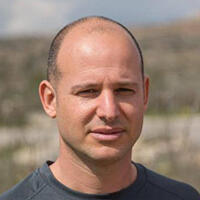
“We are at a historic moment, reshaping the entire Middle East for years to come. From the very first moment, the reserve force has fought shoulder to shoulder with the standing army, carrying out the same missions, and it continues to do so,” said Brig. Gen. Benny Ben Ari, the IDF’s chief reserve officer, nearly three years after Oct. 7, which dramatically expanded the reserve force and transformed it from a supporting element into a central fighting force.
The numerical growth of the reserve force has been significant. Exact figures are barred from publication due to military censorship restrictions, but since Oct. 7 the force has grown by more than 130,000 reservists — combat troops and combat support personnel.
Gallery
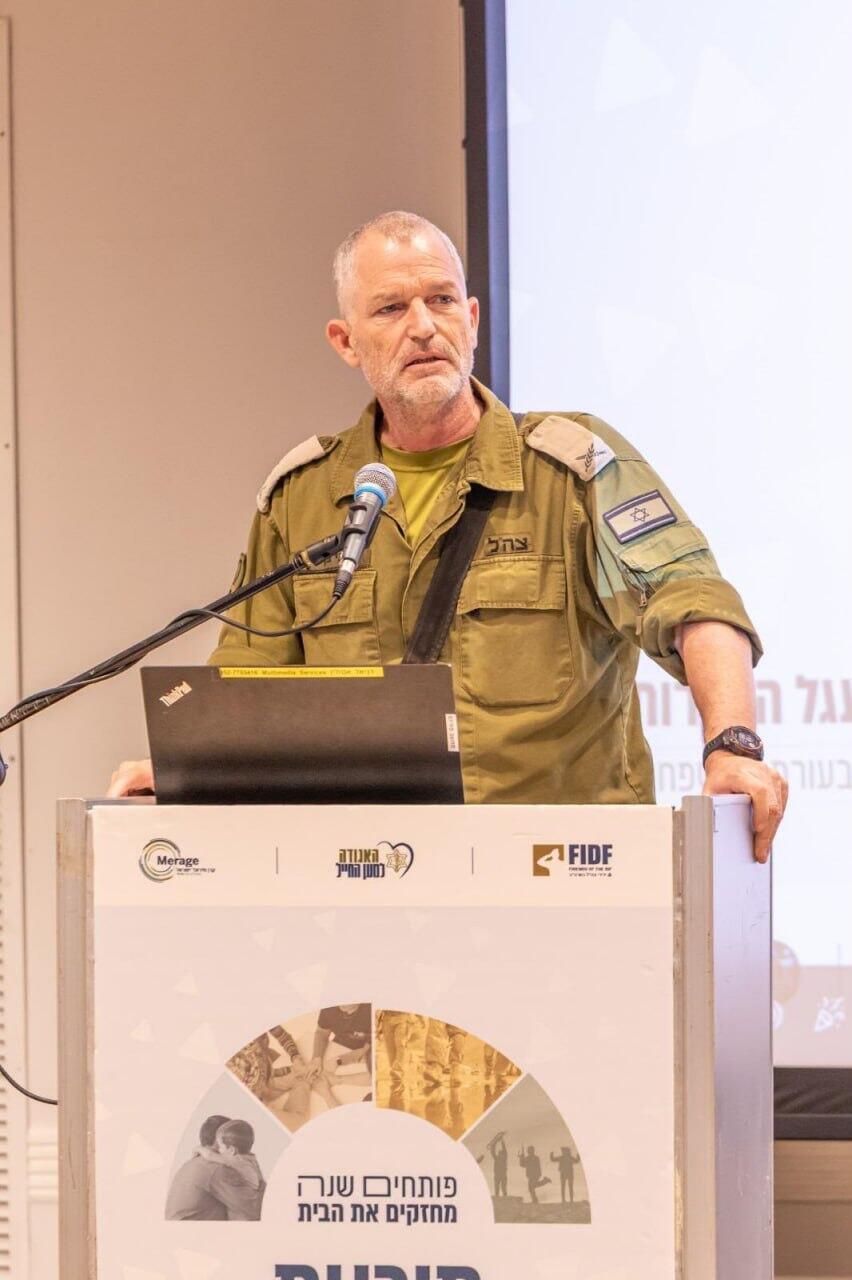
'Turn reserve service into a national status.' Brig. Gen. Benny Ben Ari
(Photo: IDF Spokesperson’s Unit)
“We understand that we are not going back to Oct. 6, so we are building the reserve force differently,” Ben Ari said. “Reservists used to serve 20 days once every three years.”
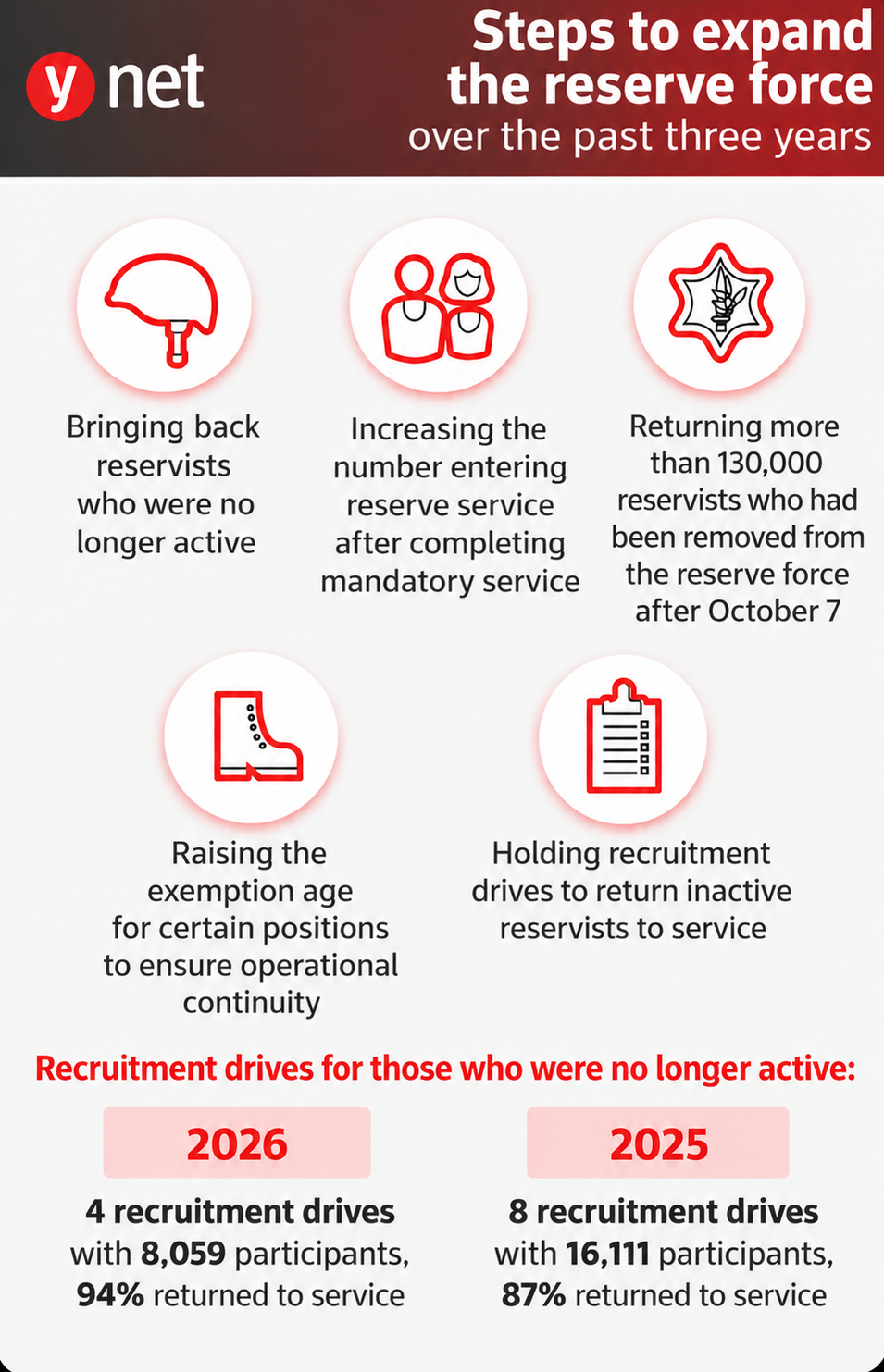
The IDF has taken a number of steps over the past three years to increase the number of reservists as much as possible and contend with the enormous strain involved in serving hundreds of reserve duty days a year. Among other measures, it expanded the number of personnel entering the reserves after completing mandatory service, brought inactive reservists back into service, raised the exemption age for certain positions to maintain operational continuity and issued a special call-up order allowing tens of thousands of people who had previously been removed from the reserve force to return to service even though they were still of reserve-service age.
In addition, the IDF General Staff held recruitment drives aimed at bringing reservists who had been inactive for various reasons back into service and assigning them to units and positions. In 2025, eight such drives were held, drawing 16,111 participants, 87% of whom were placed back into service. In 2026, four drives were held, with 94% of the 8,059 participants placed back into service.
Among the results has been the establishment of a number of new reserve formations, including the Hashomer Brigade and the 96th and 38th divisions.
‘We can’t provide certainty’
As impressive as those figures may be, they mask a troubling reality of almost unimaginable strain. While a significant portion of Israel’s population remains outside the circle of military service amid the absence of an equitable conscription law and widespread draft avoidance, the hundreds of thousands who do report for duty are buckling under the burden.
Ben Ari openly warns of the mounting strain and says the system is being stretched to its limits.
“Every time there was some kind of peak, everyone we called showed up. The problem is that we no longer have the ability to provide certainty. A reservist who knows when their service begins and ends can plan their life around it. But that’s not the situation. We have not been able to give them that certainty because different fronts have heated up, and they have been called up from time to time.
“The challenges a reservist faces during their first stint of reserve duty are very different from those they face during their third or fifth. It changes from one stint to another in many respects. We are at a point where the reservists are fully committed to us, and even the next time we call them, they will come. But they will probably pay a heavy price in the support systems around them. Those systems are already nearing their limit.”
According to Ben Ari, employment is particularly problematic.
“Reservists are protected from dismissal by their employers for 60 days. But a private employer who has someone in a managerial position and that employee is gone for three months is put in a very difficult position. Ultimately, managers will prefer someone who is there.
“There is a sense in the country that the period of intensive fighting is over, that there is no deep ground maneuver, but we still need large numbers of reservists. I also think workplaces that hold on to their reservists will benefit because, ultimately, these are the best people. Employers who know how to accommodate reservists will benefit in the long run.”
The defense establishment and the government have also sought to address the burden through an extensive support system developed through a series of government decisions over the years. These have ranged from assistance funds and special grants in 2023 to family grants, emotional support and subsidies for tuition and vacations in 2024, followed by expanded assistance for students, mental health support and digital wallets in 2025 and 2026.
In addition, the IDF Personnel Directorate launched the “Ma’agal HaSherut” (“Service Cycle”) program, a General Staff initiative intended to reduce burnout through dedicated unit budgets, mental health support and training for personnel assigned specifically to assist reservists. Targeted assistance has also been developed for groups at greater risk of burnout, including students, through tutoring and academic accommodations, as well as reservists who own small businesses.
‘We are still short on combat troops’
But despite all the assistance, repeatedly reporting for duty under immense strain ultimately depends on the reservists themselves.
“These are people who have spent more time with one another than they have at home, so they don’t leave us. Those who volunteered at the beginning of the war are still with us,” Ben Ari said.
“Being a reservist is not easy. It is challenging. We know that having a reservist serve 100 days a year wears them down. But today it is clear to everyone — the IDF, the State of Israel and its citizens — that without a strong reserve force, we will face serious challenges.
“Fortunately, despite the unimaginable price the reservists are paying — particularly combat troops — in terms of those killed and wounded, those suffering psychological injuries and the personal toll on the support systems around them, reservists continue to report for duty and fight.
“For the first time, there is an understanding both by the state and the IDF that we are responsible for reservists even when they are not in uniform. We are building mechanisms and tools to address the needs of reservists, and that is something they see.”
According to the chief reserve officer, there is no alternative.
“I think the war demonstrated in the clearest possible way the enormous importance of the reserve force to the State of Israel’s national security doctrine and the importance of keeping it fit, trained and equipped.
“For this system to withstand the challenges facing the State of Israel over time, reserve service must be elevated to a national status. The state must recognize and honor the reservist as its finest citizen for risking their life for the country.
“At the same time, the entire support system around reservists needs assistance: more help at home, with the children, at workplaces and at universities. To preserve that support system while maintaining such an intense level of reserve service, we in the IDF must do everything possible to reduce the burden on those serving.
“We are short on combat troops. That is no secret, and the burden falls on the reserves. The IDF needs to be larger. I can use the entire reserve force to its absolute limit, and we will still be short on combat troops.”
Nearly three years after October 7, Ben Ari said: “These are very significant days. We have lost many friends and subordinates. I think the reserve force is the element that unites and connects the people of Israel as we contend with this war.
“It represents everyone and shows that when everyone comes together, we are unbeatable. The reserve force has fought on every front, fulfilled every mission against the enemy and continues to defeat it again and again.”