


Hezbollah Secretary‑General Naim Qassem warned Tuesday that Israeli airstrikes in Lebanon could push the region closer to broader conflict, saying the current situation “cannot continue” and vowing the terrorist group would defend itself against what he described as an existential threat.
Speaking at a public event in Beirut, Qassem said Israel’s intensified operations in southern Lebanon in recent weeks amounted to “aggression” and threatened the country’s sovereignty.
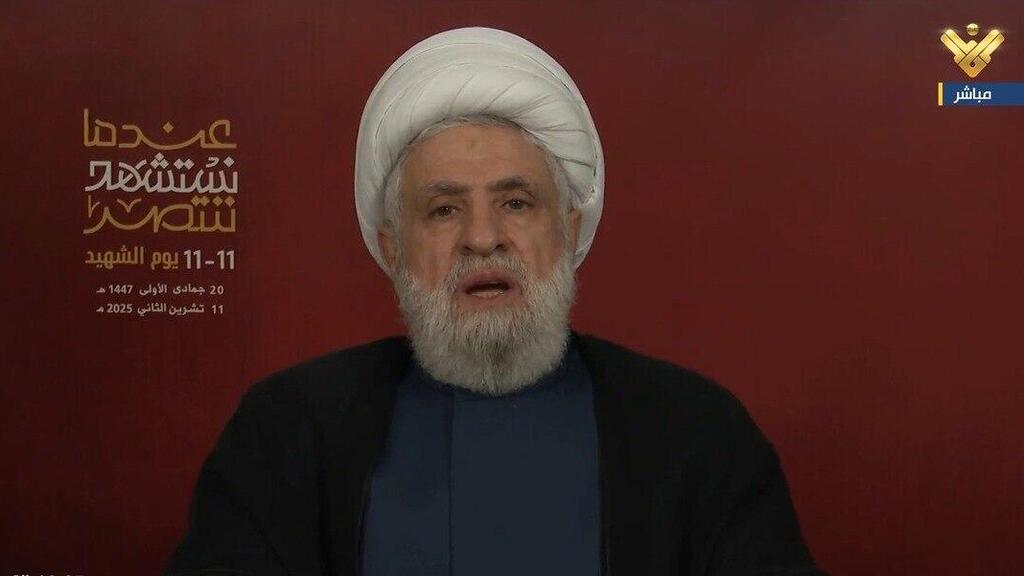
Hezbollah Secretary‑General Naim Qassem
“We cannot replace the ceasefire agreement. It must be implemented," he said. "Our very existence is used as an excuse by the Israelis. They want to destroy us. We face a real existential threat — and we have the right to do whatever we can to confront it. Intimidation and pressure will not change our stance — we will defend our land, our people and our honor. We will not give up the weapons that allow us to defend ourselves.”
“We are the ones being attacked and we will defend ourselves,” he added. “Any price is lower than the price of surrender, and the horizon of victory will open. We are certain we will win. When we die, we win.”
Qassem claimed that “the agreement applies only to the area south of the Litani River. The state of Lebanon is responsible for Israel’s withdrawal. If southern Lebanon bleeds, the bleeding will affect all of Lebanon. After the agreement is implemented, all paths are open to a positive internal dialogue and cooperation based on Lebanon’s strength and independence.”
“Every day they come up with a new pretext, from disarmament to restoration of capabilities and funding, which means their problem is the very existence of the resistance,” Qassem said, referring to Israel. “For a whole year, Israel carried out hundreds of strikes and violations; according to UNIFIL, there were 7,000. Why doesn’t the government include a program to restore sovereignty on its agenda and set a timetable for it? The government must act to protect its citizens, not to listen to and implement American dictates.”
Qassem also alleged that Israel harbors territorial ambitions in Lebanon.
Vehicle attacked in southern Lebanon on Sunday


“America and Israel are intervening in Lebanon’s future, including in its army, its economy, its politics and its standing,” he charged. “They want to eliminate Lebanon’s ability to resist and arm the army only to the extent that it can confront the resistance, and not the Israeli enemy. Israel wants Lebanon to be a backyard for expanding settlements within the framework of Greater Israel.”
Israeli Air Force strikes in Lebanon have intensified in recent weeks, against the backdrop of a Reuters report that Israel is pressuring the Lebanese army to “crack down” more aggressively on Hezbollah’s disarmament, including demands for house-to-house searches for weapons in southern Lebanon.
According to the report, the request has been raised in recent weeks but was rejected by the Lebanese army’s top command, which fears such actions could “spark internal conflict” and undermine a disarmament strategy that the army considers “measured but effective.”
Reuters reports that Lebanese officials are confident they can declare southern Lebanon free of Hezbollah weapons by the end of 2025, in line with the ceasefire agreement.
Attacks in the Al-Jarmak area in Lebanon
Two civilian sources familiar with army operations said that search operations in valleys and wooded areas have uncovered more than 50 tunnels and led to the confiscation of over 50 guided missiles and hundreds of other weapons. However, Lebanese military sources stated that the army’s plan never included searches of private property — a measure Israel considers crucial to the plan’s success.
According to the report, Israel made this demand during meetings held in October within the framework of a U.S.-led committee that includes Lebanese and Israeli officers and oversees implementation of the ceasefire. Shortly thereafter, Israel ramped up its ground and air operations in southern Lebanon, claiming it was acting against Hezbollah's attempts to rearm.
These strikes, the sources added, were perceived as a “clear warning” that if more “invasive” searches are not carried out, it could lead to another large-scale Israeli military operation. “They are demanding door-to-door searches, and we will not do that. We will not do things their way,” one Lebanese source said.
While Hezbollah has been significantly weakened by the Israeli invasion and joint Israeli-American strikes on its patron, Iran, it still holds considerable sway among Lebanon’s Shiite population and within the country’s fragile sectarian-based power structure.