


An Israeli official said Sunday evening that Jerusalem is “closely” monitoring the exchange of blows between the United States and Iran, but noted that at this stage Israel is not directly involved in the confrontation.
“For now we are outside it, but that could change,” the official said.
Overnight, U.S. Central Command (CENTCOM) announced that it had launched another wave of strikes against targets across Iran over what it said were Iranian restrictions on freedom of navigation in the Strait of Hormuz. According to CENTCOM, President Donald Trump ordered the attacks to "punish" Iranian forces for disrupting maritime traffic. Iranian media reported explosions, including in the port city of Bandar Abbas near the strategic waterway.
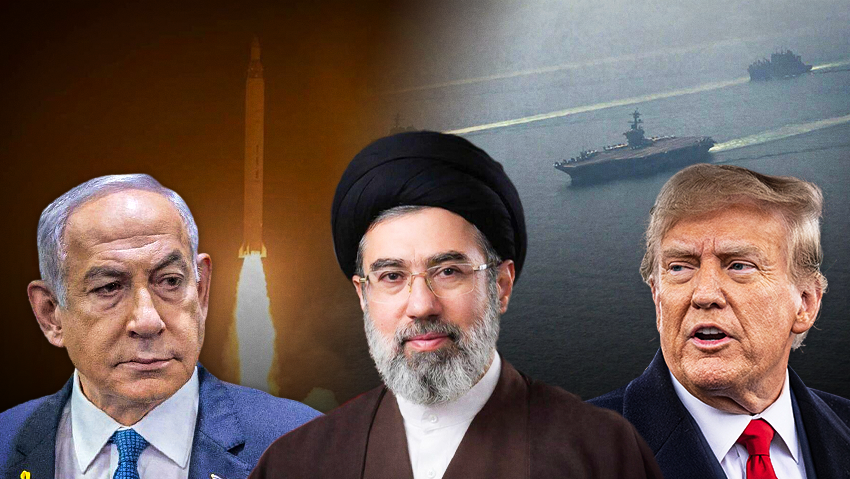
Netanyahu, Khameini and Trump
(Photos: Lev Radin/Shutterstock, Haim Goldberg/Flash 90)
Officials in Jerusalem assess that, at this stage, Iran is not interested in attacking Israel, understanding that such a move could reignite high-intensity fighting with Israel and push the cycle of escalation out of control. An Israeli official said that if Iran attacks Israeli targets or Israeli civilians, the reality could change quickly. According to the official, Jerusalem would enter the campaign only if Washington asks it to do so, or if Iran chooses to draw Israel into the confrontation through a direct attack.
Officials in Jerusalem assessed that another escalation between the United States and Iran was likely overnight after Iranian media claimed that the Islamic Revolutionary Guard Corps had killed three U.S. soldiers in Kuwait. Hours later, however, U.S. Central Command denied the claim, saying it had received no reports of American personnel killed or wounded in the region and that all service members had been accounted for.
Meanwhile, intelligence passed to the Americans by a friendly intelligence agency included concrete Iranian preparations to assassinate Trump on Turkish soil. The information included statements by senior Iranian officials that this was an opportunity that would not repeat itself. Against that backdrop, the Secret Service decided not to take risks and flew Trump out of Ankara on Air Force One, which is equipped with air defense systems, unlike the plane the U.S. president received from Qatar.
US Ambassador to Israel Mike Huckabee: 'Israel informed us that there is a plot to harm Trump'
(Video: Fox News)


Prime Minister Benjamin Netanyahu wants to attend the funeral of Republican Sen. Lindsey Graham in South Carolina and meet Trump at the same time. However, it remains unclear when the funeral will take place and whether the U.S. president will meet Netanyahu.
Trump’s warning and rising energy prices
For two months, under a quiet arrangement with the U.S. Navy, commercial tankers turned off their location transmitters, or transponders, to avoid being detected by Iran while crossing the Strait of Hormuz on their way to carry oil and gas to the world. The U.S. military provided them with some air cover in case Iran attacked, while naval officers instructed the vessels by radio to stay close to the Omani coast, opposite Iran’s shores.
According to The New York Times, the move allowed a gradual increase in the number of ships passing through the strait between May and June, during the fragile ceasefire in the war.
But the framework agreement Trump signed with Iran last month put an end to that arrangement, due to language granting Tehran formal authority in the strait and the ambiguity of several key clauses. While the U.S. president celebrated the framework and wrote on social media, “Ships of the world, start your engines,” critics of the agreement say it effectively gave official validation to the reality Iranian officials had declared throughout the war: that the Islamic Republic now controls the Strait of Hormuz.
Iranian attacks on ships in the strait effectively led to its closure shortly after the United States and Israel launched the war. Weeks later, when Washington and Tehran reached an unofficial ceasefire in early April, some tankers began traveling along a more southerly route through the strait, farther from Iran’s coast. Now, through attacks it carried out in the area last week, Iran is trying to force ships to pass through its territorial waters on the northern side of the strait, where it could claim the right to collect fees or transit charges.
According to the U.S. military, Iranian forces attacked three ships on the southern route Tuesday. In response, Trump ordered airstrikes in Iran. Tensions escalated further over the weekend when the Iranian navy said it had fired at another vessel in the strait and was closing the waterway “until American intervention in the region ends.” U.S. Central Command said it struck about 140 military targets in Iran in response, bringing the number of U.S. strikes over the past week to 310.
Following Trump’s warning that, in his view, the agreement signed in June “no longer exists,” global energy prices are rising again amid fears of a return to full-scale war. Before the war broke out, about one-fifth of the world’s oil and liquefied natural gas production, originating in Middle Eastern countries, passed through the Strait of Hormuz. Iran’s military quickly began attacking commercial ships and laying naval mines, bringing traffic through the strait almost to a complete halt. Only vessels willing to pay large sums to Iran were granted safe passage along its coast.
First published: 22:58, 07.12.26