

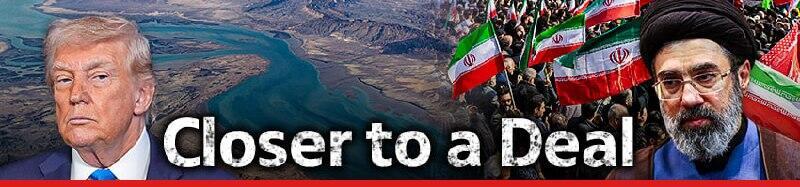
CNN reported on Sunday morning that a Qatari delegation, in coordination with the United States, flew to Tehran to help finalize a memorandum of understanding between Washington and Tehran.
The report said plans to sign the memorandum digitally and remotely are intended to prevent last-minute disruptions. Donald Trump had promised that Vice President JD Vance would attend a physical signing ceremony in Europe, but the president is set to fly to France tomorrow for the G7 summit. Since the president and vice president do not usually travel simultaneously, sending Vance could have posed a logistical issue.
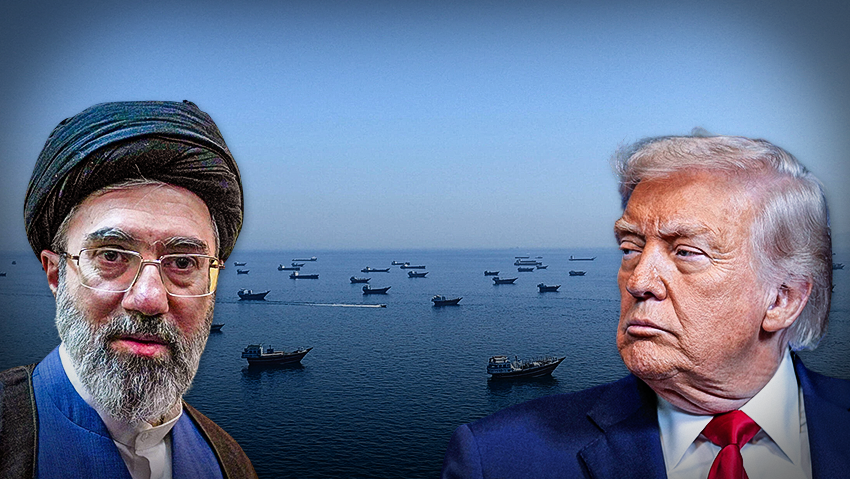
A Qatari delegation, in coordination with the United States, flew to Tehran to help finalize a memorandum of understanding
(Photo: Hamed Jafarnejad/ISNA/WANA (West Asia News Agency) via REUTERS, AP/Alex Brandon, REUTERS/Stringer)
In addition, according to a source familiar with the matter cited by CNN, the decision was made to proceed with an electronic signing. Some mediators, according to the report, fear that the longer the agreement remains unsigned, the higher the chance that something will disrupt progress or that one or both sides will back out.
However, Iranian state-affiliated Fars News Agency quoted a source close to the negotiating team saying Iran has not yet made a final decision on the proposed memorandum and is still reviewing its political, legal and technical aspects at expert and decision-making levels.
Saudi outlet Al Arabiya reported on Sunday that the signing meeting is expected to take place with the participation of Vice President Vance and Iranian parliament speaker Mohammad Bagher Ghalibaf. The meeting, according to the unverified report, will also include mediators from Pakistan and Qatar. After the agreement is signed, Al Arabiya claimed, the Strait of Hormuz would be opened and passage would be allowed without a fee.
Iran's Banking Coordination Council confirmed today reports of a cyberattack that disrupted services at four major banks in the country. According to the statement, "there was no information leak and no data was deleted."
It was also reported on Saturday that the agreement would be signed digitally. Pakistan’s foreign ministry told Al Jazeera at the time that the ceremony would take place in Islamabad but the parties would participate virtually. However, Iran has not confirmed this announcement and Tehran’s foreign ministry said no signing ceremony is expected.
Meanwhile, Iranian Spokesperson for the Ministry of Foreign Affairs Esmail Baghaei said on Saturday in a conversation with the Iranian news agency Fars that under the agreement Tehran would charge a “fee” for services allegedly provided in the Strait of Hormuz. This is a major point of dispute in talks with the United States, which has so far strongly opposed any tolls on ships in the strategic trade route, which before the war was completely open to civilian vessels and oil tankers.
Despite Iranian opposition, President Donald Trump said on Friday that the signing would take place and that the memorandum of understanding would open future negotiations lasting 60 days on Iran’s nuclear program, alongside the opening of the Strait of Hormuz and the lifting of the U.S. blockade on Iranian ports. Although the memorandum, according to reports, would not fully resolve the nuclear dispute, Trump presented it on his Truth Social platform as bringing a complete end to the Iranian nuclear threat and described it as fundamentally different from the 2015 nuclear deal reached under Barack Obama, from which Trump withdrew in 2018 at the encouragement of Israeli Prime Minister Benjamin Netanyahu.
Following that withdrawal, Iran began enriching uranium to very high levels and is now believed to hold about 440 kilograms of uranium enriched to 60%, close to the 90% level needed for a nuclear weapon, a quantity theoretically sufficient for about 10 atomic bombs. The material is currently stored under nuclear facilities that were struck during the first Operation "Rising Lion", which began exactly one year ago.
First published: 10:12, 06.14.26