

First light rises over a devastated village in southern Lebanon. Two masked men carrying black backpacks arrive on a motorcycle, enter one of the houses. A minute later they emerge into the backyard overlooking the morning mist above a picturesque mountain ridge to the south. One of them holds a drone attached to an improvised fragmentation charge and a large spool of fiber-optic cable. The other puts on VR goggles and grips two joysticks, seeing the world through the drone’s camera, which is connected by the fiber-optic line. Within seconds the drone lifts off and speeds away at low altitude, as fast as a race car, pulling the thin fiber-optic cable behind it.
Three kilometers away, beyond the ridge, an IDF unit is preparing for operations. They hear that sickening buzzing sound — the motors of the explosive drone — too late. Some try to shoot it down with their Tavor rifles. Others take cover behind vehicles. Back in the Arab village, the operator wearing the VR goggles sees them clearly, maneuvers right and left and crashes the drone into a vehicle in a massive explosion.
Smart Shooter techology in action


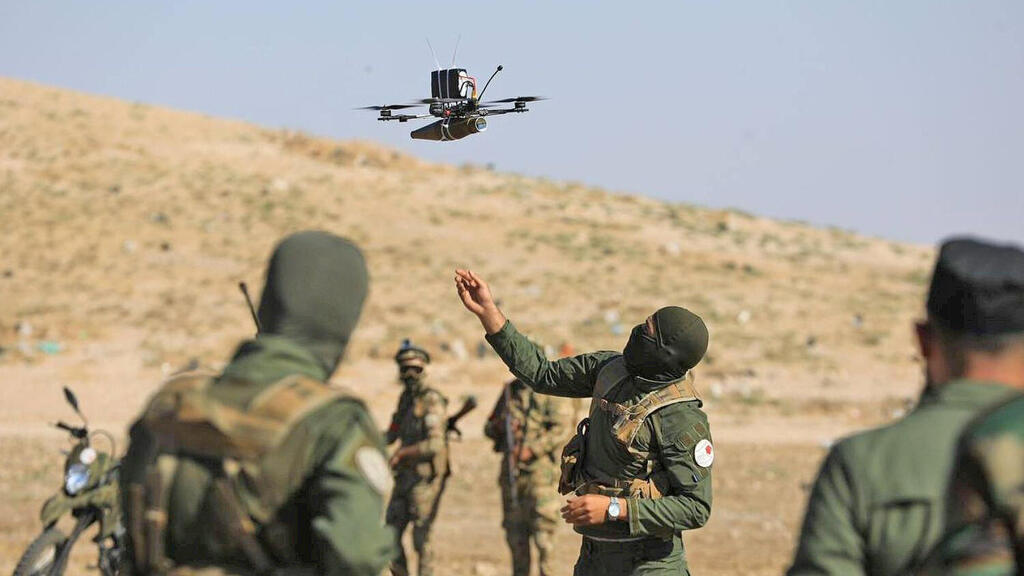
Explosives-laden FPV drones have become a major challenge for the IDF in recent weeks. The term FPV refers to their operating method — “first-person view” through VR goggles. But the truly problematic part is their operation via fiber-optic cable, which bypasses the need to transmit signals. The IDF’s detection and jamming systems are helpless. Radar systems also struggle to detect them when they fly at treetop height. By the time the drone is spotted, there is no time to scramble a helicopter or launch an Iron Dome interceptor, and the Magen Or laser system is still far away. Helplessness.
'Wait and see what happens at the World Cup'
In recent weeks, the IDF Spokesperson’s Unit has repeatedly announced injuries to soldiers and military vehicles caused by explosive drones. Just last week, seven soldiers were wounded, some seriously. Israelis, who had grown accustomed to believing the IDF had an answer for every threat — from incendiary balloons and kites to ballistic missiles — are now forced to internalize a new reality: this is a danger for which there is currently no solution. Worse still, experts warn that explosive drones could also threaten the civilian home front.
“I can even give you a spoiler for the future — wait and see what happens at the World Cup,” says Oded Napchi, CEO of Althimis. “It’s not that the IDF is struggling with explosive drones, it’s the entire world that is struggling with them. No one in the world has solved this problem, not even the Ukrainians. There is no solution. Compared to the preparations for the World Cup threat, the IDF is perfection itself.”
According to Napchi, hostile actors, terrorist groups and even teenagers looking to cause panic have already gotten their hands on fiber-optic explosive drones. To launch them, they need very little: just place them in a car trunk, drive to a stadium parking lot and launch them over the heads of spectators and players.

MetLife Stadium; peak alert in the US
(Photo: Pamela Smith/AP)
“In the Americans’ reference scenarios they call them ‘careless and clueless’ — some teenager who wants to look tough in front of his friends launches a drone, scatters 10 grams of white powder and suddenly there’s chaos, 100,000 people running from the stadium. Remember, this is America — they do mass shootings for fun.”
The real concern is that the threat is far closer to home than World Cup stadiums.
“There is no reason someone in Jerusalem couldn’t launch a drone from the Old City and fly it into western Jerusalem,” says Dr. Udi Ben Ami, CEO of laser defense company OptiDefense. “There is no reason someone east of Highway 6 couldn’t launch a drone toward communities along the road. No reason whatsoever.”
That is deeply worrying, especially given the success of these drones in Lebanon.
“They already know they can do it. The only difference is that here we have slightly more control, slightly more intelligence. In the past they tried launching mortars from Jenin. Now, for 800 shekels, they can cause much more damage and with much greater precision.”
 Oded Napchi, CEO of Althimis Photo: Messe Düsseldorf / Tillmann
It appears many share that concern. Brig. Gen. (res.) Ran Kochav, former commander of Israel’s Air Defense Array, said in an interview with Radio Darom: “Explosive drones could also appear in Jthe West Bank and in the Gaza Strip.”
According to him, such drones could threaten cities in the Sharon region, the seam line and the Tel Aviv metropolitan area. Another concern is explosive drones reaching organized crime groups. Israeli authorities have already foiled attempts by criminal organizations to use drones for assassinations inside prisons, and the ease with which they can be purchased and operated suggests they may soon appear much closer to home.
'We need to prepare for the unexpected'
Althimis, an American company with Israeli management, has developed technology used to train workers and soldiers to prepare for various threats. Using AI, its platform creates simulations of attack scenarios: different types of attackers, various launch methods and different weapons configurations. Security personnel preparing for the World Cup, after training for these scenarios, will be ready for surprises if they occur.
“Our goal is to increase soldiers’ readiness for drone attacks,” Napchi says. “When you speak with professionals, they say, ‘We just need 30 seconds warning so we can carry out certain defensive actions.’ Drones are bringing us something new that is confusing all of us. For many years we got used to believing technology would solve every problem. Suddenly it’s shocking to discover there is something technology cannot solve. We say: ‘Let’s prepare for the unexpected because it’s clear the situation here is unpredictable.’”
The problem is no longer surprise. Israel already knows explosive drone attacks will continue. Perhaps the military should be drilling soldiers on what to do when they arrive, instead of standing like ducks at a shooting range?
“The main problem is when commanders say, ‘There is no scenario where a fiber-optic drone arrives.’ That was only two weeks ago. And we are showing them scenarios with fiber-optic drones. I don’t want to say what scenarios we are seeing now that they aren’t even thinking about. You can understand why I don’t want to tell you.”
Maj. Gen. Nadav Lotan, commander of the Israeli Ground Forces, appointed Brig. Gen. A. — head of the Strike Division — to oversee finding a solution to the issue of low-altitude aerial threats. Brig. Gen. A. is an Air Force pilot chosen because of his links to both the Ground Forces and the Air Force. Under him, officers are working to develop solutions.
AI sights, laser cannons and nets
Israeli company Smart Shooter developed an AI-based targeting system. The Smash system, known in the IDF as Pigion, is a lightweight attachment mounted on assault rifles that enables any soldier to become a skilled marksman, including against drones. The system “locks on” to the drone and fires only when a hit is assured. An advanced version operates heavier weapons mounted on vehicles or robots and fires autonomously after human authorization.
Shir Ahuvia, the company’s vice president for products, says Pigion is the most suitable tool for dealing with FPV drones.
“The fiber-optic cable makes the threat immune to communication jamming, so kinetic response — bullets — becomes the only game in town. From the beginning we developed algorithms to deal with moving targets, so the system calculates where to aim in order to hit the drone.”
So why are IDF soldiers still getting hurt?
“I can’t comment on how the IDF uses the system or manages incidents. From our perspective, the system is part of the personal combat kit, a very important part of the solution, though naturally it works together with other systems. Our systems can connect to detection systems, receive indications, turn toward the threat and engage.”
 Shir Ahuvia, vice president for products at Smart Shooter Photo: Maya Chavkin
OptiDefense developed a laser cannon, similar to Rafael and Elbit’s Magen Or laser defense system, but with lower power and lower cost. The system is currently in operational use by the IDF.
“We are working on a solution,” Ben Ami says. “Not a holistic solution for every drone attack, but we are working on it with the army right now, and with Defense Ministry R&D funding we will be able to conduct proper trials and test the solution.”
OptiDefense’s approach thinks outside the box by bypassing the drone detection problem.
“Detection is a real issue,” Ben Ami adds. “This is a tool flying very low, very fast. It appears out of nowhere and suddenly drops on you. Detecting it is hard, and after you detect it you still can’t always neutralize it. Honestly, it’s a very difficult challenge. I don’t know any company that can reliably detect them. Some might try to bluff you, but I don’t know any company that currently can.”
A threat born in Ukraine
Explosive drones are not a new invention. In fact, they are an improvised weapon that underwent mass battlefield testing in the war in Ukraine. These are kamikaze drones — meaning they explode on impact — built from absurdly cheap components. In some cases, the parts are purchased on Amazon or at hobby stores. The drones themselves are small, fast and cheap, costing just a few hundred dollars. Their range varies from a few kilometers to dozens of kilometers, depending on the length of the fiber-optic cable. Their explosives are simple but deadly: RPG warheads or fragmentation grenades. Ukraine now faces swarms of such drones. How long before the same happens here?
Equally troubling is the question of why Israel’s defense establishment waited until now to tackle a problem that has been known for years and whose severity was obvious. Against Hezbollah and Iranian UAVs, the IDF deploys helicopters, fighter jets and Iron Dome systems. None of those are effective against explosive drones, which it was reasonable to expect would eventually enter the battlefield.
The Defense Ministry’s Directorate of Defense Research and Development has held demonstrations of anti-drone systems, but nearly all proved unsuitable against explosive FPV drones.
All companies developing radio-signal detection and jamming systems are ineffective against drones that do not emit such signals. The IDF’s announcement that it would deploy Airobotics’ Iron Drone Raider System — which throws a net over attacking drones — amounted to an admission of weakness, because the system relies on radar detection, which is ineffective against fiber-optic drones.
Israel Aerospace Industries demonstrated its UAS-C system, described as the “next generation of detection systems,” designed to identify, track and jam drones. The company says the system uses advanced electro-optical and radar capabilities effective even against tiny low-flying drones and can also carry out interceptions. The system has been sold abroad for hundreds of millions of dollars, but there has been no known IDF procurement decision.
A senior defense official told ynet this week: “We are in a learning race. Unfortunately, there is currently no single system that can solve the problem.”
According to the official, the defense establishment is working with Elbit, Israel Aerospace Industries, Rafael and various startups to develop interceptor drones capable of shooting down other drones. Such tools will not reach the battlefield for many months, and even then no one expects them to provide a definitive solution.
“We will bring a collection of responses that reduce the damage,” the official said. But why all this is happening now and not three years ago remains unanswered.
Nets, scissors and microphones
In the meantime, the IDF has borrowed inspiration from the Ukrainian army by covering forces and installations with high nets designed to prevent drones from making contact before exploding. It is a somewhat pathetic image for an army described as “one of the two strongest armies in the world.”
In Ukraine, soldiers have also been deployed with scissors. Once a drone passes overhead, they rush to the fiber-optic cable trailing behind it and cut it. It is doubtful the IDF will establish a “scissors unit,” but there is already a new role in the Ground Forces: spotting approaching drones.
Another method developed in Ukraine is listening for the distinctive buzzing sound of drones through a network of cellphones. That may work in Ukraine’s quiet wheat fields, but less so in the crowded and noisy battlefield of southern Lebanon.
Two Israeli companies have developed acoustic drone-detection technology: Insignito, with a sensitive microphone array and AI algorithm that filters environmental noise to identify drone motors, and Skylock, whose SkyDome system includes acoustic sensors.
Third Eye Systems developed an optical system capable of identifying tiny drones in complex terrain. B-Sense developed a radar capable of detecting “low-signature” targets — meaning miniature drones. Kela developed an AI system that gathers all the data and provides precise targeting information to weapons systems such as Smart Shooter’s AI sight, which can hit drones using personal firearms or machine guns. American company Anduril developed an autonomous interceptor drone that identifies attacking drones and collides with them. As far as is known, Israel has not purchased the technology.
Other ideas remain in development: detecting the fiber-optic cable while the drone is airborne and melting it with a laser beam; deploying thick smoke screens around forces to obscure targets from drone operators; spraying paint to blind drone cameras. There are rifles equipped with scattershot ammunition and guns that fire nets at approaching drones. In the United States, a microwave beam system has been developed to fry drones.
None of those ideas are yet operational. Meanwhile, soldiers continue to get hurt.
First published: 09:04, 05.10.26