

The launch of a new U.S.-backed aid distribution network in Gaza, intended to bypass Hamas and alleviate mounting humanitarian concerns, has been delayed amid ongoing looting, logistical setbacks and deepening international criticism.
Israel had hoped the Gaza Humanitarian Foundation (GHF), a new American-run operation with Israeli support, would begin distributing food directly to Palestinian families as early as Saturday. But the opening of four distribution centers has been pushed to Monday or Tuesday due to last-minute complications, Israeli officials said.
Palestinian crowds loot humanitarian aid truck in Khan Younis, Saturday


Finance Minister Bezalel Smotrich has vowed that “not even a grain of wheat” would reach Hamas. Israeli officials emphasize that the recent resumption of traditional aid delivery — halted for more than two months — is temporary.
Three of the new distribution centers are located in southern Gaza between the Morag and Philadelphi corridors, with a fourth situated between the Netzarim Corridor and central Gaza’s refugee camps. Each site includes controlled entry and exit points, security barriers and earthen walls. Families are to send representatives to receive food parcels after undergoing security screening.
So far, 388 aid trucks have entered Gaza since last week via the Kerem Shalom crossing, including 83 on Friday, according to the Coordinator of Government Activities in the Territories (COGAT), Israel’s liaison office to the Palestinians.
But chaos has persisted. Over the weekend, images circulated of disorder around aid convoys and reports surfaced of armed men hijacking aid trucks near Khan Younis. Palestinian sources said five more flour trucks were seized early Saturday along the Rafah-Khan Younis corridor. "They stole food that was meant to reach children and families suffering from hunger," aid organizations said.
Unrest erupts around Gaza food distribution points
International aid groups have condemned the Israeli-American distribution model, calling it inefficient and a threat to the independence of humanitarian organizations. UN Secretary-General António Guterres described the total aid delivered so far as “a drop in the ocean” and warned that more than 9,000 aid trucks remain stalled, with only a handful cleared to cross into Gaza.
The method, officials say, is part of a broader Israeli strategy to sever the connection between the civilian population and Hamas — physically, by moving residents away from combat zones, and practically, by breaking their reliance on the terrorist group for basic necessities. The aim is to move civilians to designated humanitarian zones in southern Gaza, where they can receive food and aid independently of Hamas.
Get the Ynetnews app on your smartphone: Google Play: https://bit.ly/4eJ37pE | Apple App Store: https://bit.ly/3ZL7iNv
According to officials, the new model is expected to ease global pressure once operational. But delays and concerns about crowd control at distribution sites remain significant. Israeli assessments suggest that once the aid centers begin operating, much of the global outcry may subside, giving the military greater diplomatic leeway to continue operations, including the ongoing Operation Gideon’s Chariots. With Gaza’s food supplies nearly exhausted, pressure on Israel to prevent famine has intensified, fueling diplomatic clashes with Western allies.
Criticism of Israel’s approach has been sharp, particularly from countries such as Britain, France and Canada. In response, Prime Minister Benjamin Netanyahu accused those governments of being “on the wrong side of history.”
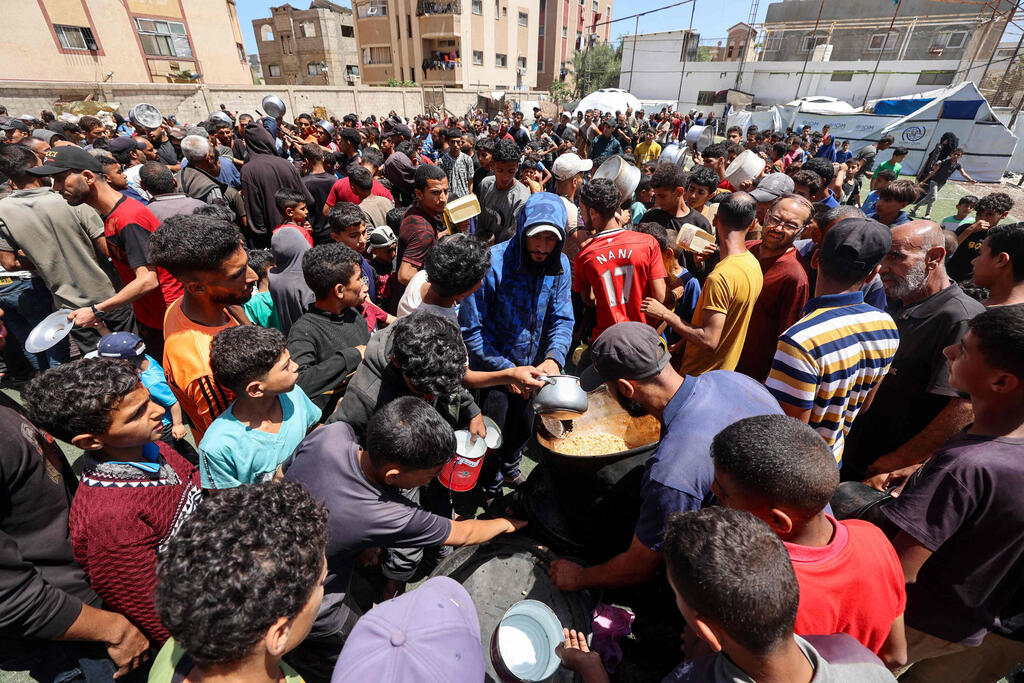
A line for food distribution in Nuseirat, central Gaza
(Photo: Eyad BABA / AFP)
Israeli Ambassador to the United States Yechiel (Michael) Leiter said in an interview over the weekend that Israel had co-founded the GHF, although it had initially been portrayed in Jerusalem as an American initiative coordinated by the White House as part of a broader agreement that included the release of American-Israeli hostage Edan Alexander.
“We’ve created it together with the United States mostly,” he said. “It’s run by former U.S. special forces veterans who’ve recently helped with humanitarian efforts in places like Haiti. They’ll operate four sites, each serving 300,000 people. The food is going to be given directly to families, not to organizations, certainly not Hamas.”
Leiter said the facilities will be secured by former U.S. Marines and Navy personnel hired privately. “These are all private citizens. We’re providing peripheral security.”