

Iran’s police chief signaled Sunday that the regime is escalating its crackdown on anti-government protests, now entering their third week. “The level of confrontation with rioters has been increased,” said Gen. Ahmad Reza Radan, adding that “significant arrests” were made Saturday night, targeting key figures involved in the unrest. He vowed the detainees would face trial once legal proceedings are complete.
His remarks came as the Iran-based Human Rights Activists News Agency (HRANA), operating from the U.S., reported a sharp rise in casualties and arrests. According to HRANA’s sources, at least 116 people have been killed and around 2,600 arrested amid the crackdown.
Protests in Tehran


Meanwhile, Iranian parliament speaker Mohammad Bagher Ghalibaf threatened that Israel and the U.S. military would become “legitimate targets” if the United States attacks Iran, in response to warnings from President Donald Trump, who said he would not hesitate to act if Tehran continues killing protesters. Ghalibaf’s comments came during a special parliamentary session on the protests, where lawmakers chanted, “Death to America!”
Iran has remained almost entirely cut off from the internet since Thursday, when the regime imposed a near-total shutdown, a tactic it has repeatedly used during past waves of unrest. The blackout is aimed at preventing coordination among demonstrators and blocking evidence of the crackdown from reaching the outside world. According to NetBlocks, an organization monitoring global internet access, Iran’s connectivity has dropped to just 1% of normal levels.
Iranian lawmakers chant, 'Death to America!' during a special parliamentary session on the protests
Despite the blackout, some Iranians have managed to stay online using alternative methods, including Elon Musk’s Starlink satellite service. These connections have allowed them to share images and updates indicating that protests continue, and that the death toll is rising.
On Saturday night, Trump reiterated his support for the Iranian demonstrators, writing on Truth Social, “Iran is looking at FREEDOM, perhaps like never before. The USA stands ready to help!!!” Reports in The New York Times and The Wall Street Journal, citing U.S. officials, said Trump has already been presented with military strike options against Iran, though no final decision has been made.
In a separate statement, the U.S. State Department warned, “Don’t play games with President Trump. When he says he’ll do something, he means it.”
The parliamentary special session was broadcast live on state television Sunday morning, with Speaker Ghalibaf—known for his hardline stance and past presidential bids—delivering a speech praising the country’s security forces for their actions during the ongoing protests. He commended the police, the Islamic Revolutionary Guard Corps and especially the Basij, the IRGC’s volunteer militia often deployed to brutally suppress demonstrations, saying they had “stood firm” in recent days. “The Iranian people must know that we will deal with them in the harshest way and will punish those who are arrested,” he said, referring to the demonstrators as “rioters.”
Ghalibaf went on to issue a direct threat toward the United States and Israel—referred to as “the occupied territories”—warning of a potential Iranian preemptive strike. “If there is an attack on Iran, both the occupied lands and all U.S. military centers, bases and ships in the region will be legitimate targets for us,” he said. “We don’t see ourselves as limited to responding after an action; we will act based on objective signs of a threat,” he emphasized, indicating that Iran could strike first.
Later in the session, the head of the Iranian parliament’s National Security Committee, Ebrahim Azizi, echoed Ghalibaf’s warnings. He declared that the Islamic Republic would consider any future actions against the U.S. and Israel “legitimate” in light of recent events tied to the protests, and cautioned that Iran’s enemies should expect “harsh revenge.”
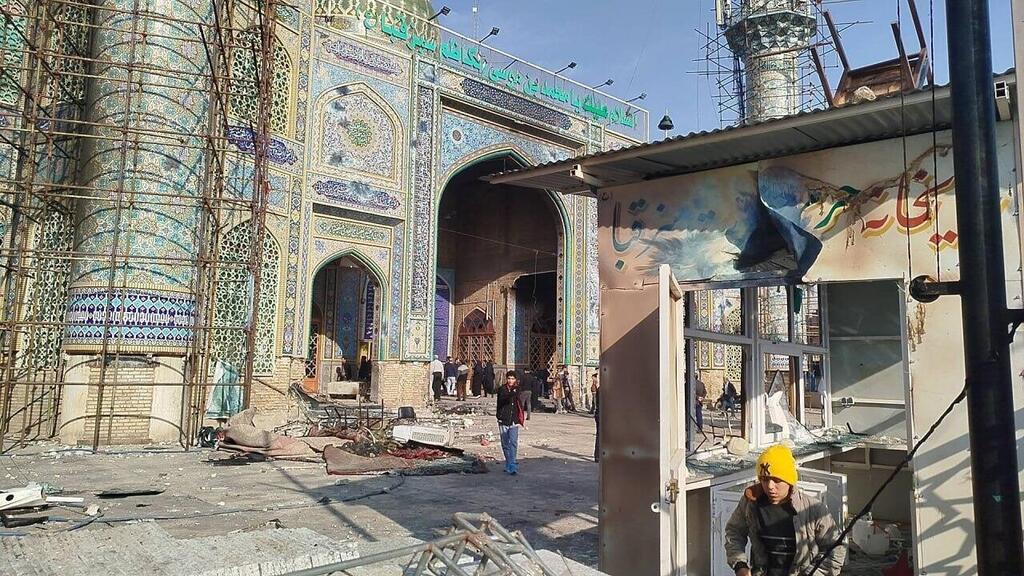
Footage of protest damage released by Iran’s state broadcaster
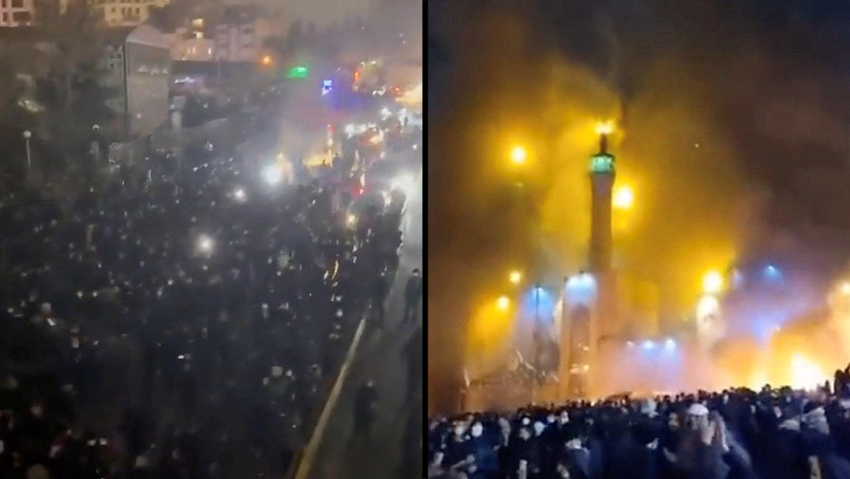
Meanwhile, protests continued across Iran overnight. Videos circulating on social media showed large crowds in the streets, including in Tehran’s northern Punak neighborhood. The footage showed blocked roads, protesters using their phone flashlights to light the darkness and others banging on metal objects as fireworks exploded in the background. Additional videos showed peaceful demonstrators marching as passing drivers honked in solidarity.
London-based opposition outlet Iran International, viewed by Tehran as a bitter enemy of the regime, cited a report from Iran’s Tasnim News Agency claiming that protesters had set fire to several rooms in a courthouse in Fars Province overnight. The blaze reportedly spread from the ground floor to the first floor before security forces arrived and dispersed the crowd.
Protest activity in Iran’s capital has shifted to short, sporadic gatherings in response to heavy security presence and mounting regime pressure, according to the Human Rights Activists News Agency (HRANA). The group reported increased surveillance, including security forces patrolling protest hotspots and reconnaissance aircraft flying overhead, which it said signals heightened monitoring by the authorities.
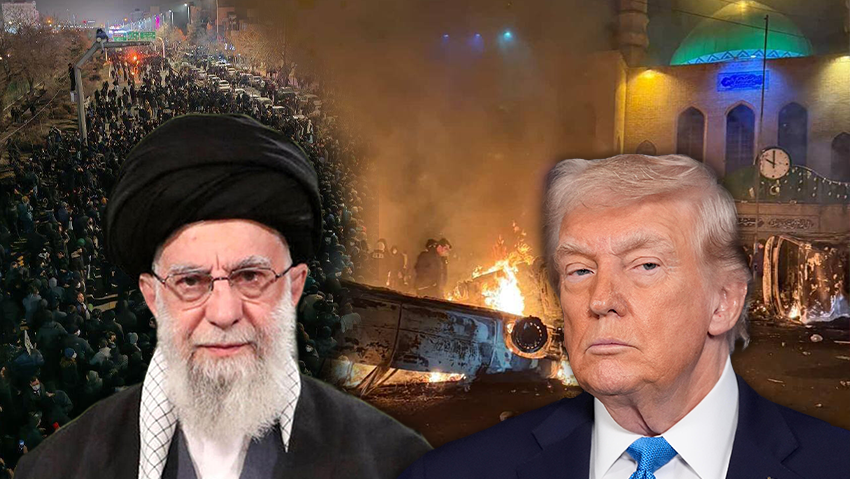
(Photo: AP Photo/Alex Brandon, AFP/HO/KHAMENEI.IR)
Overnight footage from Mashhad, Iran’s second-largest city, showed demonstrators clashing with security forces, with burning debris blocking roads. The city is home to the Imam Reza Shrine, the holiest site for Shia Muslims, making the protests there particularly symbolic and sensitive for Iran’s theocratic regime. Unconfirmed reports also pointed to demonstrations in Kerman, located roughly 800 kilometers southeast of Tehran.
As part of a push to restore calm, Iranian state TV dispatched reporters to broadcast live from the streets in several cities to portray a return to normalcy. To emphasize the footage’s recency, editors displayed the date prominently on-screen. The network also aired footage of pro-government rallies in Qom and Qazvin, followed by live coverage of funerals for members of the security forces killed in recent clashes.
More protests are expected later Sunday, following a weekend appeal from Crown Prince Reza Pahlavi—the exiled son of the Shah ousted in the 1979 Islamic Revolution—who urged demonstrators to take to the streets not only on Saturday but also on Sunday. He called on Iranians to wave the Lion and Sun flag, a symbol of pre-revolutionary Iran, and to “take control of public spaces.”
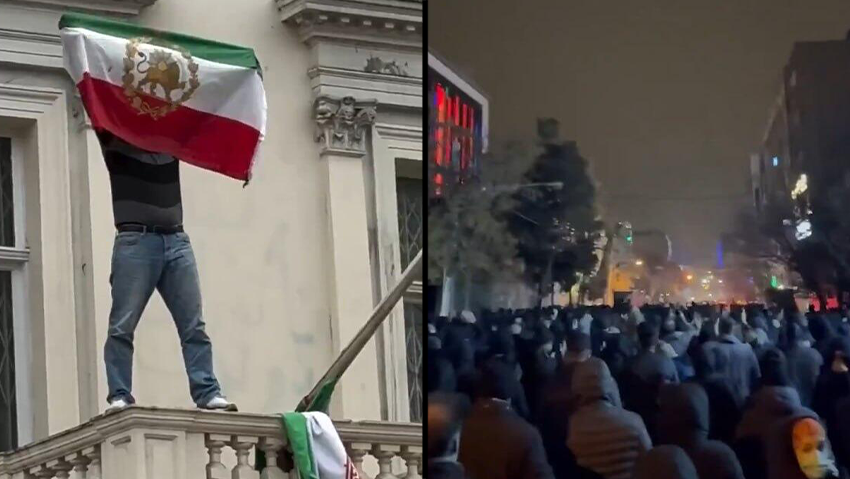
London: Protester climbs Iranian embassy, removes flag, raises Shah-era flag
(Photo: Politics UK)
Two weeks into a wave of nationwide unrest, Iran is grappling with both deepening economic collapse and mounting public outrage. The protests began as a spontaneous outcry by Tehran bazaar merchants over runaway inflation and the steep devaluation of the national currency, which has made it increasingly difficult for Iranians, already burdened by more than two decades of Western sanctions over the country's nuclear program, to afford basic goods and food.
As with past uprisings, such as the 2019 fuel price protests and the 2022 “hijab protests” sparked by the death of Mahsa Amini in morality police custody, the current demonstrations quickly evolved into direct opposition to Iran’s ruling regime. Protesters now chant slogans like “Death to the dictator,” referring to Supreme Leader Ayatollah Ali Khamenei, and “This is the final battle—Pahlavi will return,” invoking the exiled crown prince.
Demonstrators have vandalized symbols of the regime, including statues of slain Quds Force commander Qasem Soleimani and government buildings. In several cities, protesters raised Iran’s pre-revolutionary flag bearing the Lion and Sun emblem.
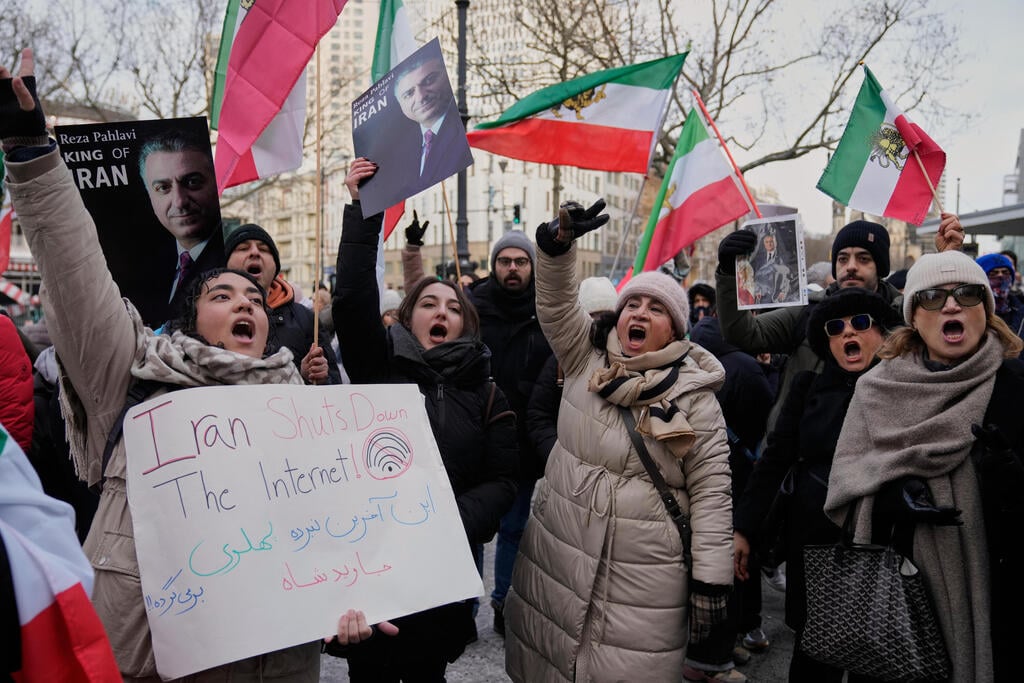
Protest in Berlin in support of Iranian demonstrators
(Photo: AP Photo/Ebrahim Noroozi)
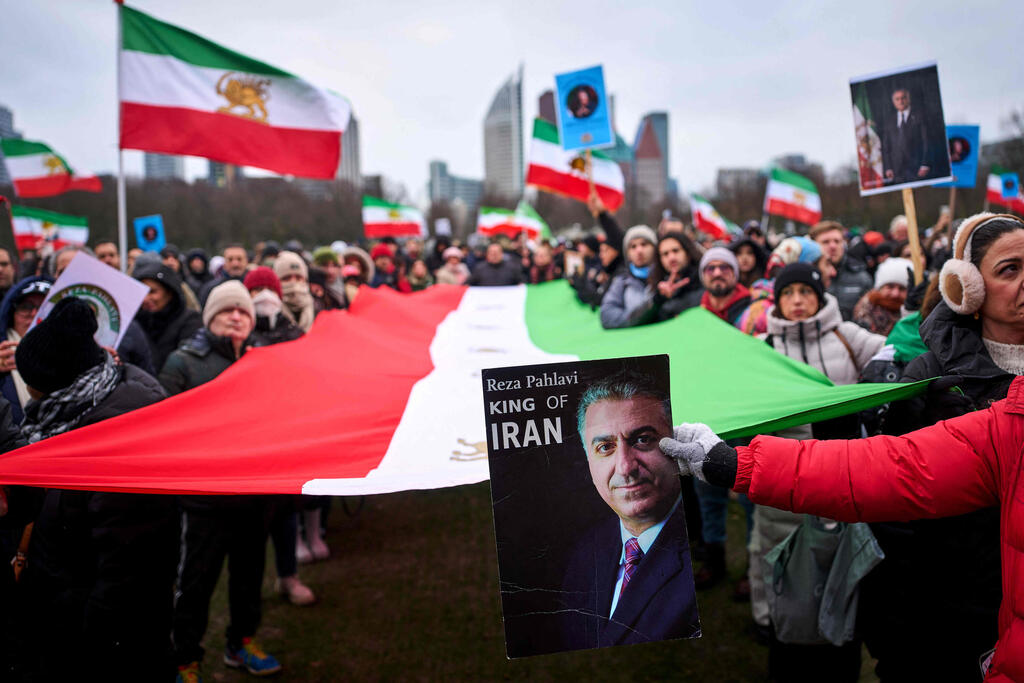
Demonstration in The Hague, Netherlands, backing Iranian protesters with Shah-era flags and images of Reza Pahlavi
(Photo: Phil Nijhuis / ANP / AFP)
The protests escalated sharply on Thursday, when large crowds answered Pahlavi’s call to take to the streets at 8 p.m. sharp. That same evening, in a sign of the regime’s growing fear, authorities shut down internet access nationwide, a blackout that has now lasted more than three days.
Human rights activists warn that the communication shutdown is intended not only to block protest coordination but also to prevent the global dissemination of evidence showing the regime’s brutal crackdown.