


U.S. President Donald Trump said overnight Tuesday that talks with Iran are continuing and suggested an extension of the ceasefire agreement could come as early as next week.
Meanwhile, Secretary of State Marco Rubio said there are signs of progress, telling reporters that “there is a prospect that Iran has agreed to negotiate aspects of their nuclear program that they previously refused to mention in discussions.”
Trump on Iran deal
(Video: The White House)


Rubio also said there are indications that Iranian Supreme Leader Mojtaba Khamenei is becoming increasingly involved in the process.
Iranian officials, however, continued to deny that negotiations are taking place. Tehran said Tuesday that “there are currently no exchanges of messages with the United States.”
The denial was published by Fars News Agency, which is affiliated with Iran’s ruling establishment. The report was the latest in a series of conflicting claims surrounding the negotiations, which Iranian officials have repeatedly denied are occurring.
“While some Western media outlets and officials are trying to portray the process of message exchanges between Iran and the United States as routine, an informed source says exchanges of messages between Iran and the United States have been halted for at least several days,” Fars reported.
The agency also contradicted Trump’s claims of progress, saying that while Trump had described the talks as advancing rapidly, “the last message Iran sent to Washington was a clear message regarding Lebanon,” which it said received widespread international attention.
That message referred to Tehran’s threat to halt negotiations with Washington — despite publicly denying they exist — because of Israeli military operations in Lebanon.
Tasnim News Agency, which is considered close to Iran’s Revolutionary Guard and hard-line factions within the regime, reported Monday that “there will be no talks until Iran’s demands for a halt to Israeli operations in Lebanon and Gaza are met.”
Tasnim also reported that Iran is demanding a complete Israeli withdrawal from territories captured in Lebanon.
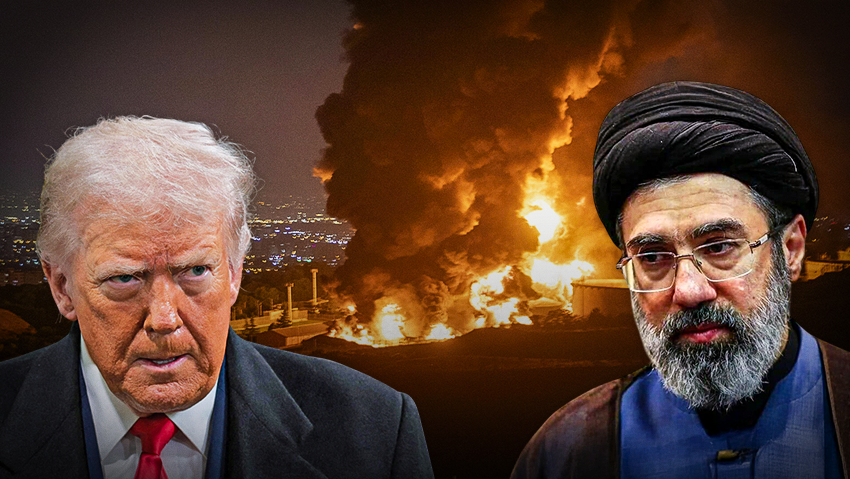
US President Donald Trump, Iranian Supreme Leader Mojtaba Khamenei
(Photo: Anna Moneymaker / AFP, Stringer / Getty Images)
Despite statements by Prime Minister Benjamin Netanyahu that he had instructed the Israeli military to strike Beirut’s Dahieh district, a Hezbollah stronghold, no such attack ultimately took place. Trump later announced a ceasefire, though rocket and drone launches toward northern Israel continued.
Subsequent reports said Trump expressed anger toward Netanyahu during a phone call, accusing him of ingratitude and ordering him to cancel planned strikes.
Iran’s threat underscored what analysts see as Tehran’s effort to link any future agreement with Washington to a ceasefire between Israel and Hezbollah, which would restrict Israeli military operations in Lebanon and allow the Iranian-backed group to preserve its position there.
Iranian state television later suggested there was a strong possibility the ceasefire with the United States could collapse if Israel continued military operations in Lebanon.
Following his ceasefire announcement and despite continued attacks on Israel, Trump told ABC News that he believes an agreement to extend the ceasefire with Iran and reopen the Strait of Hormuz could happen “over the next week.”
“Looking good, looking good,” Trump said in a phone interview with the network. “There was a little glitch today, but I turned that one around very quickly, as you probably noticed earlier. So, I spoke with Hezbollah, and I said no shooting, and I talked to Bibi, and said, no shooting, and they both stopped shooting each other,” he added, using Netanyahu’s nickname.
Growing tensions over draft agreement
The conflicting reports come after days of silence from Iran’s supreme leader, a delay that was widely interpreted as a sign that he had not approved a draft agreement with the United States.
Reports on Friday said Trump had hardened the terms of the proposed agreement after receiving no response from Tehran.
According to a source familiar with the discussions, Trump was angered by what he viewed as a prolonged wait for Khamenei’s approval after negotiators from both sides had already agreed on a draft text. He reportedly ordered several changes to the proposal, effectively tightening terms negotiated by his envoys Steve Witkoff and Jared Kushner.
In response, Tasnim reported Sunday, citing an informed source, that Iran would seek changes of its own. “The exchange of texts continues, and Iran will also make its own revisions,” the source said. “Nothing is final yet.”
The source stressed that Trump’s revisions did not mean Iran would accept them. “The criterion for Iran is a text that we ourselves approve,” the source said.
The same source repeated Iran’s warning that it remains prepared for renewed conflict. “Iran is fully prepared for a situation in which no understandings are reached,” the source said.
The comments came after Trump warned in an interview with Fox News that while he prefers a negotiated settlement, he is prepared to resume military action if diplomacy fails.
"We're close to a very good deal," Trump said in the interview, which aired on a program hosted by Lara Trump, the wife of his son Eric. He added that if the United States "doesn't get what it wants," it will "end it in a different way."
Last week, negotiations appeared to be entering their final phase, with reports that the sides had agreed on a draft memorandum of understanding intended to end the conflict and potentially address fighting in Lebanon as well.
The exact language of the memorandum remains unclear. It may amount only to a 60-day extension of the ceasefire between Washington and Tehran.
According to reports, the memorandum would also include the lifting of Iran’s blockade of the Strait of Hormuz, a gradual easing of restrictions on Iranian ports and relief from some U.S. sanctions.
The memorandum would not resolve disputes over Iran’s nuclear program. Instead, it would open a 60-day period during which negotiators would seek a final agreement addressing the future of Iran’s stockpile of enriched uranium and the limits that would be placed on any future uranium enrichment activities.