

The coalition on Sunday outlined a proposal for an alternative investigative body that the government says could replace a state‑appointed commission to examine the failures of the Oct. 7 terrorist attacks.
Knesset Member Ariel Kallner of Prime Minister Benjamin Netanyahu’s ruling Likud party presented the main features of the plan, which he said would establish a “national state investigative committee” made up of members chosen by both the coalition and the opposition.

Under the proposal, the six‑member committee would seek unanimous agreement on all members by a vote of 80 lawmakers. If no consensus is reached within 14 days, the coalition would select three members and the opposition three. If the opposition declines to participate, Knesset Speaker Amir Ohana would appoint its three members.
If the committee cannot agree on a chair, it would instead have two co‑chairs, one representing the coalition and one from the opposition. Four representatives of bereaved families, chosen by the committee members, would also participate as overseers of its work.
Netanyahu and Kallner say the proposal is aimed at avoiding the establishment of a statutorily defined state investigative commission, whose chair would be appointed by the president of the Supreme Court — currently Chief Justice Yitzhak Amit — a prospect the coalition opposes.
Last week, Netanyahu cited the U.S. commission on the Sept. 11 attacks as precedent for an “equal” inquiry panel composed of members from opposing sides of the political spectrum.
Speaking at the outline presentation, Kallner said, “The bereaved families and all citizens of Israel deserve answers and the full truth. All of the state’s systems must be examined — political, security and legal. Everyone who had influence on Israel’s security. We need a committee of the people, by the people and for the people.”
Coalition officials said the timing of the legislative push reflects two factors: a Jan. 4 deadline set by the High Court of Justice for the government to justify why it has not established a state commission, and concern that the Knesset could dissolve before one is formed and a future government might set up a state panel under existing law.
Those involved in crafting the proposal included Netanyahu, Kallner, Justice Minister Yariv Levin and legal scholar Dr. Rafi Biton, a drafter of other judiciary reform legislation.
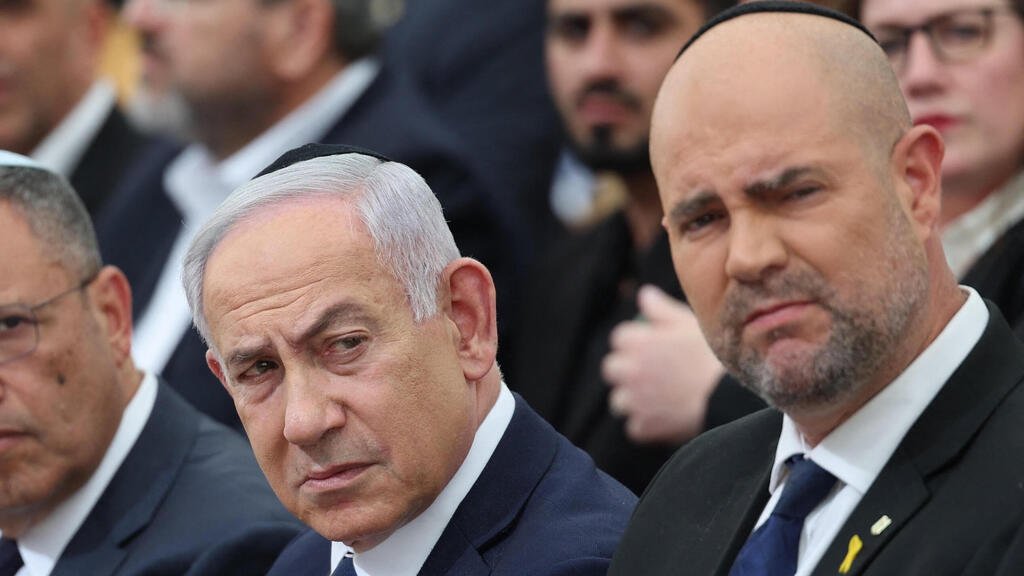
Prime Minister Benjamin Netanyahu and Knesset Speaker Amir Ohana
(Photo: Abir SULTAN / POOL / AFP)
The next step is approval to convene a special ministers’ committee to define the panel’s mandate. That group could determine the scope of the inquiry — whether it will focus solely on military operations or also cover political, social and other issues — and the time period under review, such as the years immediately preceding the attack, the period since the disengagement from Gaza or earlier.
Netanyahu reportedly wants to hold the first ministers’ committee discussion soon and aides say additional sessions may follow.
Coalition leaders have sought to pressure the opposition into cooperation by pushing the legislation, saying, “If there is a law that passes in three readings, they will have no choice but to cooperate.”
Netanyahu’s circle acknowledges the sensitivity of the issue among the public and bereaved families and that is a reason he has taken a personal role. His intention is to establish the committee and its framework before any potential Knesset dissolution to control its structure and ensure appointments are made before it is formed.
Opposition leaders harshly criticized the coalition's proposed inquiry panel into the Oct. 7 attacks, calling it a political maneuver to avoid accountability.
Opposition leader Yair Lapid of the centrist Yesh Atid Party rejected the plan outright, labeling it “a whitewash committee.” Former prime minister Naftali Bennett said the bill amounted to “the investigated appointing the investigators,” calling it a betrayal of bereaved families and a means to evade responsibility for years of failed policy. He pledged to dismantle the committee if returned to power.
Yashar Party chief Gadi Eisenkot said the proposal was not an investigative committee but a “committee for escaping responsibility.”
The October Council, a group representing more than 1,500 bereaved families, hostages’ relatives and survivors of the 2023 Hamas attacks, also condemned the bill, calling it a “political cover-up” aimed at obstructing the truth. The group criticized the provision granting Knesset Speaker Ohana power to appoint committee members, citing his prior role in the 2021 Meron disaster—a deadly stampede at a religious festival that left 45 people dead—for which a state commission held him personally responsible.