

Seven months after Operation Roaring Lion, as the prime minister and defense minister appear to be seeking to stoke fears of a surprise attack by Iran or Hezbollah, residents whose homes were damaged in the latest round of fighting against the Iranian regime told ynet how they have been coping more than six months after being left without homes to return to. They also addressed the possibility that Israel could be heading into another round of fighting.
Meanwhile, following Netanyahu's statement that Tehran "is once again trying to develop its weapons of death" and a report that U.S. President Donald Trump had thwarted an Israeli strike on Iran, American officials told Reuters that the State Department plans to evacuate some diplomatic staff and their families from Saudi Arabia. According to the officials, the move stems from concerns about an escalation in fighting, particularly involving the Houthis in Yemen.
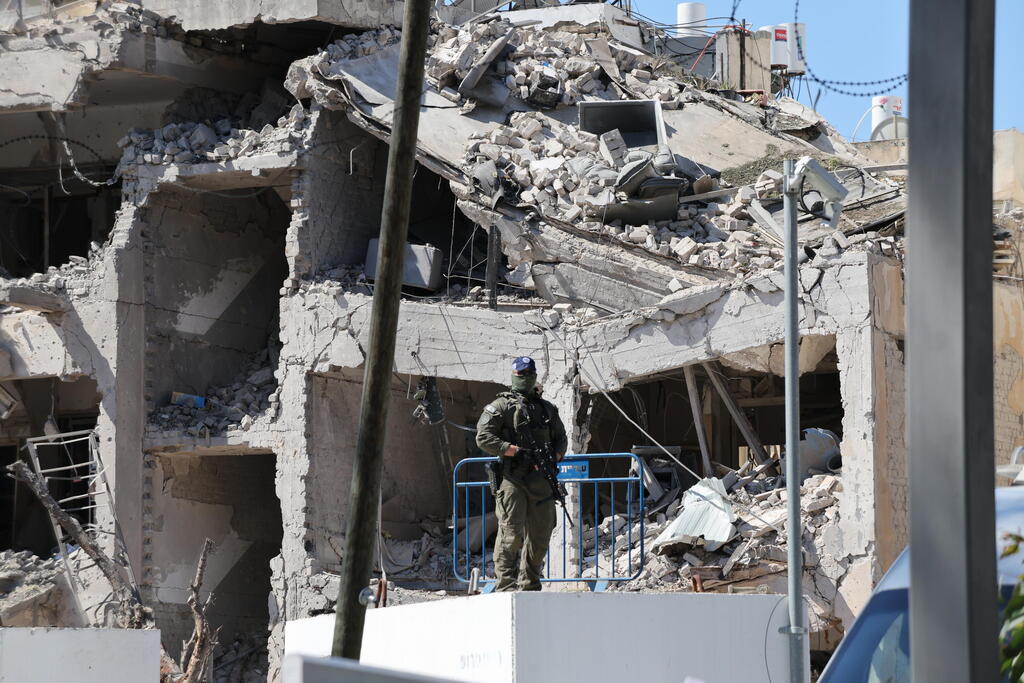
A building struck in Tel Aviv at the start of the war
(Credit: Yariv Katz)


Regine Shoshan, 55, lost everything when an Iranian missile destroyed her apartment on Yehuda Halevi Street in Tel Aviv on the first night of Operation Roaring Lion. Seven months later, she is still struggling to rebuild her life.
"My home was completely destroyed. I lost everything. Everything. Everything. Nothing was left. I walked out that night with nothing but the clothes I was wearing, and that was it," she said.
"I lived in that apartment for 10 years. Over the past few years, I'd been working on my master's thesis, writing plays and poetry, and preparing lesson plans and workshops I wanted to teach. I had photography equipment and a home I'd made my own, where I could invite people over. I don't do any of those things anymore."
Shoshan now lives in a rented apartment but has been reluctant to replace the possessions she lost.
"I'm homeless, but I've got style," she joked. "I've rented an apartment, but it's an Airbnb-type place because I didn't want to buy anything. I'm still paying rent for my old apartment, which the state is covering, but that won't last forever. Because I was a tenant, I get no compensation for losing my home. The compensation from the Tax Authority is woefully inadequate."
Along with the loss of her home, Shoshan has had to contend with a maze of bureaucracy and a lack of ongoing psychological support.
"I still haven't been officially recognized as someone harmed in an enemy attack, even though that's exactly what happened to me. All the bureaucracy and paperwork are a huge headache. The night the missile hit, I was taken to the hospital. I later received 24 sessions with a psychologist through Amcha, a nonprofit organization. But those sessions have ended, and now I'm left hanging.
"I have no support. Nobody calls to ask how I'm doing or what I need. I'm fighting this battle alone."
Adding to her frustration, companies are still demanding that she return equipment destroyed in the strike.
"My television provider wants its equipment back because I canceled my subscription. I keep trying to explain that there's nothing to return. It's all gone. The same thing happened with my water dispenser. It's absurd and heartless."
For Shoshan, the destruction of her home was the second devastating blow her family suffered in the wars with Iran. During the first confrontation, Operation Rising Lion, an Iranian missile directly hit her parents' home, destroying it completely. Both were hospitalized for three months.
"When I hear people talking about another war with Iran, I almost feel numb. I'm shocked by the very idea," she said.
"I've had to shut down all my anxiety because I started feeling the stress in my heart. My ECG was abnormal, and so was my cardiac CT scan. The damage isn't just financial. It takes a physical toll, too."
She has not been able to return to work since the strike.
"I'm not working right now. I just haven't been able to work since it happened."
'They put us in terrible neighborhoods, without safe rooms'
In Dimona, Ziva Abuaziz, 47, is facing a similarly uncertain future. Her apartment building was hit in the Iranian missile attacks in March and is now slated for demolition.
"Our building is slated for demolition. It was too badly damaged to be repaired," she said. "Other residents were able to renovate their homes and move back in. The municipality tried to help us, but there's only so much it can do."
For the residents of her building, many of whom live in public housing managed by Amidar, a state-owned housing company, the uncertainty has dragged on for months.
"Nothing is clear. They've left the Amidar tenants waiting. Nobody knows what's going to happen to us," she said.
"Time is running out. We were given a year's rental assistance from the day of the strike. We had to set up a residents' committee to get things moving, but in the end, we realized we were just being pushed around. Nobody remembers us. We survived the strike and the trauma, but we've been forgotten."
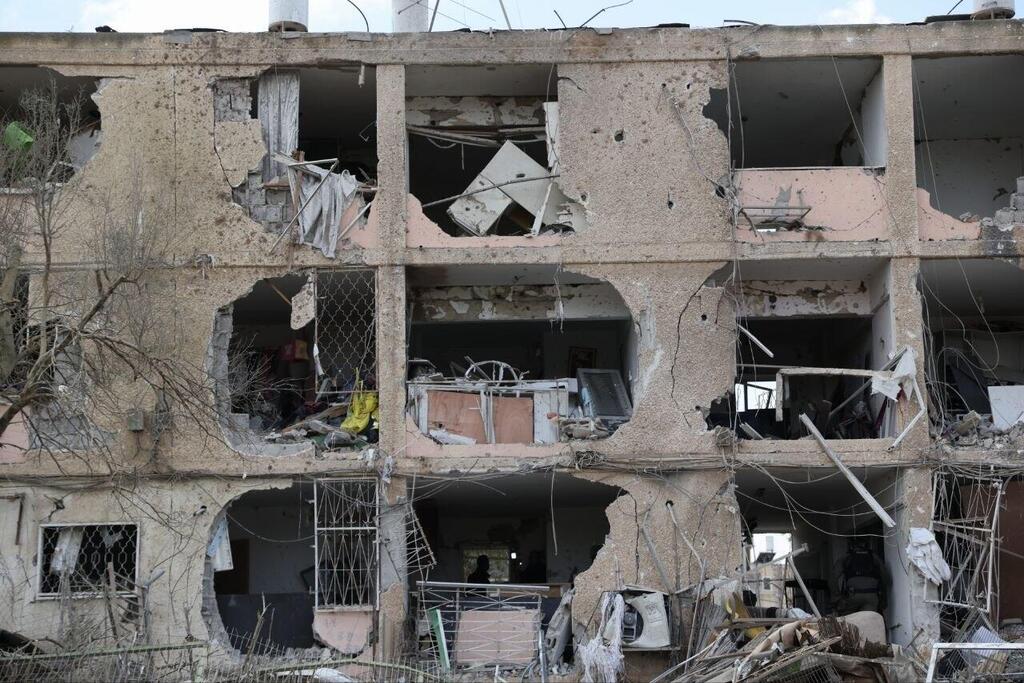
Extensive damage caused by the Iranian missile strike in Dimona
(Photo: Alex Kolomoisky)
Abuaziz said the attack also had a devastating effect on her husband, who has a disability.
"The attack undid years of progress my husband had made. Soon a year will have passed, and the rental assistance will end. The Tax Authority has been our lifeline and has helped us, but we have no idea what's going to happen next.
"Who are we supposed to wait for? How much longer are we supposed to wait? I don't have any answers.
"They gave us alternative housing in terrible neighborhoods, without reinforced safe rooms. That means having to run to public shelters again. My husband is disabled. He can't run to a shelter. But nobody seems to care. Unfortunately, no one has managed to help us."
With the possibility of another war looming, Abuaziz said she feels increasingly helpless.
"We're at a loss. This is a city of tens of thousands of people, and even at the cemetery where I work, we still don't have a protected space.
"If, God forbid, there's another round of fighting, and unfortunately it looks like there will be, I won't go to work. I pray it doesn't happen.
"Unfortunately, the wrong people are making the decisions. How many rounds have we already been through? Two. We were hit in the second one."
'We miss the peace and quiet, the greenery and our neighbors'
In Haifa, seven months have passed since an Iranian ballistic missile struck an apartment building on Shimshon Street, causing extensive destruction and ultimately claiming five lives.
The fifth victim, Michael Katz, 82, died in July from injuries he suffered when the missile directly hit his building on April 5.
Katz was pulled from the rubble in critical condition and fought for his life for more than three months. Despite prolonged hospital treatment, he eventually succumbed to his injuries, bringing the death toll from the strike to five.
Work at the site of the missile strike on Shimshon Street in Haifa
(Video: Elad Gershgoren)
The evening strike at 57 Shimshon Street was the deadliest attack on Haifa during the war. Four members of the Gershovitz family, who lived on the building's first floor, were killed.
Katz, who turned 82 in May, had worked for decades at Rafael, the Israeli defense technology company, contributing to the country's defense capabilities. He was also a recipient of the Rafael Prize.
He is survived by his wife, Nina, his sons, Itamar and Yoav, and six grandchildren.
All eight families living in the building were forced to move into rental properties in the area, where they are expected to remain until a new building is constructed.
The badly damaged building was demolished several months ago. Residents estimate that the planning and approval process, followed by construction, could take another four or five years.
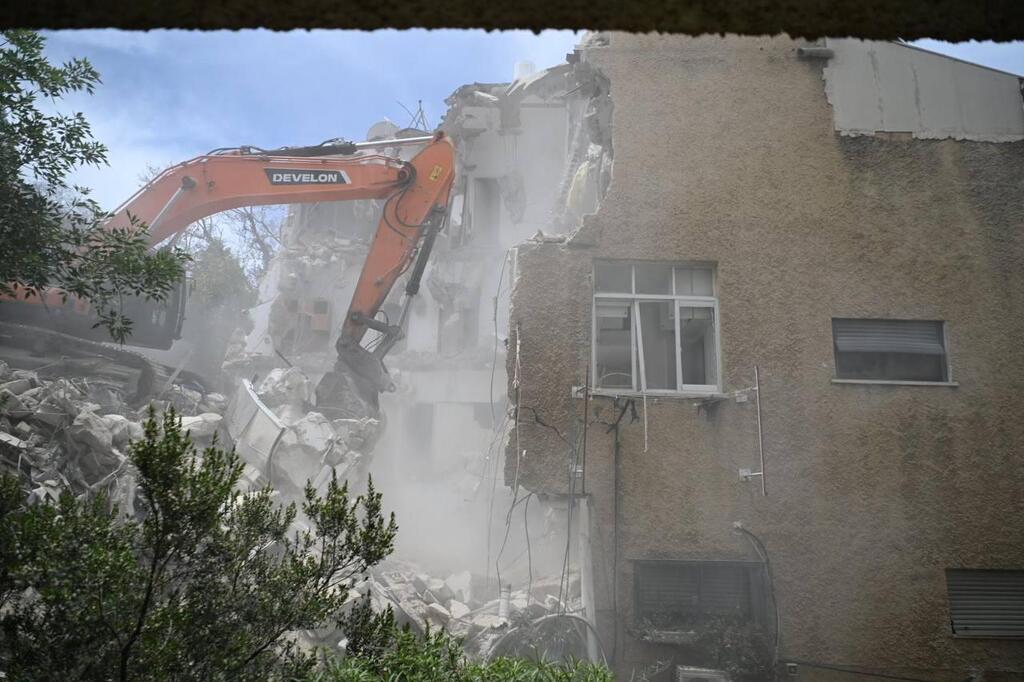
Demolition of the apartment building in Haifa where members of the Gershovitz family were killed
(Photo: Reuven Cohen, Haifa Municipality)
Among those displaced were Tal Aharonovitch, 44, his wife, Orian, 37, and their son, Ilay, who is about a year old. The family has since moved into a rented apartment on Mount Carmel.
"At first, we stayed with relatives. This week, we finally moved into a rented apartment, with a lot of help from the Home Front Command and Haifa Municipality," Tal said.
"We'd lived there for almost four years when a missile hit our six-story building, destroying everything in seconds.
"And of course, there was the terrible tragedy of the four family members on the first floor who didn't make it to the shelter in time and were killed."
Tal, deputy head of the security department at Rambam Medical Center, remembers every moment of the attack.
"It was evening, and we were giving the baby a bath when the early warnings came through. We didn't hear our phones. Just as we finished bathing him, the siren went off," he recalled.
"The shelter was three floors below us, and we knew we wouldn't make it in time. A few seconds later, there was an enormous explosion.
"We threw ourselves over Ilay to protect him as the apartment filled with shattered glass and smoke. Then we went down to the shelter, where our neighbors helped us."
He knew immediately that the missile had hit nearby.
"The explosion was so powerful that I realized it had to be very close. When the rescue teams arrived, we went outside and saw the scale of the destruction.
"We went to the hospital to get checked out and were discharged, but we knew we had no home to go back to."
The family is now trying to settle into its new surroundings, but Tal said they still miss their former home.
"We've moved to Mount Carmel, but we miss our old place terribly. The Tax Authority is helping us cover the rent for now.
"We miss the peace and quiet, the greenery and our neighbors. They were wonderful people.
"Everything was destroyed in a moment. It was a terrible tragedy. Five people lost their lives in that building."
Although a new building is planned, Tal knows it will be years before the family can return.
"Every so often, we drive by and stop to look at where our building used to stand. We hope construction will start soon, but we know that with all the permits and approvals, it's going to take years."
'Netanyahu is desperately trying to shift the focus to security'
Meanwhile, senior Israeli officials sharply criticized Netanyahu's remarks at an IDF officers' graduation ceremony in southern Israel.
The officials rejected his warnings of an imminent existential threat from Iran.
"There's nothing even close to what Netanyahu described," they said. "We are not facing an existential threat, and Iran is not once again trying to develop 'bombs of death,' as he claimed."
They accused Netanyahu of trying to divert public attention from domestic issues.
"Netanyahu is desperately trying to put security back at the center of the public agenda," the officials said. "Anything to avoid talking about the ultra-Orthodox or the chaos in the government's management."
However, another Israeli source familiar with the intelligence assessments offered a different view, saying Iran had resumed work on its nuclear program and was seeking to improve its readiness.
"The Iranians have indeed restarted their nuclear program, and they want to reach a point where they're ready," the source said.
"That's why I believe another strike is only a matter of time. I don't think it will happen before the elections in Israel and the United States because of various constraints, but it could happen immediately afterward."
The source said the developments had also prompted efforts to accelerate diplomatic negotiations in hopes of reaching an agreement.
"There's a push to speed up the talks and try to reach a deal," the source said. "But as far as the diplomatic track goes, I think the chances of actually reaching an agreement are extremely slim."