


Israel has been without an ambassador to Britain for nearly a year as its designated envoy, a senior aide to Prime Minister Benjamin Netanyahu, remains unable to leave the country amid a criminal investigation — leaving the post vacant as relations between Jerusalem and London deteriorate and Britain weighs new sanctions against Israel.
Tzachi Braverman, whom the Israeli government appointed ambassador to the United Kingdom, is suspected of obstruction of justice, fraud and breach of trust in a case involving allegations that he sought to interfere with a security investigation connected to the Prime Minister’s Office. Restrictions imposed as part of the investigation have prevented him from traveling abroad.

A British diplomat said the British government has approved Braverman’s appointment and has no objection to his taking up the post in London. Israeli authorities, however, are still considering his status.
Former Civil Service commissioner Daniel Hershkowitz had considered suspending Braverman. Foreign Minister Gideon Sa’ar argued at the time that Braverman should be allowed to leave for his diplomatic posting, but Hershkowitz left the decision to his successor, Doron Cohen.
Cohen later held discussions with Foreign Ministry Director-General Eden Bar Tal and initially decided not to suspend Braverman. Shortly afterward, however, prosecutors published a formal statement detailing the suspicions against him, prompting Cohen to hold another hearing. No final decision has been made.
Sa’ar’s position is that as long as Braverman has not been indicted and no decision has been made to suspend him, he can and should leave Israel to take up the ambassadorship.
“No decision has yet been made on the matter because it is still under review, as is customary,” the Civil Service Commission said.
The prolonged uncertainty comes as Israeli-British relations enter an increasingly confrontational period.
An antisemitic attack in London's Golders Green


Britain is expected to decide whether to impose additional sanctions on Israel. Measures under consideration include banning trade with Israeli settlements in the West Bank and expanding restrictions on arms exports to Israel.
Sa’ar has warned that Israel would respond with significant measures of its own if Britain takes action against it.
Israeli officials believe the British decision to consider sanctions predates the approval of the controversial E1 settlement plan in the West Bank. They point to previous statements by Britain’s new prime minister, Andy Burnham, who said Britain had been too lenient toward Israel and should adopt a significantly tougher approach.
Israel has also received information indicating that Britain was considering such sanctions well before the E1 plan was approved and had been coordinating with other European countries, according to the Israeli assessment.
Israeli officials also believe British domestic politics may be playing a role, citing the Labour Party conference later this month and political competition between Labour and the Green Party.
Israel recently worked to block similar measures within the European Union. The Netherlands, Spain and Ireland promoted steps against Israel but failed to secure the necessary consensus after Sa’ar held intensive talks with EU foreign ministers.
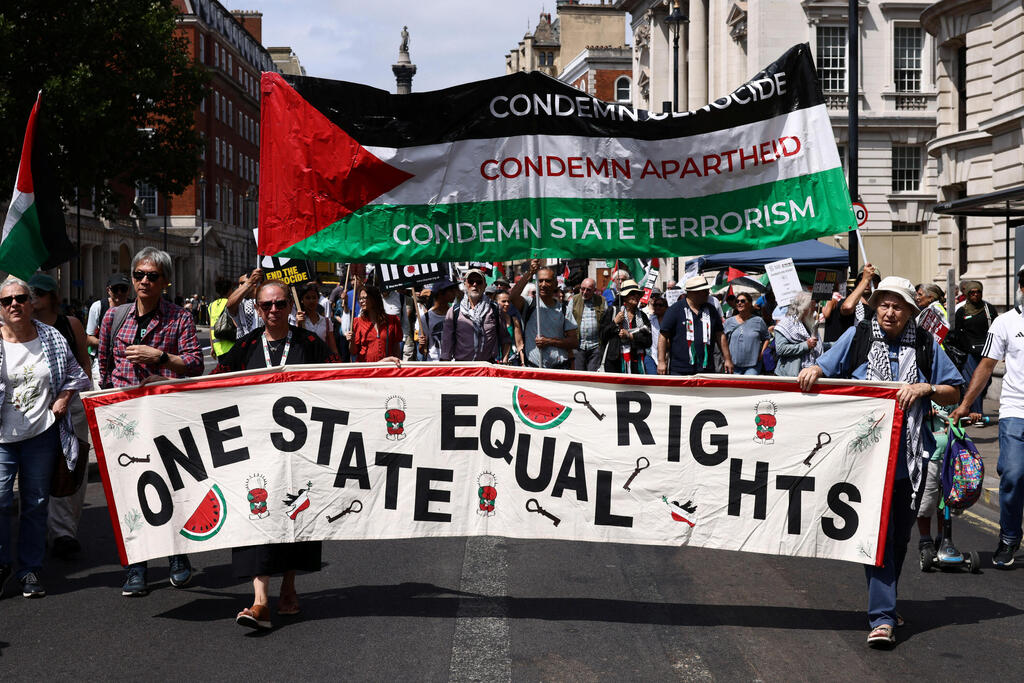
A pro-Palestinian rally in London
(Photo: REUTERS/Jack Taylor)
Over the past year and a half, the Foreign Ministry has also sought to block attempts to take action against the EU-Israel Association Agreement, which provides the framework for political and economic relations between the two sides. Those efforts began in spring 2025 and continued at the latest meeting of EU foreign ministers.
The proposals have so far failed to advance, which Israeli officials attribute to intensive diplomatic efforts and opposition from a bloc of EU countries friendly to Israel.
Israeli officials are now preparing for a possible British sanctions decision. Sa’ar has held a series of discussions and drawn up potential Israeli responses depending on the measures London adopts.
In his discussions with European foreign ministers, Sa’ar has also rejected criticism of the E1 settlement plan, calling claims that it would break the territorial continuity of a future Palestinian state “ridiculous.”
The E1 project, planned for an area between Jerusalem and the settlement of Maale Adumim, has long drawn international opposition because critics say construction there could severely disrupt territorial contiguity between Palestinian population centers in the West Bank.