


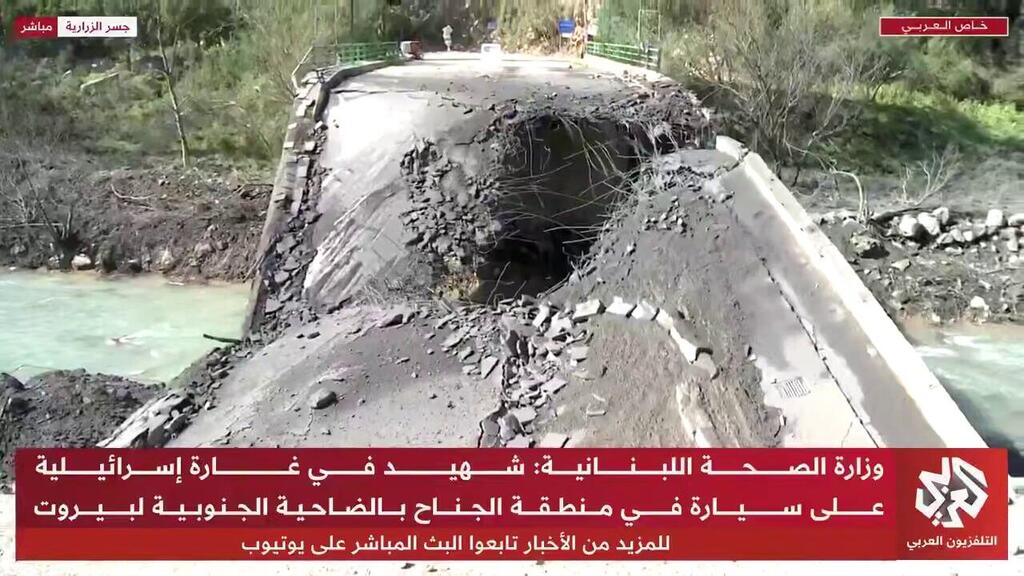
There is a significant blow to Hezbollah’s overland supply routes. The IDF’s operations against the Shiite terror group have taken a turn in recent days with the decision to bomb bridges in southern Lebanon. On Friday, immediately after the IDF struck the Zrariyeh Bridge over the Litani River, the military said: “Hezbollah uses this bridge to move from the north to the south of the country, prepare for combat against IDF forces and operate against the citizens of the State of Israel.”
Footage of the destroyed bridge circulated in Lebanon. The network Al-Mayadeen, which is aligned with Hezbollah’s axis, complained that the IDF is working to sever connections to southern Lebanon by striking several roads and bridges. On Saturday, reports in Lebanon also said the Khardali Bridge had been attacked. The bridge connects the Nabatieh area with the Marj Ayoun region in southern Lebanon.
The bridges in southern Lebanon have logistical and humanitarian importance. They connect residents of southern Lebanon to other parts of the country and facilitate the transportation of goods and essential supplies in normal times. Hezbollah uses these routes for terrorist purposes, exposing them to danger and harming, first and foremost, Lebanese civilians.
Struck in the Second Lebanon War and rebuilt
In a video posted by the Lebanese newspaper An-Nahar on X, several key bridges in southern Lebanon were mentioned. One is the Qasmiyeh Bridge over the Litani River, located north of the city of Tyre in the western part of southern Lebanon, which is also known as an important port city. The Qasmiyeh Bridge connects the Zahrani and Sidon areas to the entire southern region that includes Tyre and nearby villages. The bridge was attacked during the Second Lebanon War in 2006 but was later rebuilt.
Another bridge mentioned in Lebanon is Wadi al-Hujeir. Last week, reports in Lebanon claimed it had also been struck. According to An-Nahar, the bridge is located in southern Lebanon not far from Marj Ayoun, north of the Israeli town of Metula. The report said it is an important bridge connecting the Marj Ayoun area with villages closer to the border with Israel. According to the newspaper, the bridge serves as a tactical target during military operations when there is a need to restrict movement or control the area.
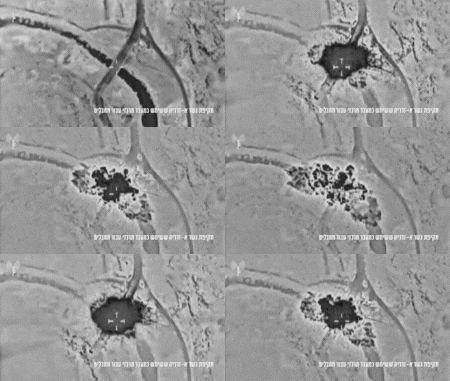
IDF struck the Zrariyeh Bridge over the Litani River
The video also reported the attack on the Khardali Bridge over the Litani River. This bridge connects the Marj Ayoun area with the Nabatieh region, effectively linking the area eastward to roads leading toward Lebanon’s western Bekaa region. This bridge was also attacked by Israel in 2006. An-Nahar noted that it is a strategic point that can serve as an observation and monitoring position over supply routes.
Regarding the Zrariyeh Bridge, whose strike the IDF confirmed, An-Nahar said it is a vital artery for southern villages. It is also known as the Tir Falsayeh Bridge because it connects the villages of Zrariyeh and Tir Falsayeh in southern Lebanon. The bridge effectively links the Tyre area with the Zahrani region. It was built in 1992 and was also struck in the past, in 1996 and 2006, before being rebuilt.
The bridge is 43 meters long and about 12 meters wide. An article on An-Nahar’s website noted that trucks and private vehicles normally pass over it and that it is used to transport goods and basic supplies from the port of Tyre and the coastal areas to inland regions.
On the Lebanese network MTV, which is known for its opposition to Hezbollah, commentators noted that “when crossings that connect the operational area to rear areas are destroyed, the ability to transfer supplies or move military reinforcements becomes significantly more difficult, and the area gradually turns into a semi-isolated zone. This appears to be what is happening in the area between the border with Israel and the Litani River, where the destruction of bridges and the cutting of roads are reducing military and logistical movement between the south and the rest of Lebanon.”
However, as can be understood from the history of these bridges — which have previously been struck and rebuilt — the damage represents a temporary disruption, including to Hezbollah’s operations.
First published: 21:39, 03.16.26