

Events in Lebanon marking the anniversary of the assassination of former Hezbollah leader Hassan Nasrallah were set to reach their peak Saturday, with ceremonies in several locations and a speech by the group’s current chief, Naim Qassem, scheduled for the evening.
The commemorations have stirred tensions in Lebanon over the past several days. Despite an order from authorities, Hezbollah projected images of Nasrallah and his slain successor Hashem Safieddine onto Beirut’s Raouche Rock. At the same time, the government refused to allow two Iranian planes carrying officials and clerics to land for the events.
Gallery
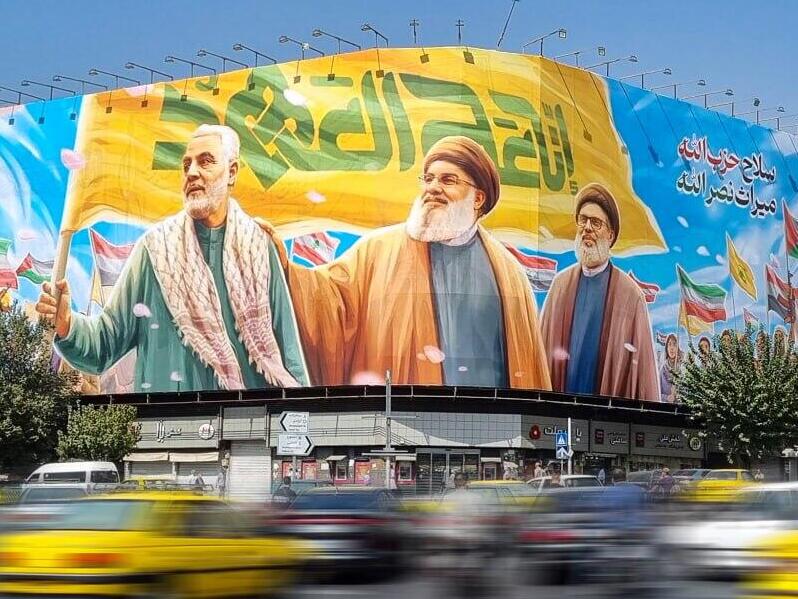
A banner in Tehran’s Revolution Square marking one year since the assassination of Hassan Nasrallah
Ceremonies were scheduled to begin at 4:30 p.m. at multiple sites, including Nasrallah’s shrine in Beirut, Safieddine’s burial site in the southern village of Deir Kannon al-Nahr, and the shrine of Abbas al-Musawi — a Hezbollah leader killed in 1992 — in the Beqaa Valley village of Nabi Shayth. A broadcast of Qassem’s speech was expected, followed by a minute of silence at 6:21 p.m., the exact time of Nasrallah’s assassination in Beirut’s Dahieh district.
Earlier in the day, Lebanese media reported that an Israeli military drone struck near a house in the border village of Maroun al-Ras in southern Lebanon.
Iranian official visits despite restrictions
While Beirut reportedly barred Iranian planes from bringing a delegation, Ali Larijani, secretary of Iran’s Supreme National Security Council, arrived in Lebanon for the ceremonies. Speaking to Al-Mayadeen, a Hezbollah-affiliated television channel, Larijani said Nasrallah’s predictions about Israeli actions in the region had been proven correct.
The Lebanese newspaper Al-Akhbar ran a front-page cover of Nasrallah with the caption “The Eternal.”
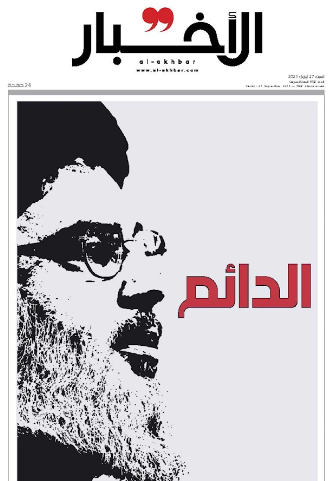
'The Eternal'
Larijani said Israeli aggression in the region demonstrated Nasrallah’s warnings about attacks on neighboring states. He described Lebanon as “small geographically but great and strong through its people,” and called the country a stronghold against Israel. He added that the Iranian delegation planned to hold meetings during the visit.
An event in Beirut’s Dahieh district marking one year since the assassination of Hassan Nasrallah


The Islamic Revolutionary Guard Corps also issued a statement marking the anniversary. The IRGC noted that Iranian General Abbas Nilfarushan, commander of the Lebanon and Syria division in the Quds Force, was killed alongside Nasrallah. The statement declared that “enemies of the resistance will be humiliated” and claimed that efforts by Israel and the United States to weaken or dismantle Hezbollah had failed repeatedly. It described Hezbollah as not just a military organization but an “identity, ideology and culture rooted in the people.”
Projection on Beirut landmark triggers backlash
Two days before the anniversary, Lebanese Prime Minister Nawaf Salam issued an order tightening restrictions on the use of public lands, maritime areas, archaeological sites and tourist attractions. The order required special permits for such use. While Hezbollah was not mentioned by name, the order was understood to prohibit the projection of images onto Raouche Rock.
Despite that, Hezbollah went ahead with the projection, displaying the faces of Nasrallah and Safieddine on the rock. Supporters waved Hezbollah and Amal movement flags, as well as Iranian banners, while chanting pledges of loyalty to Nasrallah.
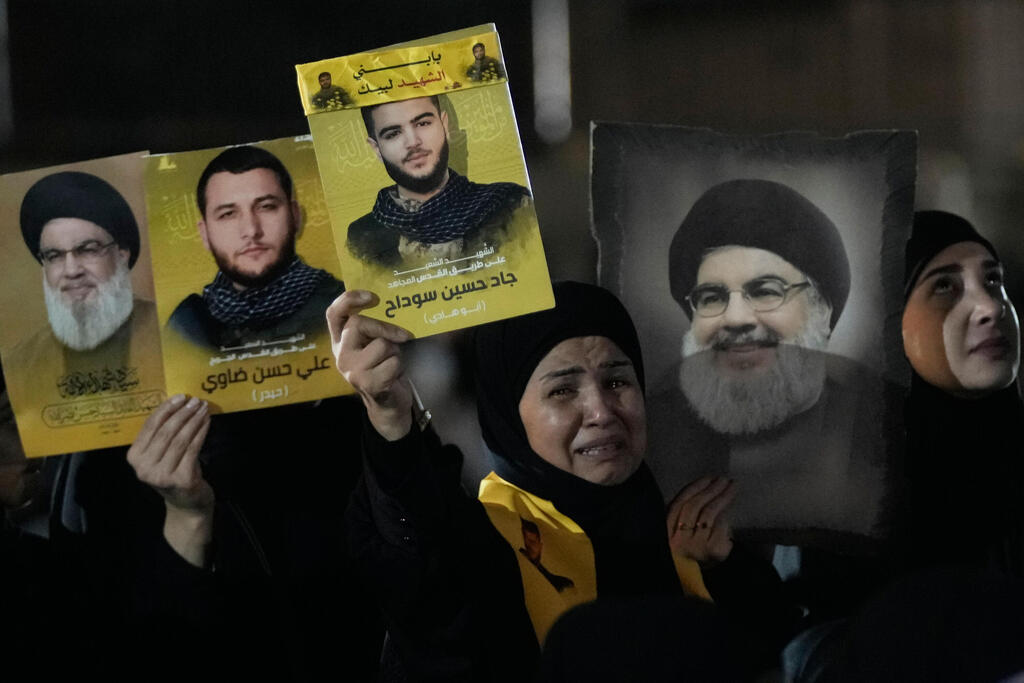
(Photo: AP Photo/Hassan Ammar)
Salam later condemned the act, saying it violated the permit granted by the Beirut governor, which explicitly forbade illuminating the rock by land, sea or air. He said he had instructed the ministers of interior, justice and defense to take action, including the arrest of those responsible.
Regional concerns
Asharq Al-Awsat, a Saudi newspaper, reported that the Iranian embassy in Beirut had requested approval for two planes carrying officials and clerics to attend the ceremonies. Lebanese authorities considered the request but, according to the report, could not secure guarantees from the United States that Israel would not strike the planes.
The anniversary comes as the Lebanese government faces pressure to implement a plan to disarm Hezbollah and place all weapons under state control. The decision was formally approved on Sept. 5 and presented by Lebanese army commander Lt. Gen. Rudolphe Heikal.
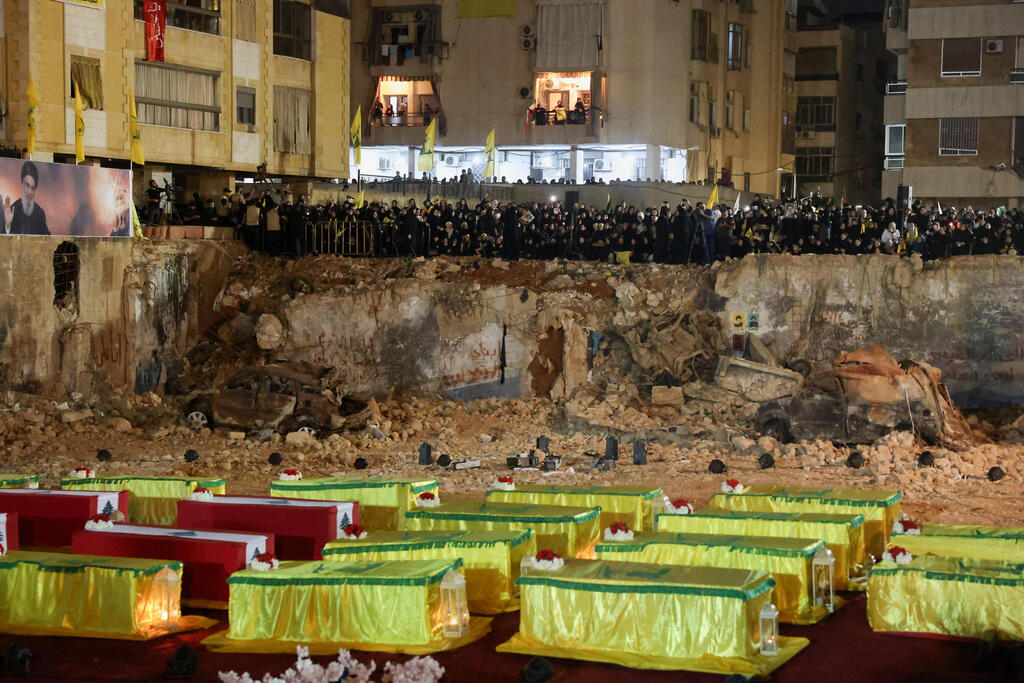
(Photo: REUTERS/Mohamed Azakir)
Hezbollah has strongly rejected the plan, insisting that any discussion on disarmament must be part of what it calls a national defense strategy. The group says the government should instead focus on halting Israeli strikes, forcing a withdrawal from southern Lebanon, securing the release of Lebanese prisoners and rebuilding war damage.
In an interview with the Lebanese daily Al-Jumhuriya, a senior political figure described the situation as “critical,” warning that Lebanon had reached “an abyss from which only a miracle can save us.” He said political options were blocked and the country had been left to face the crisis alone, adding that Lebanon was “open to all possibilities and perhaps even dangerous surprises.”
Assassination of Nasrallah
Nasrallah was killed in September last year during the IDF's Operation New Order. More than 80 penetrator bombs, each weighing a ton, were dropped on the underground bunker where he was hiding in Dahieh along with other Hezbollah officials.
This week, Yedioth Ahronoth and Ynet reported that Mossad agents had infiltrated the area of the bunker in advance of the operation and planted special devices designed to ensure precise strikes at varying depths.