

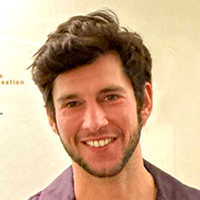
Every morning, as the doors of the Church of the Holy Sepulchre in Jerusalem are opened, an unusual ritual takes place. A member of the Nusseibeh family, one of the city's oldest Muslim families, receives a heavy iron key from a representative of the Joudeh family, climbs a small wooden ladder and opens the doors to one of Christianity's holiest sites.
This division of responsibilities has continued for centuries, intended to preserve the delicate balance among the rival Christian denominations. Now, a member of the Nusseibeh family is seeking to take on an equally complex role: leading the United Nations.
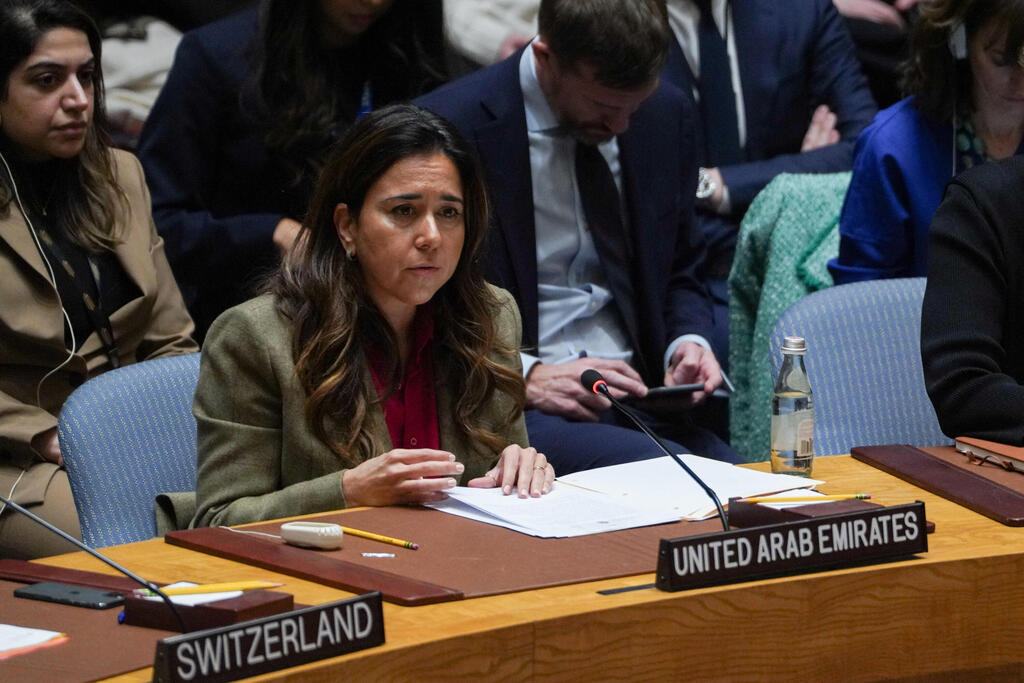
Lana Zaki Nusseibeh, 48, a senior diplomat from the United Arab Emirates, has officially entered the race to succeed UN Secretary-General António Guterres, whose term ends at the end of the year.
Her candidacy was submitted by UAE President Mohammed bin Zayed. A day later, all six members of the Gulf Cooperation Council, including Saudi Arabia and Qatar — two countries whose relations with Abu Dhabi have not always been smooth — unanimously endorsed her candidacy. The move represents a significant show of regional support, although it does not, at this stage, amount to the backing of the Arab bloc at the UN.
Her father became an adviser to the UAE's founder
Nusseibeh was born in Abu Dhabi in 1978, but her family's story begins in Jerusalem. Her father, Zaki Nusseibeh, was born in the city in 1946. When the Six-Day War broke out, he was studying at Cambridge University in England. The war disrupted his plans to return home, and he traveled to Abu Dhabi with a collection of about 100 books.
He initially worked as a journalist, including for Western media outlets, before becoming the personal interpreter and one of the closest advisers to Sheikh Zayed, the founder of the United Arab Emirates. He remained close to the ruling family for decades and now serves as cultural adviser to the country's president.
Anwar Nusseibeh, Lana's grandfather, was a prominent figure in Palestinian and Jordanian politics. He was wounded in the 1948 war and lost a leg, later serving as Jordan's defense minister and governor of Jerusalem under Jordanian rule.
After the Six-Day War, he held secret talks between Israel and Jordan over the future of the West Bank and maintained contacts with Moshe Dayan and then-Jerusalem Mayor Teddy Kollek. He later argued that the Arab world's greatest failure was missing the opportunity to establish a Palestinian state alongside Israel under the 1947 UN partition plan.
Sari Nusseibeh, Lana's uncle, is a philosopher and former president of Al-Quds University. He was appointed by Yasser Arafat as the Palestine Liberation Organization's representative in Jerusalem and later joined forces with former Shin Bet chief Ami Ayalon to launch the People's Voice peace initiative.
When he concluded that efforts toward a two-state solution were making no progress, he called on Palestinians to begin discussing a one-state solution.
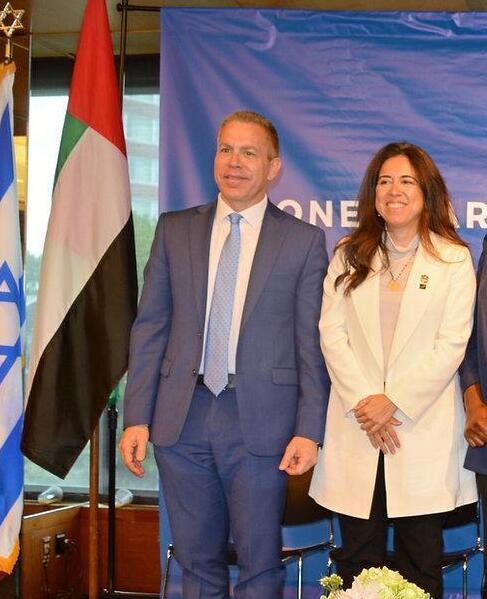
Lana Nusseibeh with then-Israeli Ambassador to the UN Gilad Erdan at an event at the Museum of Jewish Heritage in New York
(Photo: AJC)
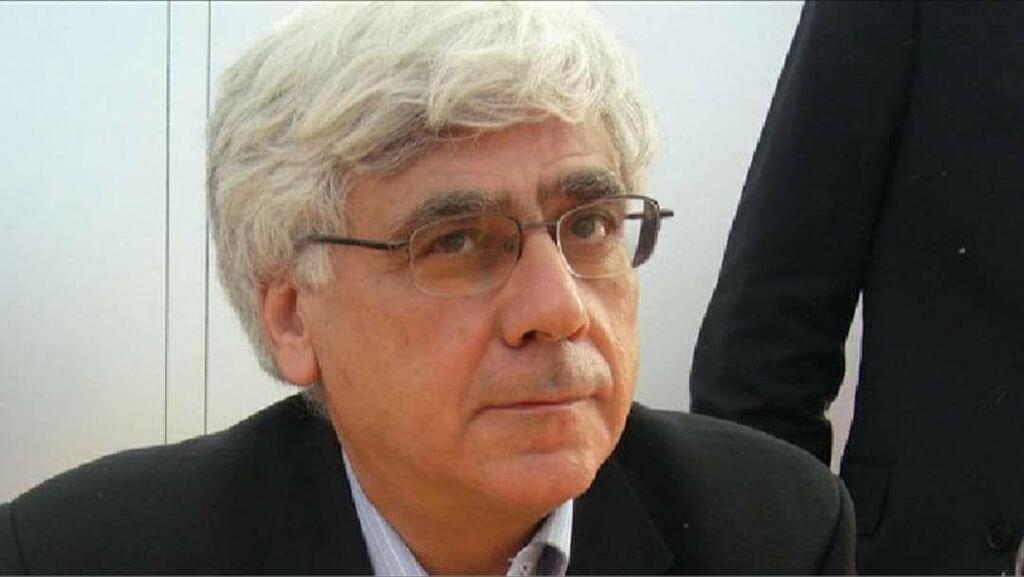
Her uncle, Sari Nusseibeh, joined former Shin Bet chief Ami Ayalon to establish the People's Voice peace initiative
Growing up in a family that had been involved in politics, religion and the fate of Jerusalem for generations, Lana initially wanted to pursue a different path.
"Like any normal child, I thought I would do exactly the opposite," she once said of her family's diplomatic tradition.
She attended Wycombe Abbey, a prestigious girls' boarding school in England, before studying history at Cambridge University. She then chose a particularly unexpected field for someone from a Palestinian family: a master's degree in Israeli and Jewish Diaspora studies at the University of London, graduating with honors in 2003.
In addition to Arabic and English, she speaks French and Hebrew.
Professor Colin Shindler, a scholar of Israel and Zionism who taught Nusseibeh, described her as "a brilliant student who submitted in-depth papers on Zionism and Israeli history." According to Shindler, she later played a significant role in advancing the Abraham Accords.
Shindler recalled visiting her father's home in Abu Dhabi and finding the Encyclopaedia Judaica and numerous books on Jewish history in his extensive library. The 100 books Zaki Nusseibeh brought with him from Jerusalem eventually grew into a private collection of more than 40,000 volumes.
Lana Nusseibeh began her career advising UNESCO in Paris and conducting research on security and terrorism. In 2009, she established the Policy Planning Department at the UAE Foreign Ministry, and in 2013, she became the first woman appointed as the UAE's ambassador to the United Nations.
She remained in New York for more than a decade, representing her country on the Security Council in 2022 and 2023 and twice presiding over the council during the UAE's rotating presidency.
In an earlier interview, she said she had tried to escape the family tradition of politics but ultimately discovered that she was drawn to it.
Accused Israel of indiscriminate bombing in Gaza
From Israel's perspective, Nusseibeh's record is complicated. Over the years, she has maintained ties with Jewish organizations and, following the Abraham Accords, participated in meetings with American Jewish community leaders.
After the October 7 massacre, she explicitly condemned the killing of Israeli civilians and the taking of hostages, making clear that Hamas did not represent the Palestinian people.
At the same time, she accused Israel of indiscriminate bombing in Gaza, demanded a ceasefire and strongly opposed the possibility of annexing territory in the West Bank.
In September 2025, she warned that annexation of territory in the West Bank would constitute a "red line" for the UAE and could spell the end of the vision of Israel's regional integration.
"There is an outstretched hand, despite all of this misery, in the region to Israel. But annexation would withdraw that hand," she said.
She also expressed hope that Trump, who signed the Abraham Accords during his first term, would not allow what she considers one of his major achievements to be undermined.
In December 2023, Nusseibeh was one of the key figures behind UN Security Council Resolution 2720, aimed at expanding humanitarian aid to the Gaza Strip. She took pride in organizing a visit by Security Council members to the Rafah crossing so they could see the situation for themselves.
In February 2024, she also led the UAE delegation at hearings before the International Court of Justice in The Hague on the legality of Israel's presence in Palestinian territories.
In her address, she accused Israel of serious violations of international law, indiscriminate bombing in Gaza and infringement of the Palestinians' right to self-determination.
"International law cannot be an à la carte menu; it must apply equally to all," she told the judges.
When she concluded her tenure, Palestinian Ambassador to the UN Riyad Mansour presented her with a plaque in recognition of her work.
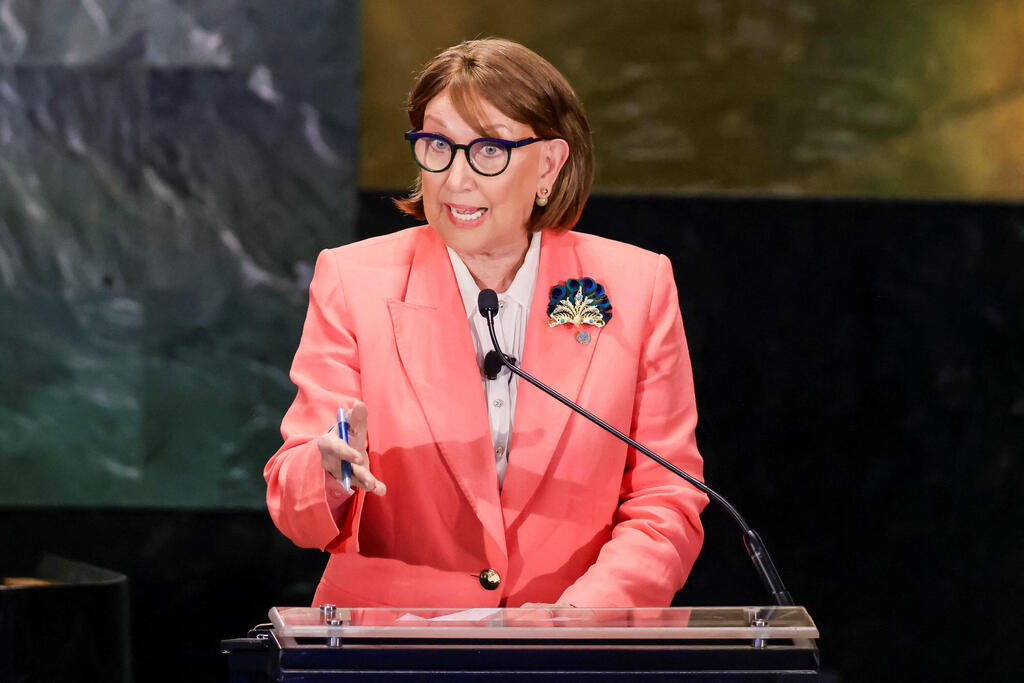
Rebeca Grynspan, Costa Rica's candidate for UN secretary-general
(Photo: REUTERS/Eduardo Munoz)
Why enter the race so late?
But why enter the race now, with just over two months remaining in Guterres' term?
The answer lies in six secret straw polls held by the Security Council.
The leading candidate, Rebeca Grynspan, a Jewish candidate from Costa Rica, received nine votes in favor in the latest round — the number required for appointment — but two representatives of the five permanent Security Council members voted against her. The other candidates also faced opposition from powers with veto authority.
The deadlock has attracted interest at the White House. Trump is dissatisfied with the field of candidates and is looking for a "disruptive figure" who would lead substantial reform at the UN.
Nusseibeh's name has already come up in discussions about alternative candidates, alongside surprising possibilities such as FIFA President Gianni Infantino and former Turkish Foreign Minister Feridun Sinirlioğlu.
There is no confirmation that Trump himself proposed her name or that his administration has decided to formally endorse her. However, several former senior officials have already publicly backed her.
Brett McGurk, who served as President Joe Biden's senior Middle East envoy and played a central role in negotiations to free hostages held in Gaza, wrote on X:
"How did UAE become the largest global provider of humanitarian aid to Gaza, according to UN data?Because of Lana Nusseibeh – a diplomat who knows everyone and works with them to GSD (Get S*** Done). She would be an inspired choice for this impossible job."
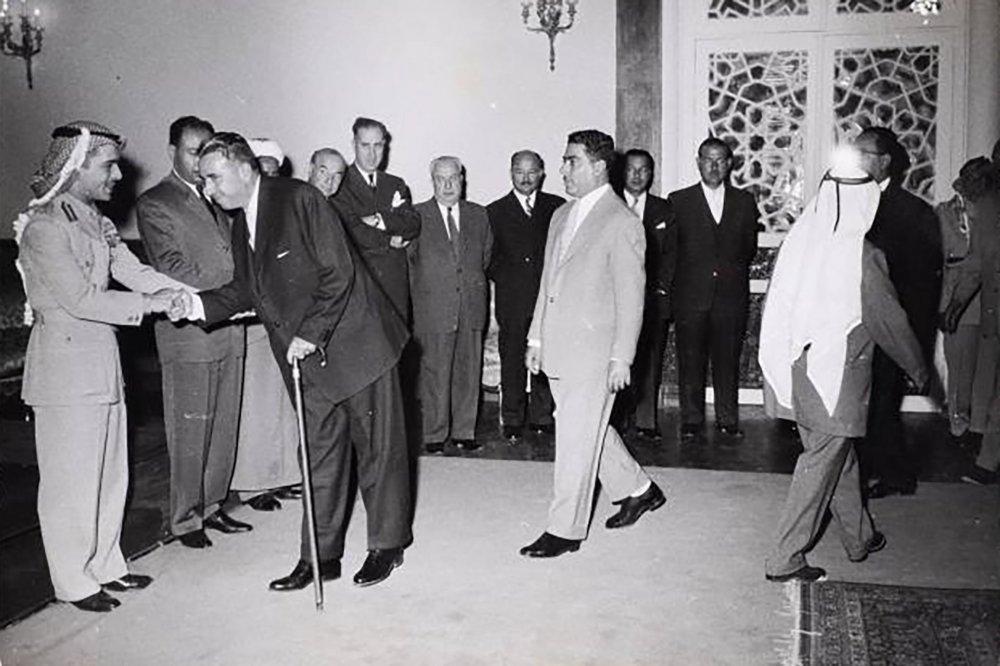
Lana Nusseibeh's grandfather, Anwar Nusseibeh (leaning on a walking stick), meeting with King Hussein of Jordan
(Photo: The Palestinian Museum Digital Archive)
There is already a historical precedent for a late entry ending in victory.
In December 1996, after the United States vetoed another term for Boutros Boutros-Ghali, Kofi Annan of Ghana was nominated. He was selected on the Security Council's recommendation just four days after his formal nomination, even though France had opposed him during the straw polls.
Guterres, by contrast, entered the 2016 race at the beginning of the process and led in the voting rounds. That same year, Bulgaria's Kristalina Georgieva also entered the race late, but her bid failed.
Nusseibeh is not starting from scratch. More than a decade at the UN has given her personal relationships with many of its key decision-makers, while the UAE maintains ties with Washington, Moscow and Beijing.
But she also faces obstacles. The informal tradition of regional rotation gives Latin America preference this time, while the UAE has faced sharp criticism over allegations that it has supported militia forces responsible for atrocities in Sudan. Abu Dhabi denies providing them with military assistance.
Nusseibeh, who has taken leave from her government position to pursue her candidacy, has pledged to act independently if elected.
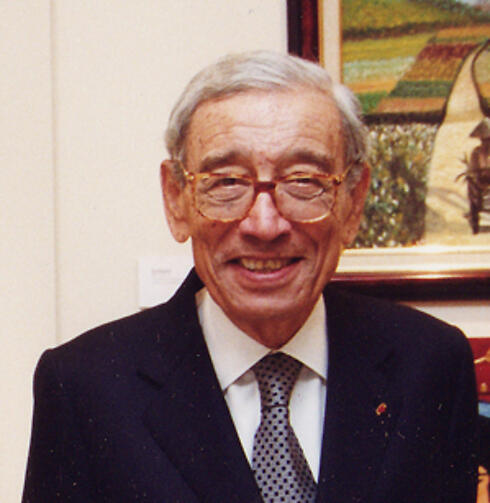
Boutros Boutros-Ghali, the only Arab to have served as UN secretary-general
Her election would be historic. She could become the first woman to lead the UN, its first Muslim secretary-general and the first secretary-general of Palestinian descent.
The only Arab to have held the position, Egypt's Boutros Boutros-Ghali, was a Coptic Christian.
For Israel, Nusseibeh is a candidate with extensive knowledge of Jewish history who comes from a country that maintains diplomatic relations with it. But she is also a diplomat who has already spearheaded international initiatives against Israeli policies in Gaza.
Israel's ambassador to the UN, Danny Danon, has so far refrained from taking a position on her candidacy. He said Israel is closely monitoring the race and expects the next secretary-general to combat antisemitism within the organization's institutions.
Nusseibeh, the mother of two young sons, wrote in a document she presented this week that they had taught her more about patience and urgency than any diplomatic negotiation.
Four years ago, when asked about the importance of women's participation in the Security Council, she explained that she wanted the people seated around the council's famous table to reflect the real world, rather than the old images from the 1950s when, in her words, "men sat in cigar smoke-filled rooms and decided the fate of countries and empires."