

Jared Kushner and senior members of President Donald Trump’s Board of Peace met a Hamas delegation in Egypt on Sunday ahead of a highly sensitive meeting with Prime Minister Benjamin Netanyahu, as Washington intensifies pressure to move its Gaza plan from negotiations to implementation.
At the same time, Saudi Arabia, the United Arab Emirates, Egypt, Qatar, Jordan, Indonesia and Turkey joined together to issue a statement condemning Israel’s rejection of Trump’s roadmap for Gaza and accusing Jerusalem of delaying efforts to end the war.
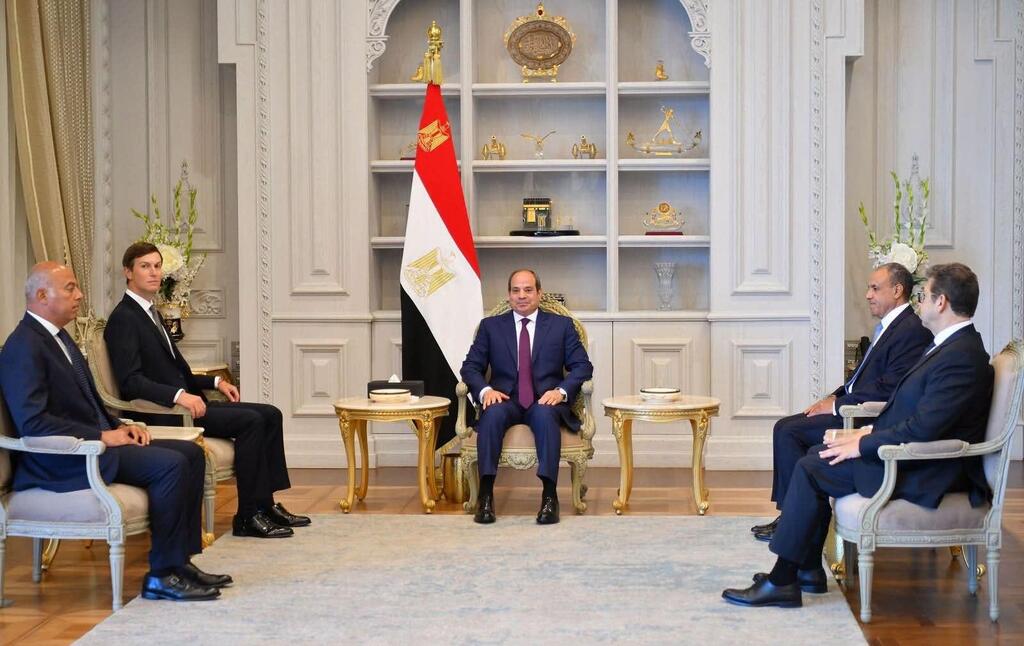
“The roadmap constitutes a critically important milestone for restricting weapons, alongside the withdrawal of Israeli forces, deployment of the International Stabilization Force, transfer of administrative authority to the National Committee for the Administration of Gaza and Gaza’s reconstruction, as stipulated in the plan,” the statement said.
“Rejecting the roadmap constitutes a clear refusal to move forward with the plan and threatens to undermine President Trump’s efforts to end the war in Gaza and create the conditions for lasting peace. Israel bears direct and full responsibility for all consequences,” the statement concluded.
The countries called on the Board of Peace, with active U.S. backing and participation, to take “immediate and concrete steps” to protect the integrity of the plan and prevent either side from obstructing its implementation.
‘They feel Israel is playing games’
Against that backdrop, Jerusalem is preparing for an unusually sensitive meeting between Netanyahu and Kushner, Trump’s son-in-law and senior envoy, who is expected to arrive in Israel on Monday for the first time since January 2026. Kushner is traveling with senior Board of Peace officials, including envoy Nikolay Mladenov and former British prime minister Tony Blair, after talks with mediators and Hamas representatives in Egypt, where heavy pressure was applied on Hamas to agree to disarmament.
Unlike previous negotiation rounds, however, the message from Washington is now considerably tougher. Trump wants agreements that have already been discussed to be implemented rather than reopened for another round of bargaining. A source familiar with the talks said the purpose is “to translate the roadmap commitments into concrete and verifiable steps.”
People familiar with the U.S. position say Trump believes Netanyahu has already given his basic approval to the framework and that, after Washington carried out steps Netanyahu had requested, it is now the prime minister’s turn to fulfill his commitments. The message from Trump’s circle, according to those sources, is essentially that Netanyahu must agree to the deal because the president has already delivered what Israel asked of him and now expects Israel to do the same.
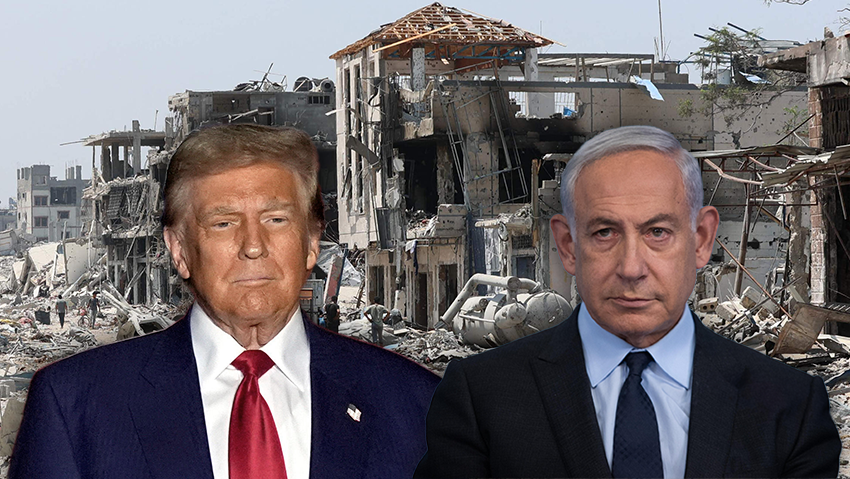
(Photo: Omar AL-QATTAA / AFP, AP Carlos Osorio, Alex Kolomoisky)
Washington is increasingly concerned that Israel is trying to buy time, introduce new reservations and change the sequencing set out in the roadmap. “They feel Israel is playing games,” one source familiar with the details said.
Another source said Kushner is not coming to Israel for another round of diplomatic “ping pong.” “He’s coming to close,” the source said.
According to people involved in the talks, Kushner is expected to raise a series of concrete steps the U.S. administration wants implemented immediately: halting attacks in Gaza, advancing withdrawals toward the yellow line, significantly increasing humanitarian aid deliveries and allowing reconstruction and civilian governance mechanisms to begin moving forward.
Money is also part of the discussion. Under the roadmap, the future Palestinian body designated to administer Gaza would be authorized to address legitimate financial obligations to suppliers and contractors of up to $400 million as part of the transition and reconstruction process. U.S. officials also view increased aid and the creation of conditions for reconstruction as integral to moving into the next phase.
Disarmament versus withdrawal
Trump’s 15-point plan to end the war calls for an end to military operations, Hamas disarmament, transfer of civilian authority in Gaza to a Palestinian technocratic body, a gradual IDF withdrawal and establishment of an International Stabilization Force. The plan is built around reciprocal and verifiable steps, with Israeli withdrawals and the dismantling of weapons infrastructure advancing in parallel.
That sequencing has become the central dispute. Hamas has announced that it accepts the framework, while Netanyahu has said Israel will not withdraw from its positions in Gaza before Hamas is fully disarmed. Israel has also publicly rejected the roadmap in its current form.
Board of Peace officials have been less alarmed by those public statements, viewing at least some of them as driven by domestic Israeli politics. They say they are judging Israel by actions on the ground rather than rhetoric. Officials in Trump’s Board of Peace have also criticized the Israeli narrative surrounding the yellow line. Israel currently controls positions covering roughly 53% of Gaza, and in their view the two critical conditions for moving to the next phase are that Israel not advance beyond the yellow line and that targeted killings stop except in cases of an immediate threat.

IDF forces in northern Gaza
(Photo: IDF)
In practice, the targeted strikes have largely stopped and now require approval from the IDF chief of staff, while the yellow line has not been crossed, according to the sources. “What matters to us is not giving either side an excuse to violate the agreement,” one official said. “It is important that Israel have diplomatic backing and comply with the understandings, but it is unfortunate when it says otherwise for internal political reasons and loses that backing. In our view, Israel is generally doing fine and complying. It is easier to confront Hamas violations when Israel follows the rules.”
A potential turning point with Trump
Another U.S. argument is that the roadmap did not suddenly land on Netanyahu’s desk without preparation. According to people familiar with the process, Israel’s National Security Council was involved in work on the framework, and Israeli-U.S. discussions went into detailed implementation mechanisms
From Trump’s perspective, they say, there is therefore a significant gap between agreeing in principle and actually carrying out the plan. Trump approaches the framework as a deal that has already been negotiated and now needs execution. In that view, if Netanyahu committed to it, that commitment is binding.
If no compromise is reached, the meeting could become a turning point in the Netanyahu-Trump relationship
People familiar with the president’s thinking also say Trump believes he has already given Netanyahu significant political support, including signals connected to Netanyahu’s pardon request, and does not intend to keep paying for the same commitment. The gap between that transactional approach and Israel’s insistence on full Hamas disarmament before withdrawal is at the heart of the dispute ahead of Kushner’s meeting.
Behind the U.S. effort is a broader coalition of mediators and guarantors led by Egypt, Qatar and Turkey. From Jerusalem’s perspective, the prominent roles given to Qatar and Turkey are especially problematic because of Israeli opposition to their involvement. Washington sees the arrangement differently. U.S. officials believe Qatar and Turkey are essential to any regional mechanism capable of pressuring Hamas to take meaningful steps toward disarmament.
Gaza, West Bank and Lebanon converge
Kushner also arrives as tensions between Jerusalem and Washington extend beyond Gaza. In the West Bank, recent days have seen heightened concern over settler violence, particularly following events in the West Bank village of Qusra. The U.S. has pressed Netanyahu to condemn the violence while Israel continues advancing measures connected to settlement expansion.
Lebanon may also come up in the talks. A source familiar with the discussions said Lebanon’s political lobby in Washington is highly influential and is pushing the message that Israeli strikes against Hezbollah are undermining diplomatic progress. Israel, by contrast, argues that Hezbollah has deliberately carried out attacks and violations in an effort to provoke an Israeli response and derail negotiations over its disarmament in Lebanon.
Over the weekend, 11 people were killed in Israeli strikes in southern Lebanon, the deadliest incident since the ceasefire with Hezbollah took effect in June. Israel said the strikes were a response to Hezbollah activity, while Lebanese officials condemned them and warned of renewed escalation.
For the Trump administration, the regional picture is increasingly interconnected. Gaza, Lebanon and the West Bank are no longer necessarily treated as separate arenas but as elements of a broader U.S. effort to stabilize the Middle East and prevent new rounds of escalation.
IDF strikes in southern Lebanon overnight


That is why Monday’s Netanyahu-Kushner meeting is expected to differ from previous rounds of talks. Washington wants implementation. Israel wants guarantees that implementation will not hand Hamas gains before it gives up its weapons. The Americans are speaking in terms of reciprocal and verifiable steps. Israel is demanding full disarmament as a precondition for withdrawal.
At the center is Trump, who views a deal already announced as an American achievement as something that cannot remain stuck over disputes about sequencing. The message Kushner is bringing to Jerusalem is expected to be blunt: Trump is not asking Netanyahu to renegotiate the agreement. He wants him to carry it out.
If Netanyahu and Kushner can bridge the timing dispute, particularly the relationship between halting attacks, Israeli withdrawals and Hamas disarmament, implementation of the roadmap could move forward. The approaching Israeli election complicates that effort. U.S. officials understand that Netanyahu faces domestic political constraints, but they are pressing him to show implementation before voters go to the polls.
If no compromise is reached, the meeting could become a turning point in the Netanyahu-Trump relationship, shifting from a phase in which Trump is still trying to persuade the Israeli prime minister to accept the framework to one in which he begins demanding compliance with commitments the U.S. believes were already made.
The Board of Peace has been tracking violations by both Hamas and Israel in recent days, and Kushner is expected to raise them with Netanyahu and seek his response. He is also expected to stress the importance of Israeli withdrawals taking place in parallel with deployment of the International Stabilization Force.
A source familiar with Kushner’s talks with Hamas in Egypt said the goal was to translate roadmap commitments into “concrete and verifiable steps” that preserve the ceasefire, transfer governing authority to the National Committee for the Administration of Gaza, ensure Hamas has no future role in governing the enclave, begin comprehensive dismantling of weapons and military infrastructure, allow deployment of the stabilization force, facilitate parallel Israeli withdrawals and accelerate humanitarian aid, recovery and reconstruction.
“There can be no ambiguity,” the source said. “Hamas must relinquish governing authority and all weapons and military infrastructure. And Gaza must never again be a source of terrorism against Israel.”
The Egypt meeting was the first between Kushner and senior Hamas officials since the October 2025 ceasefire agreement. Participants included Hamas political bureau chief Khalil al-Hayya, Egyptian intelligence chief Gen. Hassan Rashad, Qatari minister Ali al-Thawadi and a senior Turkish official.