

After the lifting of U.S. sanctions against two aircraft and three airlines linked to the Revolutionary Guards, and amid Iran’s claim of “understandings” in its contacts with Oman over how to reopen the Strait of Hormuz, a Gulf official said Wednesday evening that “the concession has already been made regarding some form of control over Hormuz.” Speaking to Reuters, another official said not all the details had yet been completed regarding “how control” over the strait would be defined.
At the same time, The Associated Press reported that Iran and Oman had finished preparing a draft agreement that would allow the strait to reopen. According to the report, which was based on two Gulf officials, the parties are now awaiting final approval from Iran’s supreme leader, Mojtaba Khamenei. However, Iranian state television reported Wednesday evening that President Masoud Pezeshkian said interacting with Khamenei is “very difficult” at the moment.
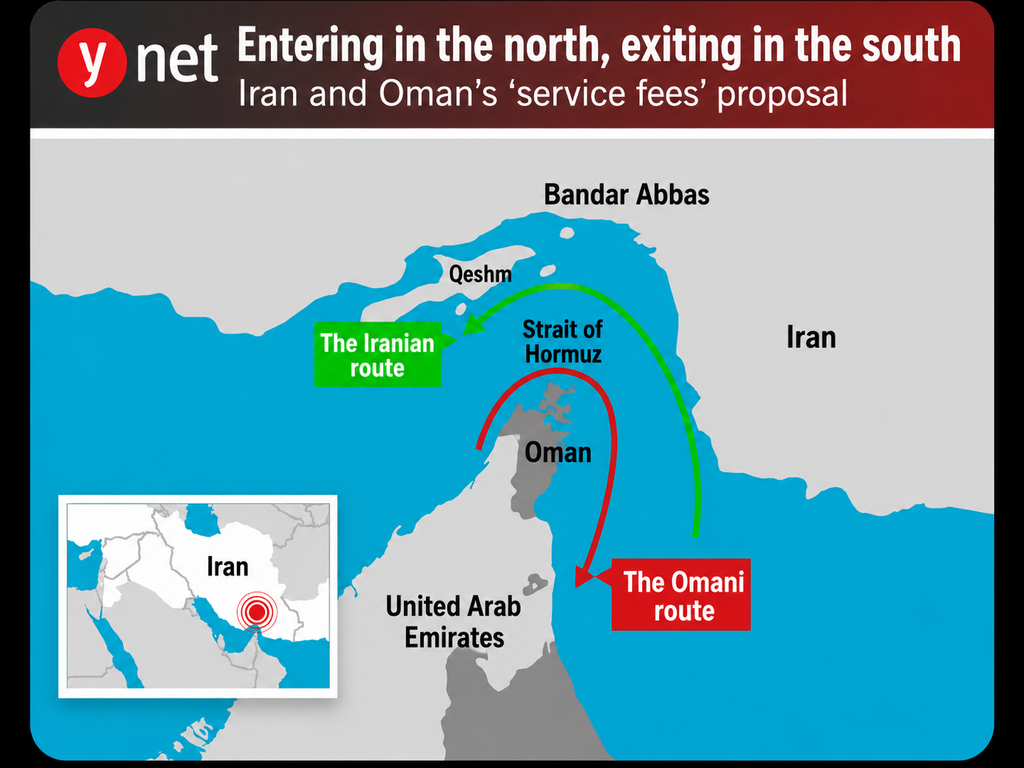
The officials who spoke to AP and were briefed on the negotiations presented the potential deal as a temporary solution to the dispute over the strait, saying it would pave the way for renewed negotiations between Iran and the U.S. on the nuclear program. They also said the possible agreement includes ships entering the Persian Gulf through a route controlled by Iran and leaving through a route controlled by Oman. According to the officials, “service fees” would be collected from ships passing through the routes.
The contacts are taking place against the backdrop of the constant fear that the war could resume if they fail, and it is clear that Gulf states hope to prevent that out of concern that Iran could attack their sensitive oil and energy facilities.
Reuters reported Wednesday evening, citing five sources familiar with the details, that Iran had “warned” Gulf states that any renewed U.S. strike on its territory would lead to a response targeting “critical energy infrastructure across the region.” According to the sources, Iran is trying to raise the price of renewed war by threatening Washington’s allies in the region. The sources said the Iranian threat was conveyed after Trump threatened to strike energy facilities and infrastructure in Iran on July 28, a threat from which he ultimately backed down, in part following Saudi pressure that included a phone call with Crown Prince Mohammed bin Salman.
U.S. President Donald Trump insisted that a deal to reopen the Strait of Hormuz is expected very soon, perhaps as early as Wednesday, after reports said he had demanded that the deal be completed Tuesday. But so far, no announcement has been made, and CNN reported Wednesday afternoon that it may wait until Friday. A senior Gulf official told the American network there is a “50-50” chance the deal will be reached Friday.
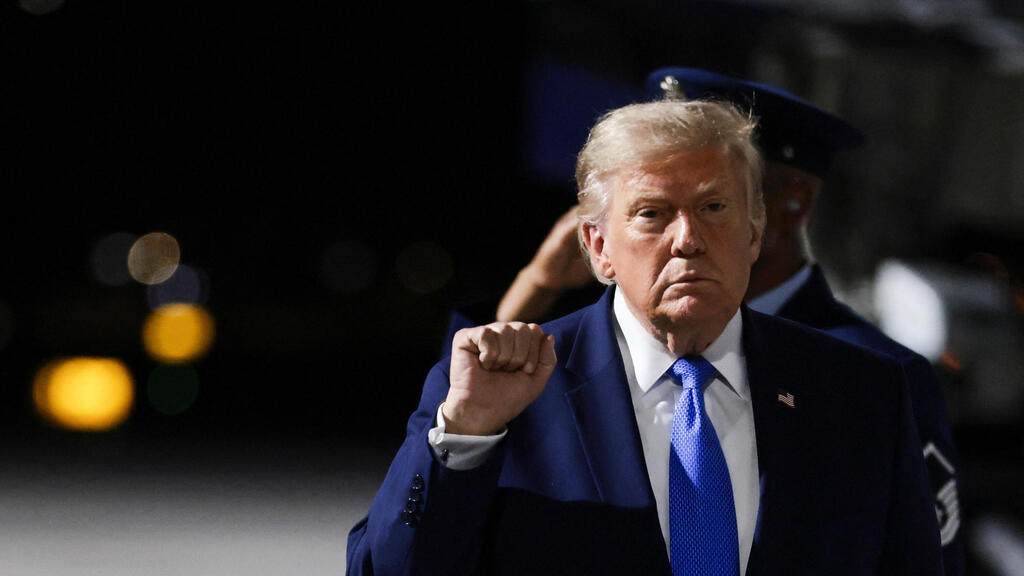
U.S. President Donald Trump insisted that a deal to reopen the Strait of Hormuz is expected very soon
(Photo: Evelyn Hockstein/Reuters)
At the center of the contacts is a temporary agreement to reopen Hormuz under a framework that would effectively accept at least some of Iran’s demands for control over traffic in the strait, the oil artery of the global economy, as part of its refusal to give up the strategic pressure lever it gained by blocking it during the war. Talks over how the strait will be managed under the temporary agreement are officially being held only between Iran and its neighbor on the strait, Oman, but in practice the U.S. is also involved.
The official who spoke with CNN said the Iranian delegation in the talks does not include the “voice” of the Revolutionary Guards, the most powerful military force in Iran, which now effectively controls decision-making in the ayatollahs’ regime. According to the official, the Guards will be required to give final approval to any agreement reached.
Trump himself gave a somewhat similar timeline Wednesday morning, after reports said he had demanded that the agreement be reached Tuesday. “We’ll know within 48 hours. Things are moving nicely,” he said. Earlier, in an overnight interview with Fox News, he said that “the strait will open soon, or they [Iran] will be hit hard and then it will open.” He claimed that if Iran leaves the talks, “they will be hit very hard.”
A senior Iranian official addressed the negotiations on an agreement, telling Qatar’s Al Jazeera that “only one or two issues remain unresolved before an agreement can be reached.” According to him, those issues “can be resolved.” He concluded that “any closure or reopening of the Strait of Hormuz depends on any action Washington takes.”
On Wednesday evening, Iran’s Foreign Ministry said that “the geographic characteristics of the routes in the Strait of Hormuz have been agreed upon between Iran and Oman.” The ministry’s spokesperson said that “a joint Iran-Oman statement is in the final drafting stages — if a certain ‘third party’ does not interfere.” He added a caveat: “The agreement in itself does not mean the strait is safe.”
Trump gives deadline for deal with Iran


According to reports, Iran is continuing to insist that under any arrangement it will retain control of the strait. U.S. officials told The Wall Street Journal that Washington expects an agreement similar to the one already reached in a memorandum of understanding signed in June. Under that agreement, a ceasefire would first be reached, which in the memorandum also included the opening of Hormuz, and only then would negotiations be held on the “heavy” issues, such as the nuclear program.
Accordingly, an Iranian source described as “security-political” told the Hezbollah-affiliated Al Mayadeen network that “the Iranian-Omani negotiations regarding joint arrangements for managing Hormuz have reached important stages. One of the required arrangements is the registration of every entry or exit through the strait in a special system. Iran believes this step allows it to impose full control over navigation and contributes to preventing incidents in the strait.”
Until the war, passage through the Strait of Hormuz was completely free, with one-fifth of global oil and gas consumption passing through it, in accordance with its definition as an international shipping lane. Since Iran carried out its threats and blocked it during the war, and began attacking vessels that tried to cross the area, it has claimed ownership of it and insisted on receiving transit fees from every ship that crosses.
To bypass the dispute, the memorandum was deliberately worded ambiguously, stating that the strait would be opened temporarily for 60 days without a demand for payment, and that Iran and Oman would negotiate over how it would be managed in the future. The agreement collapsed when Iran continued to attack ships that crossed the strait along its southern route, the one closer to Oman, which does not demand payment from vessels.
Meanwhile, the Houthis, Iran’s proxies in Yemen, announced Wednesday evening that they had attacked the Saudi oil tanker Daisy in the Gulf of Aden with a ballistic missile. “The operation achieved its goal. The ship was hit and was forced to change course and turn back,” the Houthis said. “This attack is being carried out as part of enforcing the maritime navigation ban on the Saudi enemy, in accordance with the equation of blockade for blockade.”
First published: 23:36, 08.05.26