

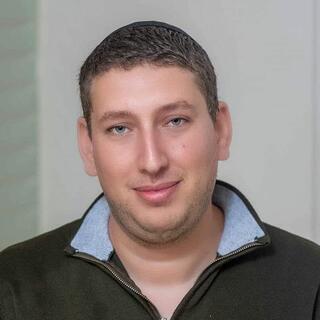
Matan Angrest, the Israeli tank soldier who was freed on Monday from Hamas captivity, held a video call with five female IDF observers who also survived captivity — promising them a future reunion.
Angrest was kidnapped from his tank during the battle at Nahal Oz, in which Capt. Daniel Peretz, Sgt. Tomer Leibovitz, and Sgt. 1st Class Itay Chen were killed. Chen’s body remains in Gaza. The female observers — Agam Berger, Naama Levy, Liri Albag, Karina Ariev, and Daniella Gilboa — were abducted from a protected shelter during the attack on the Nahal Oz post and released during a previous hostage deal in February. They had been held with Ori Magidish, who was rescued on October 30, 2023, and Noa Marciano, who was murdered at Shifa Hospital on November 9, 2023. Her body was later returned to Israel.
The conversation took place via the phone of philanthropist Shai Graucher, who supports hostage and bereaved families. Liri told Matan: “I heard you want to go back to the army. Come serve with me and Naama.” Some of the women said they had witnessed Matan being tortured during captivity.
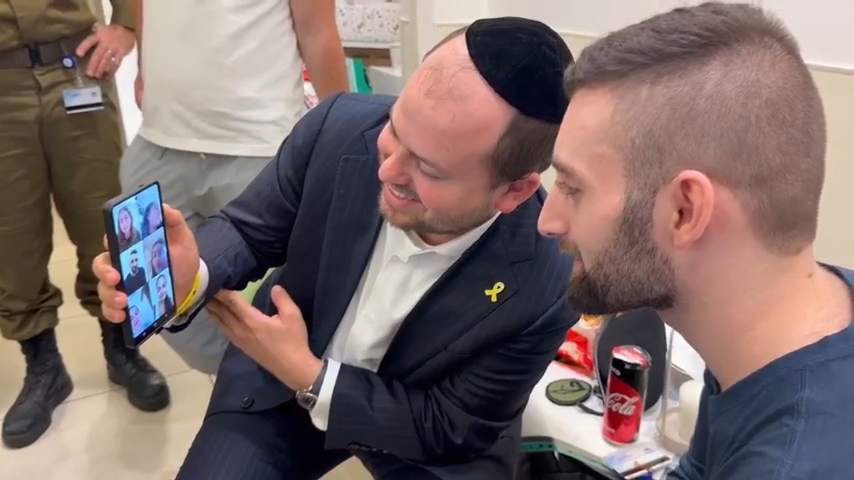
Freed hostage Matan Angrest talks on video chat with the 5 freed IDF observers
(Photo: Shlomi Cohen)
Matan promised they would all meet again, to which they responded: “Take your time.” He praised them as “amazing, real heroines,” and they responded: “So are you.” When asked if she believed this moment was real, Liri replied: “It’s surreal, it’s crazy.” Asked if they’re enjoying life now, the women replied: “Trying — it’s getting a bit easier now.”
In a prior conversation with Graucher, Angrest revealed he had limited exposure to news while in captivity and only learned after a long time that his commander, Peretz, had also been taken. “I spent most of the time with Gali Berman [a fellow hostage],” he recalled. “He’s a great guy, even if he supports Maccabi [Tel Aviv]. In captivity, you put those things aside.” He also saw Berman’s brother at times, and Omri Miran. “There were five months I was completely alone,” he said.
Asked how he coped alone, Matan replied: “You try to lift yourself, cling to optimism, sing to yourself. Whenever there are lows... you try. I prayed three times a day.” He said that after five months, he requested a siddur (Jewish prayer book), explaining: “I needed something to keep my faith strong. I always had a Tehillim [Psalms] book, but they didn’t let me take it out with me.”
Matan shared that Gali had a Torah scroll, and the two read all five books of the Torah repeatedly. “I know every Torah portion by heart,” he said.
Freed hostage Segev Kalfon meets Herzog: 'There are moments you can’t forget'
Also on Saturday, freed hostage Segev Kalfon met with President Isaac Herzog and spoke candidly about his recovery. “I’m slowly rebuilding. There are moments you can’t forget, but I’ll try to stay strong and focus on what really matters,” he said. He only learned of his upcoming release a few days beforehand and believed it “only when I was in the Red Cross vehicle.”
Herzog responded: “I know. That’s part of the psychological pressure to break you.” Kalfon agreed: “Until I was in the Red Cross car, I just didn’t believe it.”
Later in the conversation, the two spoke in Arabic. Herzog noted that his mother was born in Egypt, and Kalfon replied with a smile: “Morocco.” The president and his wife, Michal, embraced Kalfon, telling him he is surrounded by the best people. “I have no words — they really are the best,” said Kalfon emotionally. Herzog concluded: “Your words remind us all that the strength of the people of Israel lies in unity, love, and faith in one another.”
Torture and solitary confinement
Matan Angrest returned home with visible injuries — burns on his hand and a bent pinky finger— and shared that he endured severe torture. He said his captors beat him until he lost consciousness, shocked him with electricity, and tied him by his hands and feet to a gas cylinder for two weeks. He also suffered wounds sustained during the battle on October 7.
For half a year, he was held alongside Omri Miran, moved between locations, and spent time in tunnels. He heard IDF maneuvers and airstrikes overhead and lived in constant fear. “When I came out, I saw all the houses destroyed,” he recalled.
During captivity, he put on tefillin, read Psalms or any book he could get, and requested a siddur — eventually receiving one from a senior Hamas member. He prayed three times a day and taught himself Arabic using the news. He kept himself occupied with card games and sang songs by Israeli artists Omer Adam, Shlomo Artzi, and Eyal Golan.
In his last six months in captivity, Angrest had no access to television. Before that, he was allowed to watch a few minutes at a time. He was aware of the war with Iran and said the Hamas captors celebrated when Iran launched missiles at Israel. He also knew of Nasrallah’s assassination but had not heard of the pager operation against Hezbollah. He was aware of what had happened to his comrades from the October 7 battle.