


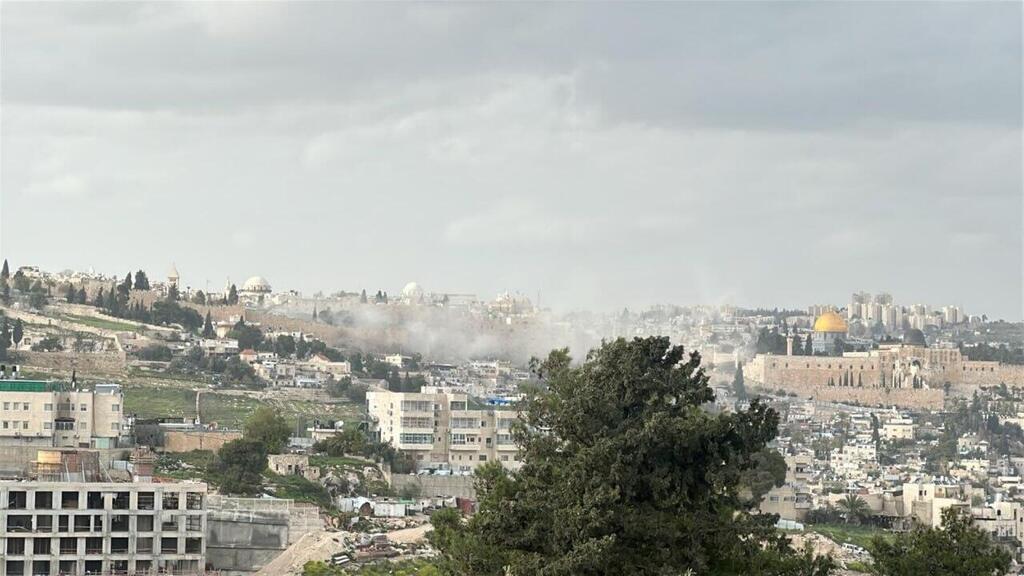
Missile shrapnel fell near the Al-Aqsa Mosque compound in Jerusalem, injuring a Palestinian man. According to the Palestinian Red Crescent, the man was wounded on Friday night by fragments in the Old City and was evacuated for medical treatment.
The missile impact near the Mughrabi Gate — just 350 meters from the Al-Aqsa compound — sparked widespread anger at Iran, which has been launching cluster-type missiles indiscriminately toward Jerusalem, potentially endangering Islamic holy sites. Several structures were damaged in the Friday attack, and videos circulating on social media showed thick smoke rising from the impact area. The incident added to anger over Iranian strikes against Arab countries and launches that have also hit the West Bank, killing four Palestinian women on Thursday.
Missile falls in Old City of Jerusalem
(Video: Section 27A of the Copyright Law)


Amid the developments, the Palestinian Authority’s Jerusalem governor’s office said Israeli security forces closed the Al-Aqsa compound and evacuated worshippers, citing an emergency situation and a ban on gatherings including over the weekend during Eid al Fitr, a major three-day Islamic holiday marking the end of Ramadan. The Ibrahimi Mosque in Hebron was also closed “until further notice” after worshippers and staff were evacuated.
The events triggered a wave of sharp reactions across the Arab world and on social media, against a backdrop of relative silence from senior Arab officials. Some commentators blamed Iran directly for targeting a religiously sensitive area, warning of a serious threat to one of Islam’s holiest sites. At the same time, conspiracy theories have circulated online claiming Iran has no interest in striking Jerusalem and that Israel is responsible for the incident.
Missile falls in Jerusalem not far from Al-Aqsa
(Photo: Israel Fire and Rescue)
At the official level, the Palestinian Authority government said Prime Minister Mohammad Mustafa convened an emergency meeting to assess preparedness and instructed relevant bodies to assist civilians.
“Israel is a clear enemy, but the more dangerous enemy is Iran — because it hides behind religion,” said Rima from Saudi Arabia. “Whoever bombs Mecca does not truly care about Al-Aqsa.” Journalist Ahmed Salman added: “Iran is bombing Al-Aqsa Mosque. Muslims, does that remind you of anything?” referring to a Houthi missile fired toward the Mecca area in 2016.
“You saw Al-Aqsa empty of worshippers, but you didn’t see Iranian missiles falling nearby? What will you say if an Iranian missile hits Al-Aqsa directly?” Hussein Abed from Jordan said. Nasser al-Hamoud, also from Jordan, said: “What Smotrich and Ben Gvir failed to do, Khamenei is doing, in an attempt to harm Al-Aqsa.” He added that “whoever struck Mecca will not hesitate to strike Jerusalem.”
Home Front Command activity at the scene of the missile strike in Jerusalem
(Video: IDF spokesman)
Bayan Bayan, a Gaza resident affiliated with the Fatah movement, argued the incident is not only security-related but also narrative-driven. “The real danger is not just the rocket itself, but the narrative prepared in advance," he said. He warned that, in the event of a future strike on Al-Aqsa, responsibility could be preemptively attributed to Iran as part of a “pre-prepared story.”
Maher Lofi of Egypt claimed that “everyone is trying to harm Al-Aqsa Mosque” and suggested that restricting holiday prayers at the site is part of a broader effort. He also raised suspicion that the strike near the compound could be “preparation for a larger scenario.”
Abdelhudaifa al-Amari from Yemen expressed similar concern, writing that he “fears Israel will strike the mosque and blame Iran.” He added that the situation is already complex and does not require “further confusion and accusations.”
At the same time, conspiracy theories have spread claiming Iran was not responsible for the strike. Dr. Mahmoud Taha Masalha of Daburiyya asked: “Who is endangering Al-Aqsa Mosque? Iran says it did not target Jerusalem — so who benefits from this risk?”