

The government of October 7 cannot manage Israel’s economy wisely — this is not a political or ideological statement, but a firm conclusion drawn from analyzing the budget battles between the Finance Ministry and the Defense Ministry. A proverb goes, “Scalded cats fear even cold water.” By extension: a leadership under whose watch more than 1,000 Israelis were killed in a single day cannot manage risk responsibly. It will lack the ability to say “no” to any defense procurement project — whether for the air force, intelligence, navy, space or missile corps.
Although Netanyahu avoids taking responsibility for October 7, there is no doubt the failure shapes his decision-making. This was evident in his so-called “Sparta speech,” in which he declared that economic considerations must yield to security.

This is even clearer in the "Doctrine and Policy Guidelines for 2025–2026," a highly classified paper from late 2025 in which Netanyahu reshaped Israel’s security doctrine. In it, he effectively issued a “shopping list,” instructing the military to arm and prepare for multiple arenas and scenarios. The document's essence is that the prime minister said “yes” to every demand.
According to defense officials, in its broadest interpretation the policy Netanyahu seeks would cost about 800 billion shekels (≈$216B). Ultimately, they presented him with two plans — one costing 450 billion shekels (≈ $121.5B) and another 250 billion (≈ $67.5B). After prolonged negotiations between the Finance and Defense ministries, a compromise of 350 (≈ $94.5B) billion shekels over a decade was reached. Part of this sum was approved Sunday by the ministerial procurement committee — including the purchase of two new air force squadrons.
The implications of this plan for Israel’s economy are dramatic. According to Bank of Israel Governor Professor Amir Yaron, Israel is already on a rising debt path. In other words, lenders see a future in which the country becomes increasingly entangled in debt. Add to that the 350-billion-shekel plan and the desire — or necessity — to wean off U.S. aid, and by 2035 Israel’s debt-to-GDP ratio is expected to reach 83%. Importantly, all these projections assume the war ends soon — an assumption that has persisted since roughly the end of the first quarter of 2024 and should be treated with skepticism. An ongoing war would have far more severe consequences for quality of life, from physical and psychological casualties to the cost of reserve duty days and damage to the economy and public finances.
The Finance Ministry is misreading the situation
Despite the apparent clarity of these issues, they are not fully understood within the Finance Ministry. Officials there believe they are engaged in a routine struggle with the Defense Ministry. Senior bureaucrats even take pride in the perception that Finance Minister Bezalel Smotrich stands with them in the fight. Their analysis of the dispute is overly simplistic: “Does the budget law apply to the Defense Ministry or not?”
The background to this claim is that the Defense Ministry is demanding an additional 30 billion shekels (≈ $8.1B) for 2026 alone, unrelated to the war. In December 2025, when the budget was approved, the two ministries agreed on a defense budget of 111 billion shekels (≈ $30B) plus an additional 4 billion shekels (≈ $1.1B) to be transferred later, despite the Defense Ministry’s insistence that it required about 144 billion shekels (≈ $38.9B). Following the war, the budget was reopened, and another 32 billion shekels (≈ $8.6B) were allocated for war needs (along with a 7-billion shekels (≈ $1.9B) reserve yet to be decided upon). The Defense Ministry treated part of this wartime allocation as a “base adjustment,” infuriating the Finance Ministry, which argues that, if Defense Ministry officials agreed to 111 billion shekels, they must manage within it — and if they cannot, they should resign.
Defense officials, for their part, respond with anger. They argue that the Finance Ministry’s assumptions about annual reserve duty days were unrealistic from the outset. More fundamentally, they insist the issue lies not with them but with the political leadership: given the missions assigned, the tasks simply cannot be carried out within the budget allocated. Moreover, they hint that the 111-billion-shekel agreement was made at the political level without specifying where cuts should be made.
From the Defense Ministry’s perspective, Smotrich’s position is particularly troubling. The minister supports expanding the war across nearly all fronts, opposes meaningful steps to draft ultra-Orthodox youth, and simultaneously rails against the growing defense budget.
Indeed, Smotrich and his aides frequently speak of “waste” in the defense establishment, implying that savings can be achieved without cost. Yet while inefficiencies exist, they are not the main driver of spending. It is simply not possible to save 30 billion shekels in 2026 through efficiency measures alone. While the military should certainly be pressed to streamline operations, determining the overall trajectory of defense spending requires strategic decisions by the political leadership.
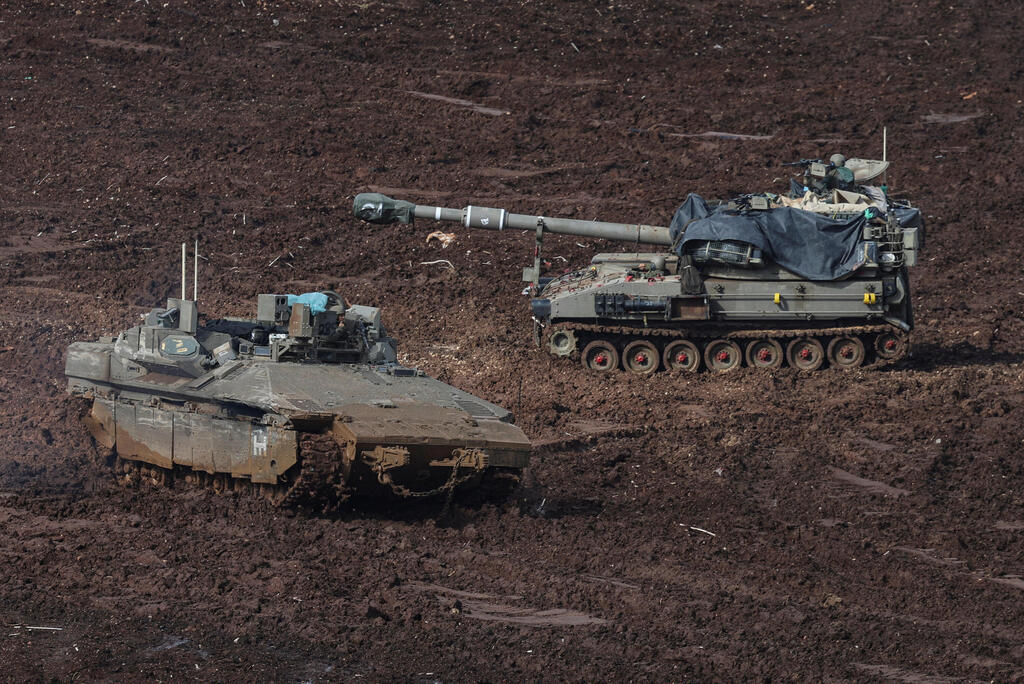
IDF tanks near the Lebanese border
(Photo: REUTERS/Tyrone Siu)
Professor Zvi Eckstein, head of the Aaron Institute for Economic Policy, said at the institute’s annual conference last week that “defense spending must be based on an agreed reference scenario. The disputes between the Finance Ministry and the defense establishment undermine already low trust following October 7.”
In other words, disputes amounting to tens of billions shekels annually — and hundreds of billions of shekels over decades — are not merely about stricter reserve mobilization policies. At their core lie two fundamentally different security doctrines. Resolving them requires difficult, principled decisions.
And here we return to the starting point: it is unrealistic to expect Netanyahu to make a rational determination. One who has been burned cannot manage national security risks with balance; he will continue trying to satisfy all security actors. Smotrich, in practice, follows a similar line — not advocating abandoning any front, but insisting the same security posture can be achieved for hundreds of billions less.
A failure to align goals with resources
To make this concrete, consider remarks by former IDF Chief of Staff Gabi Ashkenazi at the same conference. He defined a “failed strategy” as one in which “there is no alignment between objectives and resources.”
In his speech, Ashkenazi reviewed all arenas and outlined ways to modestly reduce the burden. There was nothing politically radical in his positions — he even called for a unity government — but he demonstrated how a general and statesman unmarked by October 7 approaches strategy. He argued that Israel should maintain its presence in Lebanon to address anti-tank threats, while simultaneously strengthening the Lebanese government, pursuing a peace agreement and dropping the demand to disarm Hezbollah, since neither Israel nor its current government is truly willing to pay the price such a move would entail.
Regarding Syria, Ashkenazi suggested consolidating along the border and seeking a non-belligerence agreement with the current regime, accepting the risk of reversal due to the existence of significant security buffers.
He framed the government’s central dilemma as whether to continue fighting across multiple fronts or to seek closure in those arenas. Closing fronts, however, requires decisive choices — and with them, a willingness to take risks. That is precisely the kind of risk any leader associated with October 7 is likely to avoid. The question of managing post-war security risks may be the most urgent and consequential issue for Israel’s economy.
First published: 20:07, 05.04.26