

While Israelis were gripped by a whirlwind of emotion surrounding the release of hostages in Gaza, remembrance of fallen soldiers and, on a lighter note, the whirlwind visit of U.S. President Donald Trump in Israel, Israeli-American Professor Joel Mokyr was experiencing a different kind of drama.
On Monday, he received a call informing him that he had won the most prestigious award in his field - the Nobel Prize in Economics.
“I was completely stunned. I didn’t expect it at all,” Mokyr told Calcalist. “There’s a long list of people who deserved it. The Nobel prize is great material for academic gossip. I was totally shocked but, as they say, I will take the money."
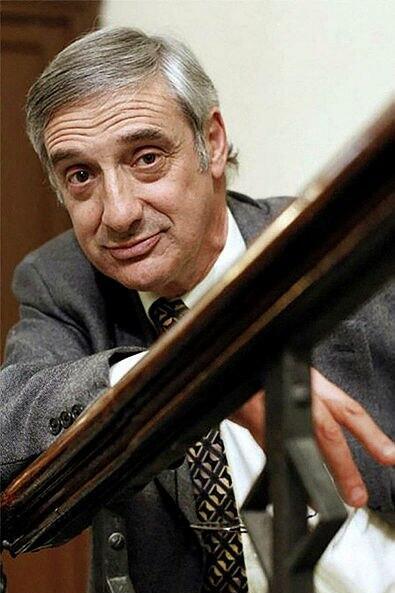
Mokyr went on to name another scholar he believes should have won: “For years, I’ve thought the Nobel Prize should go to my friend Elhanan Helpman, who is Israel’s greatest economist."
When reminded that there’s another figure with Israeli ties – President Donald Trump, who had been openly expecting to win a Nobel Peace Prize, Mokyr replied with a mix of criticism and sarcasm:
“Maybe he deserves a Nobel in medicine for his insights on the link between Tylenol and autism. But I don’t see things only through an Israeli lens. I look at what he does, he holds grudges forever. I also think his role in the hostages’ release was smaller than people think. The ceasefire was already in place when Biden left office. But I understand he’s very popular in Israel.”
'Technology alone doesn’t guarantee growth'
Still, there is one area where Mokyr agrees with Trump, and hopes the president stays engaged in the Middle East.
“He has a good instinct about war; he genuinely hates bloodshed. You don’t need to be a genius to realize war is stupid, but I’m glad Trump also hates wars. That sets him apart from other Republicans like Reagan and both Bushes,” Mokyr said.
“As for Ukraine, he completely failed. In the Middle East, the shooting stopped, and that’s wonderful. But I don’t know how long that will last in Gaza and the West Bank. Trump has a very short attention span, so it’s worrisome. The moment he sees that the path to an arrangement is getting complicated, he might just move on to something else."
At 79, Mokyr remains deeply engaged with Israeli politics and current events.
“My heart rejoiced when the hostages returned,” he said. “Winning the prize pales in comparison. Nothing is more important than bringing our sons and daughters home. I wish the families healing from this trauma, and I hope there are never Israeli hostages again."
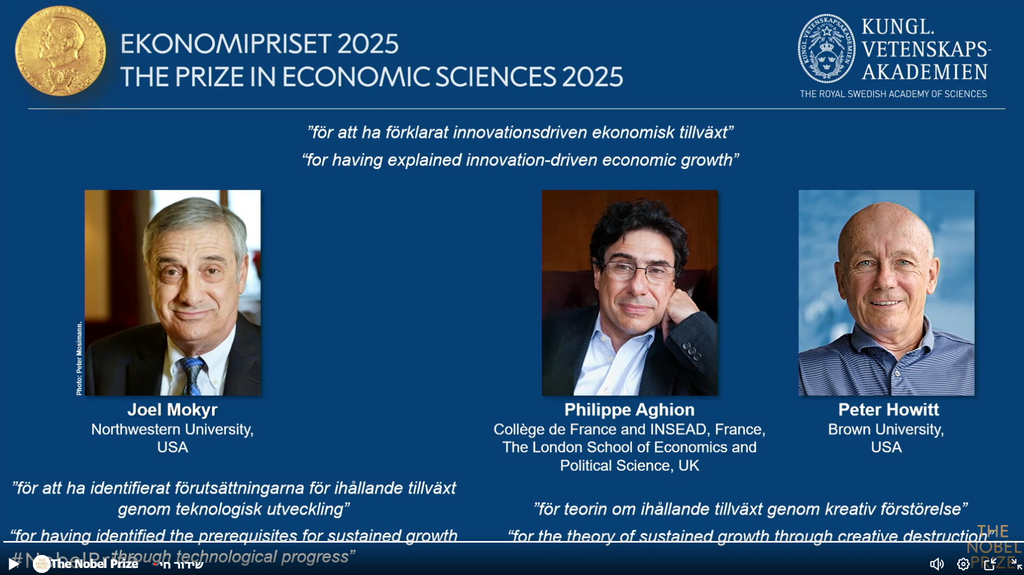
2025 Nobel Prize winners in economics
(Printscreen from Nobel Prize X-account)
Mokyr has taught at Northwestern University in Illinois for more than 50 years. He was raised in Israel and earned his first academic degree at the Hebrew University of Jerusalem. A historian and economist, he holds full appointments in both the history and economics departments.
Though it’s been decades since he lived in Israel, Mokyr still sees himself as Israeli. “I have an Israeli passport and an Israeli heart,” he said. “This prize also says something about Israel."
He also maintains academic ties with Israel, teaching at Tel Aviv University. “I don’t need to attend faculty meetings, this is an honorary appointment, but I teach a mini-course there every year. It’s an excellent economics department, and they’ll share in the credit for the prize, which they absolutely deserve.”
Mokyr was also among the economists who signed public letters warning about the economic fallout of the judicial overhaul initiative advanced by Israel’s government in 2023.
He was awarded the 2025 Nobel Prize in Economics and will receive half of the prize. The other half will be shared by professors Philippe Aghion and Peter Howitt. The Nobel committee summarized Mokyr’s achievement in one sentence: "For having explained innovation-driven economic growth."
Mokyr explains his contribution in layman’s terms: “It’s not enough for a technology to work in order to drive growth. We need to understand scientifically why it works. Inventions before the technological revolution lacked that understanding. Without a scientific grasp of how technologies function, it’s very difficult to replicate innovation."
His research also emphasized that, for innovation to take root and fuel sustained growth, “society must be open to new ideas, allowing a change.”
Mokyr is also regarded as an outstanding teacher, having supervised around 40 doctoral students. His relationships with his students are considered close and long-lasting.
'We haven’t learned to avoid war'
Mokyr’s field is economic history. For years, economic historians were rarely awarded the Nobel Prize. The first to do so were Douglass North and Robert Fogel in 1993.
However, Mokyr points out that this trend has changed: “Claudia Goldin is an economic historian through and through, and she won the prize, though it wasn’t for work in history. On the other hand, last year’s prize to Daron Acemoglu, for his work on the importance of societal institutions for a country’s prosperity, was fundamentally about economic history."
Like many economic historians, Mokyr is considered an optimist. In a 2014 interview with Calcalist, he said, "As a historian, my job is to say 'Yes, the world we live in is truly a mess, but in the past, it was worse in every measurable way.’” Even then, he tempered his optimism, warning: “From a political-institutional perspective, I see very dark clouds.”
In another interview with Calcalist during the Iron Swords war in January 2024, Mokyr was more direct: “The problem is that technological progress hasn’t been matched by institutional progress. We haven’t learned how to avoid war."
In that conversation, he noted that: “In the 20th century, it took countries 10 to 15 years to recover from a war. Almost every war leads to a rapid increase in national debt, and then you pay for it."