


It is easy to understand why Israeli filmmakers and television creators feel compelled to address the October 7 massacre. If they believe their work can contribute to processing a national trauma, there is justification for returning to moments that are almost unbearable to revisit. But belief in the value of one’s creation does not grant immunity from artistic and moral responsibility. "12 Hours in October,” the film by Danny A. (Abeckaser) that premiered two days ago on Apple TV Plus, is certainly not entitled to such immunity.
All of us have been exposed, to one degree or another, to footage filmed by the Nukhba terrorists’ GoPro cameras, by street and security cameras in Israeli communities and by the cellphones of Israelis themselves. These are images etched into the wounded psyche of the nation. We all know what unfathomable acts took place that day, even if we did not watch the IDF so-called “horror film.” Is there any justification for recreating these atrocities in “12 Hours”? The answer is clear: The film confirms every fear about an amateurish treatment of national trauma.
Abeckaser is an American actor born in Israel who became a producer and director. He works at a rapid pace — this is his 10th film in the past seven years — with most of his output consisting of low-budget crime movies featuring fringe-industry actors. He has previously addressed an episode from the history of the Israeli-Palestinian conflict with “The Engineer” (2023), about the killing of Yahya Ayyash. A sub- “Fauda” misfire like “The Engineer” is one thing; a crudely executed reconstruction of the horrors of October 7 is far more troubling.
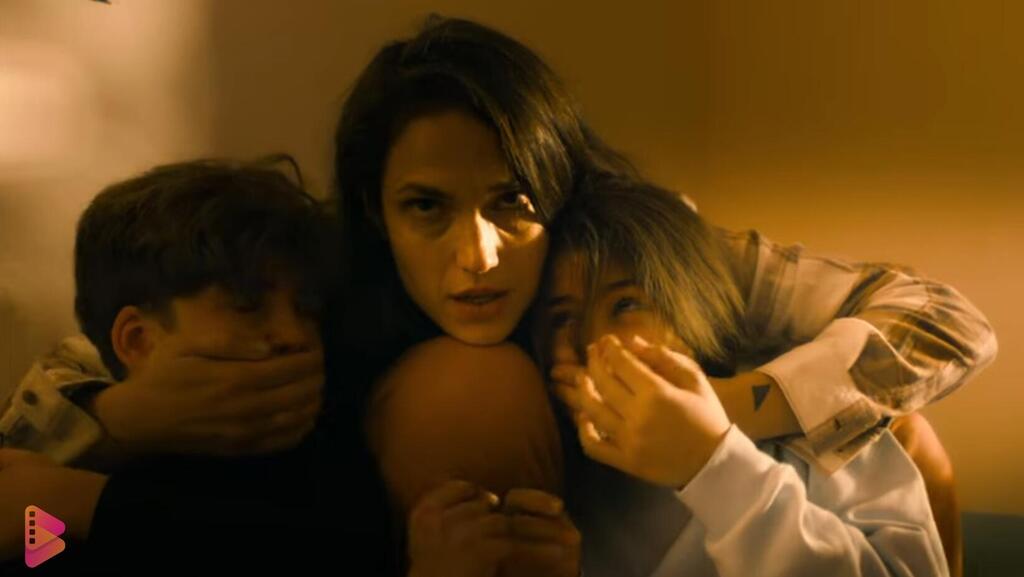
From the film '12 Hours in October'
(Photo: Screenshot, Apple TV)
The screenwriter of “12 Hours” is Kosta Kondilopoulos, a frequent collaborator of Abeckaser . The script is written “inspired by the events and characters,” meaning that whatever fits can be taken and dramatic situations shaped at will. The result is a blend of fact and fiction that aims to create “cinematic moments” but in practice gives them the character of a ridiculous forgery.
Thus, near the end of the film, there is a scene in which Nukhba commander Malik delivers a speech to a young Israeli woman who has been raped and is now dying from a stab wound. In this condition, he explains to her in detail Hamas’ strategic plan: They will not stop until every drop of Jewish blood is spilled, and they plan to leave Gaza’s women and children above ground so that it will “gradually demonize you. Then we will isolate you, and in the end, God willing, we will be free to exterminate you.” An impressive strategic vision for the first day of the attack. Moments later, the same dying young woman, lying on the floor, manages to reach a pistol left beside her and shoot and kill the Nukhba terrorist Nabil, who raped and stabbed her.
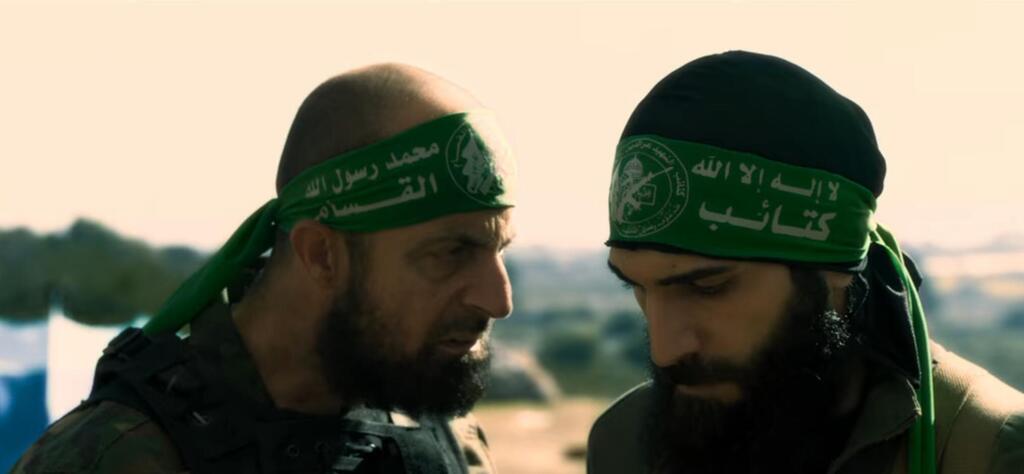
From the film '12 Hours in October'
(Photo: Screenshot, Apple TV)
The film’s propaganda values are evident from its opening seconds. It begins with an English-language news report on i24NEWS, presented by Miri Michaeli — a simplistic, preliminary factual account of the attack, even though in the film’s main timeline the assault has not yet begun. This is followed by the only truly chilling segment in the movie: an original recording made that day by Reut Karp from Kibbutz Re’im as she spoke with her eldest daughter, Lia. The younger daughter and young son were trapped for hours beside the bodies of their father and his partner. Reut spoke with her child for hours as she tried to summon help. It is an authentic flash of astonishing courage and composure, heartbreaking in its power. Two and a half minutes of the recording play over a black screen, ending with a photograph of the family. From there, it goes downhill.
The film cuts to the Nova music festival at the moment the sirens begin to sound. At the DJ booth is Sagi, who was supposed to be at the real festival that day but for various reasons could not make it. It is good that cinema can correct reality. The brief segment ends with a close-up of Talia, one of the festivalgoers, as she processes the siren. From there, the film jumps back six hours to the young people dancing at the party shortly after midnight, to establish the characters’ “backstories.” The chaos of the film’s first six and a half minutes offers a clear indication of what is to come.
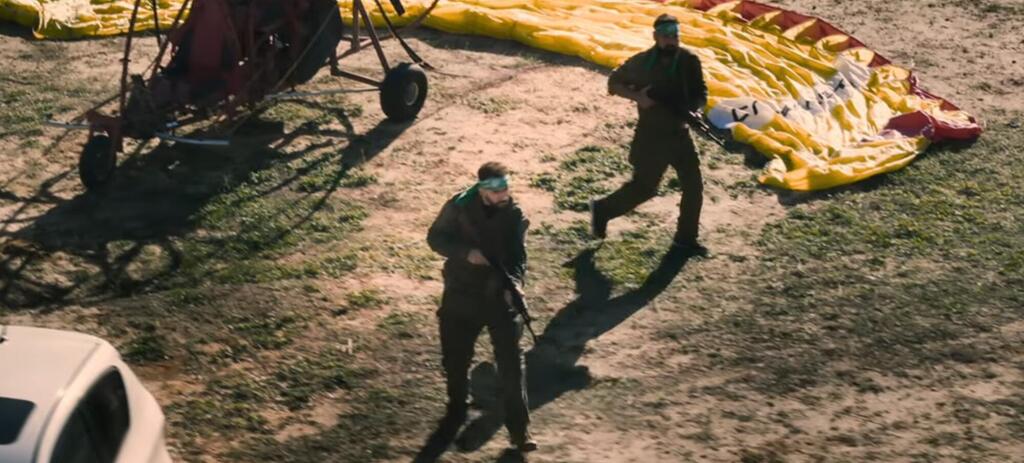
(Photo: Screenshot, Apple TV)
Talia is at the party with her boyfriend, Barak, who brought a ring and proposed marriage (we meet them after she has accepted). Also at the festival is the married couple Doron and Orly. She has just told him she is pregnant, news that unsettles the no-longer-young man. Outside the party, and six hours forward in time, we meet Ariel drinking her morning coffee on the balcony of her home in Kibbutz Be’eri — a final moment of calm before she must protect her two children in a safe room whose door does not close properly. In the same kibbutz is another couple, Gabi and Maya (Montana Tucker). During the attack, Gabi will leave the safe room to help a friend search for his son, who was at the party.
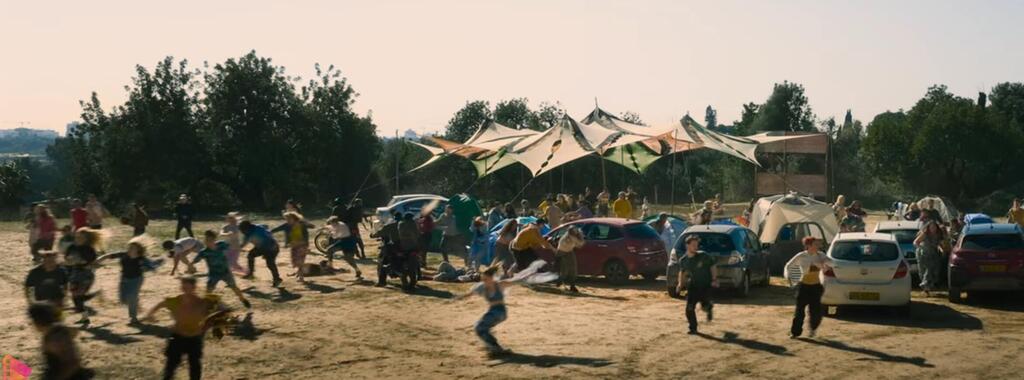
(Photo: Screenshot, Apple TV)
In the conventional format of American disaster films, the emphasis is meant to be on the survivors. In addition, the characters’ personal problems introduced during the exposition are supposed to be processed during the event, usually toward some form of resolution. Without going into excessive detail, that is not what happens in “12 Hours.” The characters’ backstories are not only sloppy but almost random. It would be generous to suspect the film of a conscious, sophisticated engagement with genre conventions. It seems the film’s purpose is to serve as “shock therapy” for viewers who watch it with little or no understanding of what happened that day.
Simply depicting acts of massacre is not enough to give a film value. The thin production makes the scenes implausible. For example, there is the depiction of a briefing conducted by the senior terrorist Malik, filmed entirely in close shots without an establishing shot. Additional implausibility stems from baffling directorial choices, such as a gun battle in which Doron and Gabi confront a group of Nukhba terrorists armed with Kalashnikovs at point-blank range. After exchanging fire on both sides, there is a strange pause in the battle, with terrorists calmly talking while fully exposed, even as the two armed Israelis remain alive and nearby.
There is little point in addressing individual acting performances. The film features several actors who have already proven their talent — half the cast is taken straight from “Fauda” — but with direction and a script this poor, even talented actors cannot come out well.
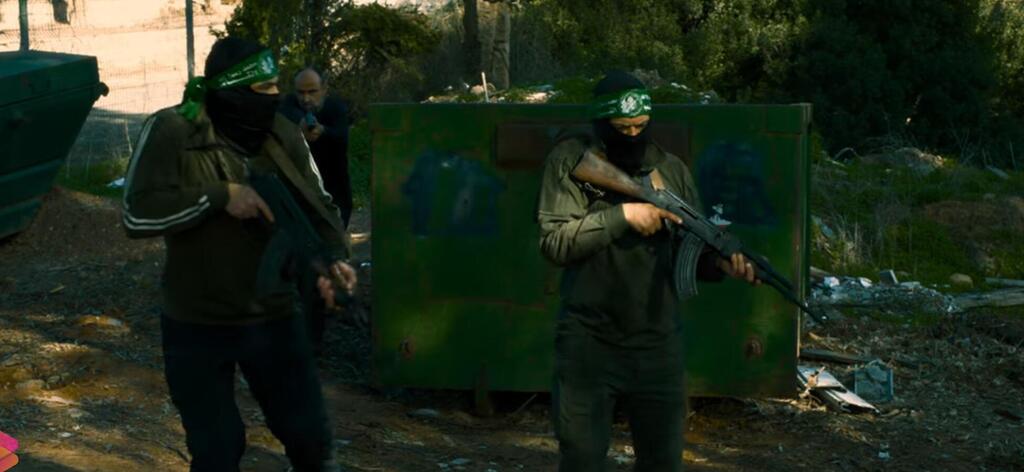
(Photo: Screenshot, Apple TV)
“12 Hours” looks like a ludicrous propaganda film of the kind our neighbors to the east produce on Al-Manar. Its target audience is not Israelis but citizens of other countries, first and foremost Americans. Accordingly, the characters always speak English, whether they are Israeli or Gazan terrorists. The Israelis have heavy accents, and even more problematic is the Arabic accent of an Israeli actor speaking English. Even if one has no concern for the dignity of the Nukhba terrorists, it sounds ridiculous. Even if the dialogue were superbly written — which it very much is not — the shared use of English creates a profound sense of falseness. In a film in which murderers and victims speak different languages and generally do not know each other’s language, there is a fundamental problem in having them speak the “same language,” which in both cases is not their own.
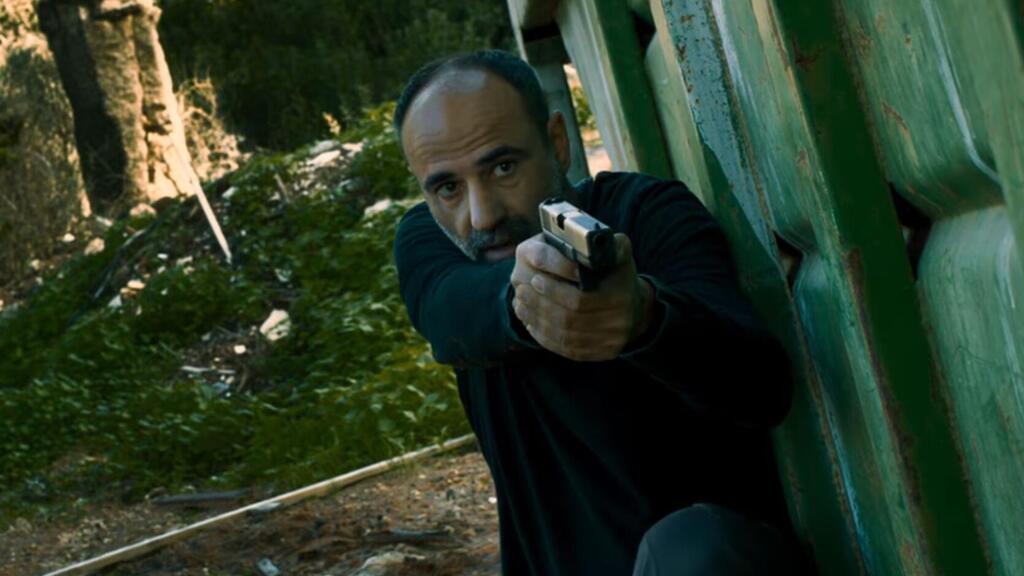
(Photo: Screenshot, Apple TV)
The catastrophic state of Israeli public diplomacy is well known. Some readers of this review may believe that the loss of sympathy for Israel is solely the product of antisemitism, Qatari conspiracies or brainwashing at universities. But even if one believes that a propaganda film is a legitimate response to these problems, the question remains: How bad do the direction and script have to be for such a film to do more harm than good? Several films have already been made about the events of October 7, some of them very good. Why watch “12 Hours” when one can watch the Emmy-winning documentary “We Will Dance Again”?