

Meet the Bautista family from Holon
Anne, 35, Johnny, 38, Emanuel, 12, Leon, 10, Liam, 5
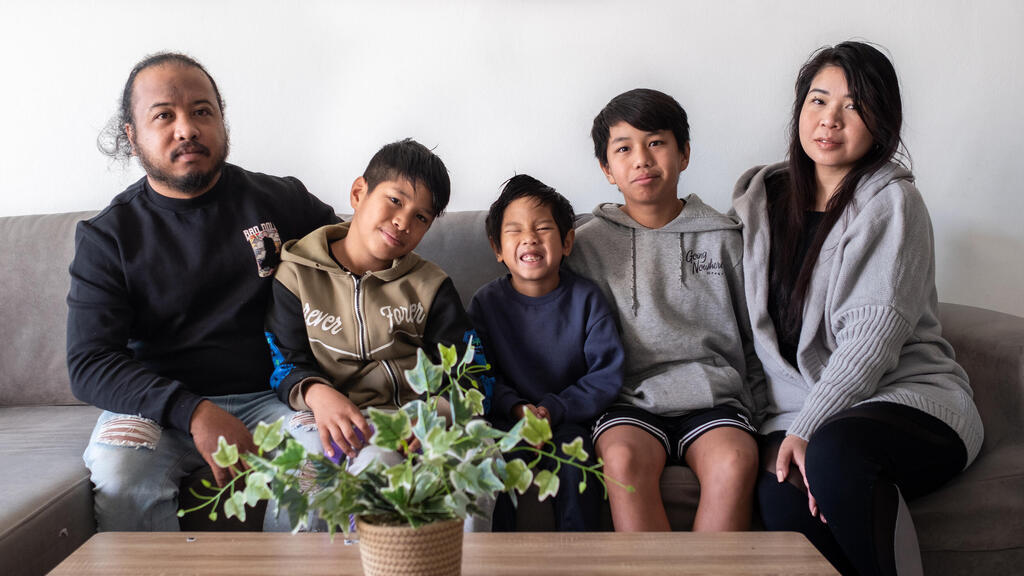
The Bautista family
(Photo: Assi Haim)
Five rooms, rented for 7,800 shekels ($2,070/month) in Holon
Why Holon?
Anne: “We moved from Bat Yam six months ago because we needed more space. We spent five years there and moved into a bigger place. Holon and Bat Yam are basically the same, it doesn’t feel very different."
Where are you from originally?
Anne: “I’m Vietnamese. My parents fled the war on a refugee boat. No country wanted to take them in, but Menachem Begin, who was the prime minister at the time, allowed the boat to dock in Israel and granted ID cards to the 100 refugees on board.
"My parents settled in Jaffa, and I was born here. My mom worked at the Hilton Hotel for 30 years. My dad was wounded in the war in Vietnam and never fully recovered. Jaffa is home to a blend of cultures, but I was the only Asian kid in school. I always felt different, but I had a good childhood overall. My mother instilled Vietnamese traditions in me, especially the culture and food."
Johnny: “I was born in the Philippines. My mother left us and came to Israel for work, met an Israeli man and married him. When I was seven, she brought my sister and me here. It was a tough adjustment. Back home we lived in a village, and here I had to get used to the city. I started first grade without knowing Hebrew. Everything was strange and hard, but slowly I adapted."
How did you meet?
Johnny: “In the Tzofim (Israeli Scouts). At 16, I moved to south Tel Aviv with roommates. I spent a lot of time in parks and started working as a dishwasher at a restaurant. I had friends in Shevet Eitan, which is a tribe for children of foreign workers. We went on trips."
Anne: “I’m a bit of a princess; I wasn’t really in the Scouts, but friends convinced me to join one of the trips where all the Tel Aviv-area tribes came together. I cried the whole time. I didn’t understand why I had to sleep in a sack on the sand. I just wanted my bed.
"But that’s when I saw Johnny for the first time. I was sitting on a rock and remember him staring at me in shock that there was another Asian in the Scouts, and he nearly walked into a tree. I burst out laughing. Later he looked for me but couldn’t find me. We met again a year later.”
Johnny: “When I saw her, I said to myself, ‘She’ll be mine.’ I ran into her by chance at the central bus station and didn’t let her slip away. We’ve been together ever since.”
What do you do for a living?
Anne: “We own a restaurant in south Tel Aviv, near the old central bus station—El Mano. People ask about the name because it doesn’t sound Asian. It’s actually a combination of our sons’ names: El is for Leon, and Mano is for Emanuel. That was before Liam was born. We merged our two cuisines, Vietnamese and Filipino. We both come from kitchen backgrounds."
Anne: “I worked in a lot of cafés, but I never cooked Vietnamese food professionally. My last job was at Manta Ray on the Tel Aviv beach. That’s when I realized I didn’t want to be an employee anymore.
"Working in a kitchen is demanding, especially for a mother. I thought, ‘If I’m working this hard, I might as well do it for myself.’ I wanted to showcase authentic Vietnamese food, which wasn’t really available here. Vietnamese cuisine is full of herbs and fresh dishes. Johnny brought the Filipino side, so you get the best of both worlds. He’s in the kitchen most of the time, but I help a lot."
Johnny: “I learned how to cook Vietnamese dishes. It was hard, but I managed.”
Why was it hard?
Johnny: “The cuisines are very different, and I wanted to create the best dishes possible. I had to watch her cook, and even after I started, I kept calling her all the time. Eventually, I learned.”
Anne: “We opened two months before the COVID pandemic. We had to fight to survive. I stayed in the kitchen, and Johnny worked elsewhere so we could keep going. At first, only foreign workers came to eat. After two years, a few bloggers randomly visited, posted about our authentic Vietnamese food in south Tel Aviv, and people started coming.
"Now we’ve been invited to take part in the Chinatown Festival at Sarona Market taking place this week. There will be booths from Asian restaurants all over Israel. It’s a great opportunity for more people to try our food and get to know us."
How is working together?
Anne: “That’s the biggest challenge in our relationship. Chefs have egos and different work styles. Johnny was a chef for six years and used to talk to me like I was his assistant. But we’re equals. Our kitchen methods clashed, and we would fight, but we overcame it. We realized our goal was to succeed together."
Johnny: “We became stronger and learned to compromise."
Anne: “Food should come from the heart. If you’re angry, it shows in the dish. We had to get past that to succeed."
Financial situation?
Anne: “It’s challenging. We manage to survive but we’re not saving. Running a restaurant is very tough. Luckily, it’s mostly just the two of us; we can’t afford to hire staff. But I love what I do and can’t imagine doing anything else."
Christmas?
Anne: “I’m Buddhist, but we celebrate Christmas, Passover, and Sukkot."
How do you spend your leisure time?
Anne: “The restaurant is closed on Mondays, so we go out to eat in Tel Aviv. We both love food. I get jealous that other places have full staff and everything."