

Antarctica may be viewed by most people as a distant continent covered in ice and home to penguins, but developments there have a direct and immediate impact on Israel’s coastline as well. Recent satellite observations have revealed alarming signs that the Thwaites Glacier, located on the continent and ominously nicknamed the “Doomsday Glacier,” is undergoing accelerated disintegration as a result of climate change.
Its eastern ice shelf, which prevents the glacier from rapidly sliding into the ocean, is on the verge of completely detaching. This may sound far removed from daily life in Israel, but the process is setting in motion changes that could affect Mediterranean sea levels, infrastructure and coastal cities in the country.
Thwaites Glacier, located on the continent and ominously nicknamed the 'Doomsday Glacier'


The impact of climate change will intensify
So why are experts around the world currently concerned about the collapse of the glacier? In a study published several years ago, researchers compared Thwaites’ eastern ice shelf to a car windshield, where a small crack could lead to a sudden shattering. Satellite and GPS measurements have indeed revealed a deepening network of cracks spreading through the center of the shelf at a rate of up to two kilometers (1.2 miles) per year. The cracks are expected to intersect with underwater canyons beneath the ice, creating a dangerous zigzag fracture pattern. Such a process could lead to the glacier’s complete collapse within a few years.
Dr. Mia Elasar, a marine ecologist, research fellow at the University of Haifa’s Leon H. Charney School of Marine Sciences and a member of the Forum of Climate Scientists, explains: “The Doomsday Glacier is a massive land glacier in West Antarctica, held back by a floating ice shelf that slows its movement toward the sea. The glacier contains enough ice to raise global sea levels by 65 centimeters (25.6 inches) if it completely melts, and its collapse could trigger a regional chain reaction, causing additional glaciers that make up the West Antarctic Ice Sheet to collapse. Such a chain reaction could add another 3.3 meters (nearly 11 feet) to global sea levels. The concern is that if the cracks continue to multiply and deepen, the shelf will no longer be able to hold back the land-based part of the glacier, and Thwaites will slide into the water and, as mentioned, pull additional land glaciers with it.”
Gallery
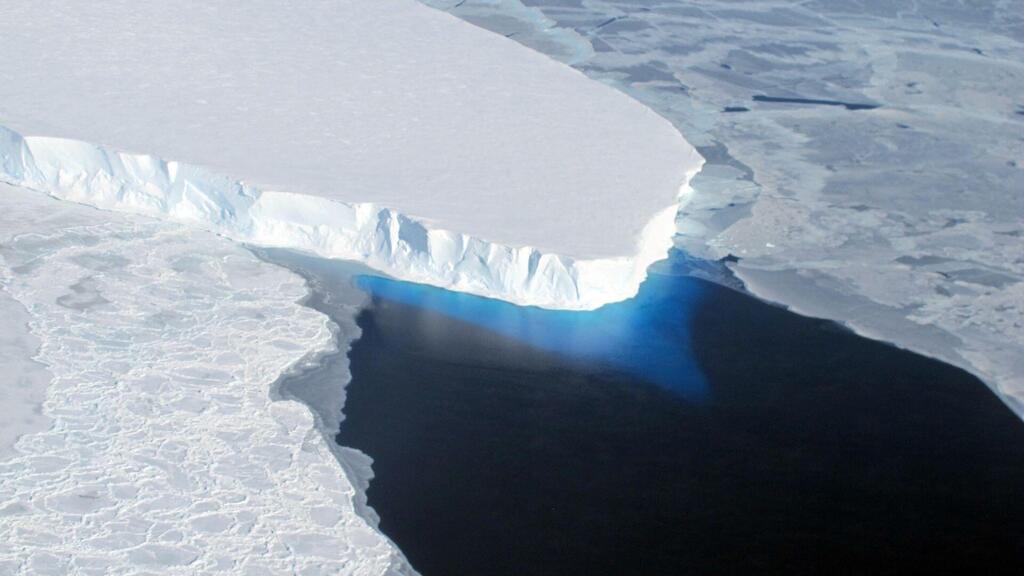
Thwaites will slide into the water and, as mentioned, pull additional land glaciers with it
(Photo: NASA)
Elasar warns that such a collapse would intensify the effects of climate change: “The enormous white ice sheets at the poles reflect about 80% of solar radiation back into space, while dark oceans absorb most of the energy. The reduction in the area covered by sea ice means that Earth reflects less radiation, while more energy is absorbed by the oceans, causing additional warming of the water — which accelerates the melting of glaciers. The melting of a glacier on the scale of Thwaites would significantly reduce the amount of radiation reflected back into space and increase the absorption of solar radiation and heat by the oceans, accelerating the pace of warming.”
The Mediterranean is rising faster
Such an effect, of course, would not remain confined to the South Pole. The warming caused by the collapse of Thwaites Glacier would also contribute to warming Mediterranean waters. Because the Mediterranean is a semi-enclosed basin, when its waters warm they undergo a process known as thermal expansion — their volume increases, causing sea levels along the coast to rise significantly.
According to a report by Israel’s Institute for Marine and Lake Research, the rate of sea-level rise in the region is not uniform and in some measurements exceeds the global average. Long-term monitoring by the institute’s Hadera measurement station shows that since 1992, sea levels have risen by an average of 4.6 millimeters per year, compared with a global average increase of about 3.2 millimeters per year during the same period.
Taking historical data into account, sea levels in the region have risen by about 18.5 centimeters since the middle of the 20th century. The report also notes that under extreme scenarios, sea levels in the eastern Mediterranean basin are expected to rise by an additional meter by 2100.
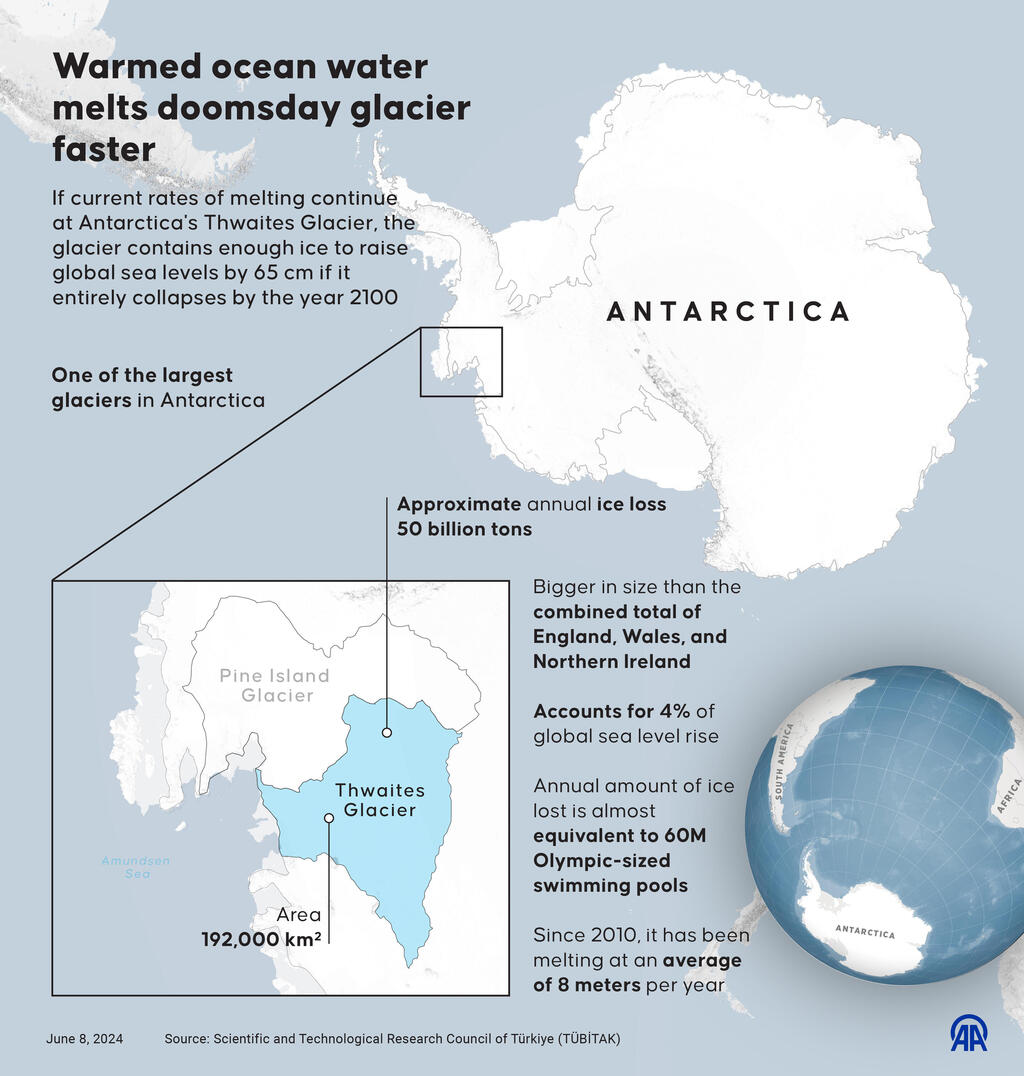
Information about the process of disintegration of the Thwaites Glacier, known as the 'Doomsday Glacier'
(Photo: Yasin Demirci/Anadolu/Getty Images)
Such a rise would have devastating consequences for life in Israel. Elser lists the main risks: “Flooding of low-lying areas along the coastal plain, an increase in the rate of erosion of coastal cliffs such as those along the Sharon coast, flooding of underground infrastructure by groundwater — as is already happening in Haifa’s Bat Galim neighborhood and Tel Aviv’s Ramat HaHayal neighborhood — and salinization of groundwater in the coastal aquifer. The quality of food sourced from the sea could be affected, as could the quality of desalinated water supplied to most Israeli households, due to algae blooms and oxygen depletion.”
In addition to structural changes along the coastline, rapid warming is expected to create more extreme weather phenomena. The Mediterranean’s high evaporation rate is already contributing to floods and storms, and if it increases these events could become more severe.
“In recent decades, mainly during the fall and winter months, storms resembling tropical cyclones in structure have developed in the Mediterranean,” Elasar explains. “Fortunately, they are rarer and weaker than hurricanes, but each such storm brings heavy rains to land, causing flooding.”
Have we reached a climate tipping point?
The term “climate tipping point” refers to a threshold beyond which processes become irreversible. The melting of Thwaites Glacier represents such a turning point, mainly because of its impact on solar radiation reflection and sea-level rise.
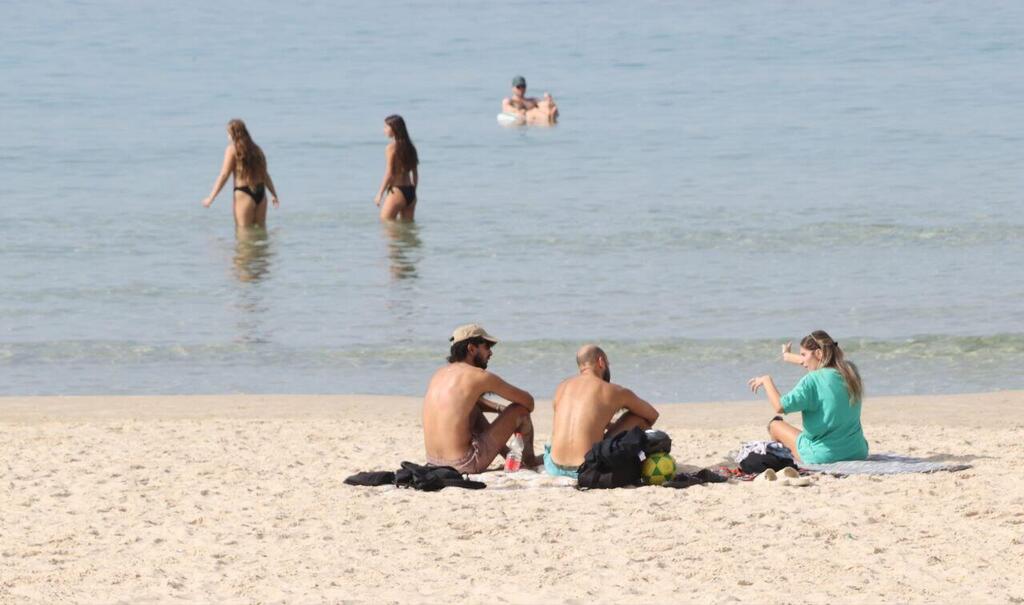
The warming caused by the collapse of Thwaites Glacier would also contribute to warming Mediterranean waters
(Photo: Moti Kimchi)
“We have not yet reached a tipping point, but we are close,” Elasar says. “Although the poles appear very distant from Israel’s reality, they have an enormous impact on the global climate, and therefore we must pay attention to processes taking place on the other side of the world. This does not mean we should panic. Even ordinary citizens have the ability to prepare for climate change.”
Among other steps, she says people can try to buy fewer new products, consume less energy and reduce private car use. Alongside individual actions, she emphasizes the importance of systemic measures, such as adapting living environments through climate-conscious construction, planting trees for shade and installing solar panels wherever possible.
“Governments, organizations and private individuals — we all need to do everything we can to slow the pace of climate change and warming,” Elser concludes. “At the same time, climate change is already here — we feel it in our daily lives through heat waves, unpredictable and extreme weather and drought years. We need to be aware and prepare for life in a more extreme climate.”
This article was prepared by Zavit — the news agency of the Israel Society of Ecology and Environmental Sciences.