

What may look like an ordinary bottle of whiskey is actually a symbol of revival in the region surrounding the Gaza border communities. Two years after the October 7 Hamas massacre, Kibbutz Be’eri is launching its first whiskey line.
Now, Haim Jelin recounts how, shortly after October 7, the idea sprouted: sow barley in the kibbutz’s bloodied fields to make whiskey, a project born during an evening of shared stories of loss, tears, hope and alcohol.

That’s how “Single Be’eri” was born - the kibbutz’s single‑malt homage, expected to be a hit at the international whiskey festival in Tel Aviv taking place this week.
This week, Haim Jelin, Avida Bachar and other members of the “Kibbutz Be’eri Whiskey Club” will finally hold their short, stout bottle, the one Jelin said he specifically chose, “It’s a bottle that’s pleasant to hug, because right now we all need a hug.”
The label bears the name “Single Be’eri,” a nod to the kibbutz’s famous Singletrack, Israel's first mountain bike park.
“This is much more than making whiskey; it’s a spiritual mission; a mission of revival,” says Jelin, the former head of the Eshkol Regional Council, his usually confident voice now cracked and soft.
“The barley for the whiskey grew in our fields in the midst of war, east of the bloodied Route 232, except where the tanks still stood. All while we were coordinating with the army and the Gaza Division amid heavy bombardment. We knew that this barley had a purpose and a destiny.” This whiskey from a wounded kibbutz stands as a metaphor for the Gaza border communities' stubborn determination to rise again.
“It all began on an utterly broken evening in February 2024, four months since the Gaza war broke out, when we invited members of the kibbutz’s whiskey club to the M&H (Milk and Honey) Distillery in Jaffa,” shares Tal Chotiner, VP Sales of the successful Israeli distillery that adopted the kibbutz whiskey club.
“There were about 60 people, all whiskey lovers, longtime friends. We sat with them on the production floor, pouring whiskey and food, and people started opening up about what they've been through on October 7.
"In retrospect, it turned out they hadn’t shared their most personal stories yet, until someone began talking about his son who was killed, and another talked about his wife who was murdered.
"The alcohol and the gathering, outside their hotel in a neutral place, unlocked the emotions. Haim Jelin began running between me and Tomer Goren, Head Distiller at M&H. Together with Jelin and me, Tomer is the third partner in the Be’eri whiskey venture. Jelin turned to us and said: ‘Listen, they’re talking. They're opening up. They’re sharing their stories. It never happened before; they never told anyone what happened'."
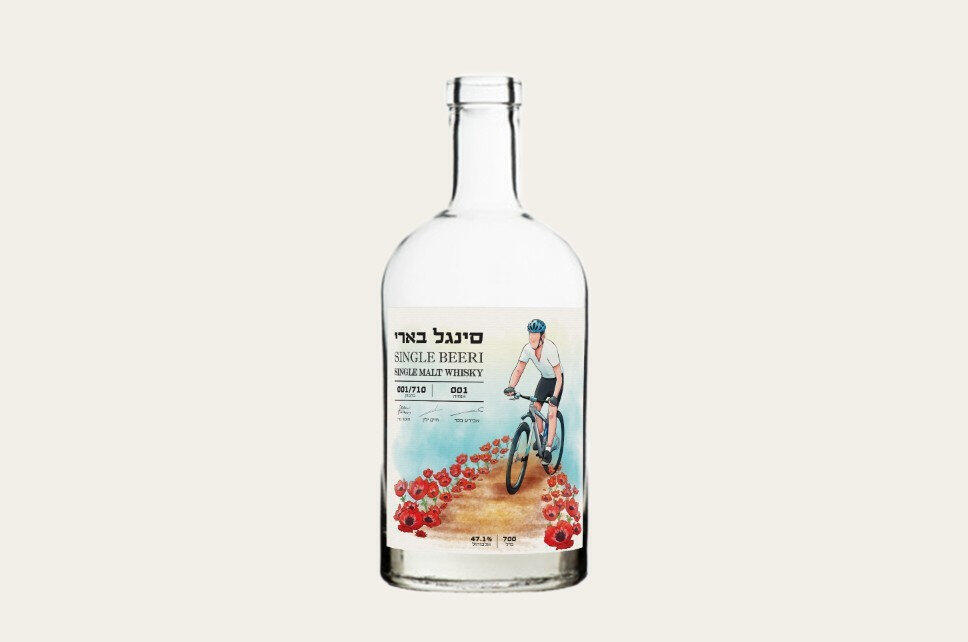
Single Be'eri whiskey
(Photo: PR)
Chotiner, typically a tough guy, becomes emotional: “One of the guys had to be carried up the distillery stairs in a wheelchair.” He was referring to Avida Bachar, the legendary head of Be’eri’s agricultural industry, who lost his wife Dana and son Carmel in the October 7 massacre, and was himself severely injured on October 7.
“Today Avida is already running with a prosthetic,” Chotiner emphasizes with a smile, “but at that time he had his leg tied in jeans. Suddenly he asked: ‘Wait, why aren’t we sowing barley in Be’eri?'"
Barley grows again
It had been three months since Be’eri’s fields had been plowed and sown with wheat, fields where barley had never been planted, not for whiskey anyway. Not in the past 150 years.
“So a few crazy people met at the distillery in Jaffa, and the result was a 250‑dunam project yielding 139 tons of barley from two strains, developed from biblical barley, i.e., local strains, from which we decided, then and there, to make Be’eri whiskey,” Chotiner concluded.
“Along the way, we also learned that 150 years ago, during the British Mandate, barley was grown in the Gaza border communities region and the surrounding area and was shipped by boat to England for the beer industry. But we chose barely suited specifically for whiskey", said Jelin.
That winter, they sowed the fields. A few months later, by May 2025, they had harvested the barley and shipped it to two malting plants in Austria and Germany. There, it was germinated, roasted and dried to develop sugars and flavors, then ground, cooked and distilled at the M&H Distillery in Jaffa.
“Even at that early stage, after distillation, we tasted the liquid, which was still far from being whiskey, but we could already recognize the flavors we were aiming for,” says Chotiner. “We continued the process, knowing exactly what kind of whiskey we’d eventually produce, after aging in barrels we specifically selected, ones with an earthy profile to match Be’eri’s barley. We can already say the quality is extraordinary."
“The Germans and Austrians were so impressed by what we sent them, they asked to buy the entire stock,” Jelin adds enthusiastically. “Of course, we didn’t sell it to them."
This week, Be’eri’s whiskey bottle will be launched at Whisky Live Israel 2025 in Tel Aviv. “What we’re tasting now and calling ‘Single Be’eri’ is a tribute to the whiskey we will eventually have", says Jelin.
"It was important to me that this tribute be released before October 7, as we mark two years since the outbreak of the Gaza war, knowing that recovery is possible", Jelin continues, distilling optimism from the pain.
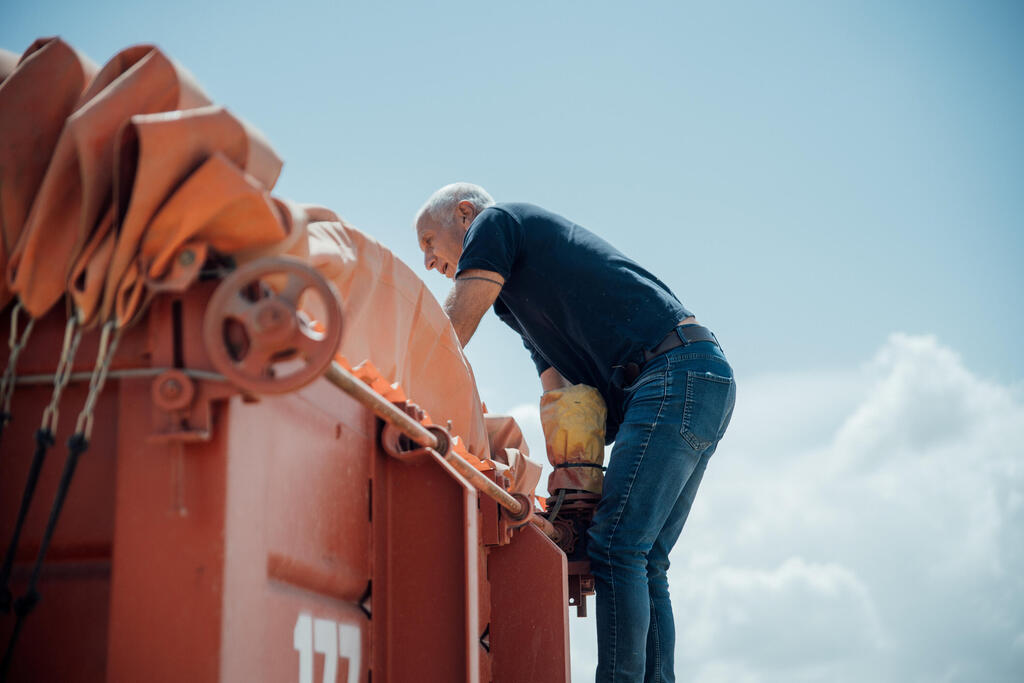
Haim Jelin on the combine
(Photo: CamelCopter)
'Single Be’eri', with its double meaning, is also named after the kibbutz’s single-track bike trail, established in 2005. It became a popular destination for cyclists, including the Be’eri cycling group, of which Bachar and Jelin were members. Bachar has not yet returned to cycling, Jelin says, but promises that day will come.
“The name ‘Single Be’eri’ is starting to catch on. People will come to the exhibition and ask for our 'Single Be'eri' whiskey,” Jelin says. “It was important for us to distill this whiskey, to distill the meaning behind its production, to establish the brand, and to found our joint company and our own malthouse. But the most important thing was returning to the fields, to the land, to till it and sow its trenches."
From mourning to planting
The one who sowed those trenches was Hagay Hakar, a member of Kibbutz Be’eri, whose parents, Ze’ev and Zehava Hakar, were murdered in the kibbutz on the October 7 massacre.
Hagay and his wife Idan also celebrated the first wedding in Be’eri after the massacre, out of a commitment to return and rebuild. It was, according to those present, one of the most moving moments the kibbutz has known.
"Hagay’s father, Ze’ev, who was murdered in the home of Pesi, was the top wheat grower in the Negev, a true professional,” says Jelin. “Now his son has taken the reins and serves as Avida’s successor. Hagay is the one who sowed the barley, watered it, raised and harvested it.
"It’s incredibly moving that now we’re awaiting the first shipment back from malting in Europe. We’re going to make whiskey from Be’eri’s very first malt, and we will drink it together when it hits the shelves in three years. For us, this is a historic moment, and we’ll invite everyone we can", Jelin promises.
But Jelin speaks not only of the historic moment, but also of healing. “When Avida, who lost his wife and son, said, ‘We’ll keep planting no matter what,’ the act of sowing became healing also for me, for Hagay and for Avida. The three of us are October 7 survivors. We were there. We lost loved ones. And this sowing symbolizes revival. Lifting our heads and moving forward.
“That evening at the distillery in February 2024, with Chotiner and Goren, was bigger than us. We were sitting there in Jaffa, all wounded, while the fighting continued in the Gaza border region, with deaths and injured every day, and still we were talking about sowing, no matter what, even when the cannons roar. It’s hard to put into words the emotional weight, the terror and the recovery. We understood we had to do this, together.
“I believe deeply in the human spirit, in shared energy, in the universe making connections. Otherwise, how can you explain why Tal, Tomer, Avida, Hagay and I connected? Why did the whiskey club come together? And how come decent, honest people were drawn into this project?” It must be the love we radiate,” Jelin says, adding that part of the proceeds from the whiskey’s sales, in Israel and abroad, will go for rebuilding the Gaza border region.
What about global sales? Who would want to buy a product with an Israeli label these days, given the state of Israel’s trade relations?
“Of course they would,” Jelin insists. “The Germans and Austrians already offered to buy from us, and we didn’t sell.
"What we produced is top-quality. And the malthouse we’ll build here in the Gaza border region, whether it’s in Be’eri, Kfar Aza or Alumim, will be state-of-the-art. We’ll bring in all the major beer and whiskey producers.
"Out of everything that’s happened, we’ve essentially created a new industry in the Negev, with the best whiskey ever made in Israel.
“Yes, the world is against us right now, but wait until they taste it. It’ll open doors again.”
‘No interest in politics’
Jelin is not only a man of the land and of people, he’s also a former politician who once roamed the halls of the Knesset. But he quickly realized it wasn’t the place for him, even if, in his view, Israel urgently needs new leadership and national healing.
“In Be’eri, Kfar Aza, Nir Oz, the Hostages Square (in Tel Aviv), and everywhere, the pain persists. And we don’t see where this government is leading us,” he says. “But I’m an incorrigible optimist. That’s just who I am. Besides, farmers must be optimists; we never know what the next season will bring."
He adds, “Already on October 12, before the movement ‘Tekuma’ even began, we founded 'Ofek Hadash' (New Horizon) here, to figure out how to keep farming during wartime and restore a sense of security in the Gaza border area.
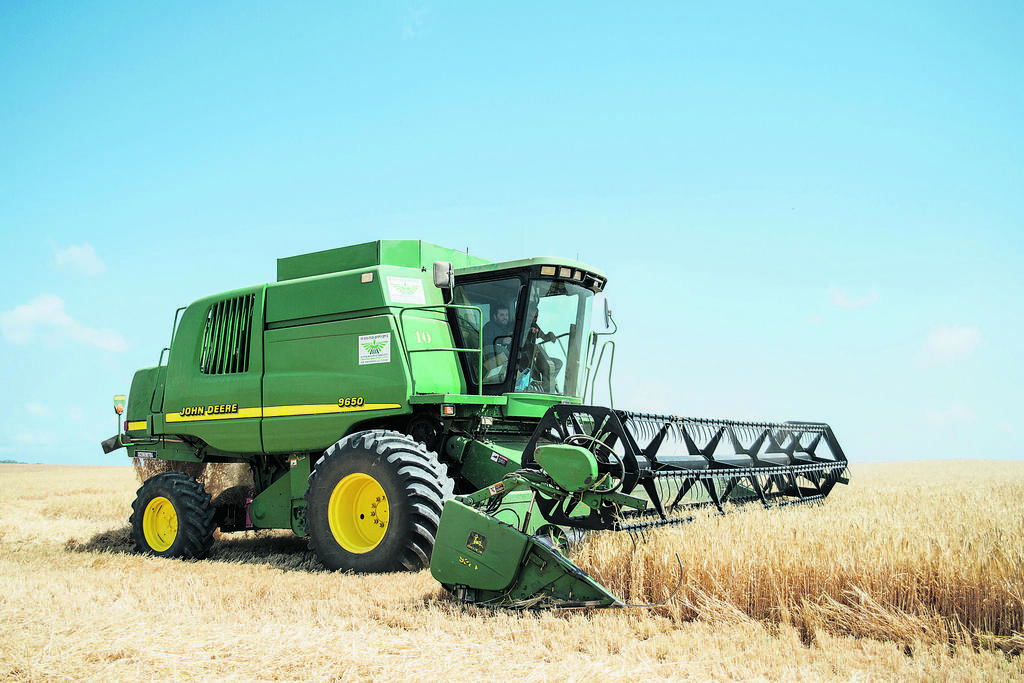
Barley harvesting by combine in Kibbutz Be’eri
(Photo: CamelCopter)
"We sat with retired IDF generals and reservists and within five days had built agricultural plans; because in the end, there’s a power in being connected to the soil, to the bond between people and land. That’s very central in our lives."
“I believe in a little less concrete and a lot more soil,” he adds, “even if I now spend half the week in Tel Aviv and really enjoy it.
"Despite the pain, I look around and I know things will get better. We’ll eventually have a government focused on healing, because that’s what we need. We don't need endless debates about a Palestinian state, but rather a real action toward our own internal recovery.”
Will you return to politics?
“I’ll be part of the people, speaking about the spiritual and moral dimension we need to heal. Because that’s something politicians don’t know how to do, or even try to do. Maybe they could learn by looking at decent people from among the public. But politics as it is now is not for me. For me to return, something would have to change dramatically."
In the meantime, he’s focused on whiskey, friends, farming and dreams, and on distilling something deeply personal from the spirit of the people of the Gaza border communities, who understand that if you look deep enough into the ruins, you’ll see a faint flicker of redemption.

Tal Chotiner
(Photo: CamelCopter)
Whisky Live Israel: All the details about the international whiskey event
Israel’s largest international whiskey event, Whisky Live Israel, returns in an expanded format at Tel Aviv’s Expo compound. Part of the global Whisky Live series organized by Whisky Magazine, the event is held annually in more than 30 cities around the world. This year marks its 11th edition in Israel.
In recent years, Israel has made significant strides in the global quality whiskey, with growing domestic consumption and an increase in local distilleries.
The event, led by Tomer Goren, head distiller at M&H (Milk & Honey), whose Elements series was named the best whiskey in the world, will offer tastings from rare bottles and leading distilleries around the globe. A premium zone will include large-scale tastings and other activities, including the much-anticipated launch of “Single Be’eri.”
Workshops will be led by whiskey experts from Israel and abroad. For example, Gil Firth, head of Israel’s online whisky community, will host a tasting panel featuring eight whiskeys from across the country, including M&H, Golani, Yerushalmi, NGK, Ruach, Drunken Owl, Papa and Pelter.
Whisky Live will be held September 10-11, 2 p.m. to 11 p.m., Expo Tel Aviv