

It took Aviva Siegel more than two years to return to her kitchen. For two years, the pots stayed in the cupboard, the stove remained off and food brought in from outside was swallowed only through force of will, without saliva, without desire, like the rotten peach the terrorist Tito gave her in captivity so he could receive confirmation that he was humane.
The turning point came in one small, direct blow delivered by her daughter, Ilani. “Mom, do you know that your grandchildren don’t know you can cook?” And then she came back.
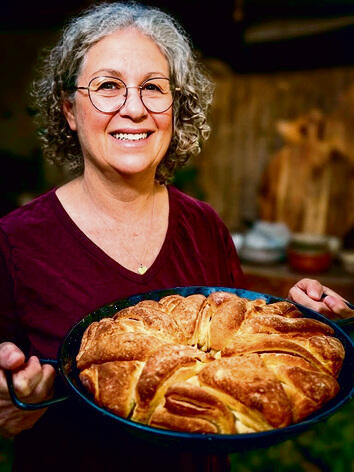
Things do not come out exactly as she remembers, but control over the menu is once again hers. It is astonishing how long it took.
Siegel, an educator for 40 years who cooked and baked all her life, has in recent months returned to making her famous cinnamon yeast pastries, the ones she has baked forever, with sweet dough and salted butter, long before sweet and salty became fashionable.
She sits in the living room of her small home in Kibbutz Gazit. Outside, everything is green, with some of the biggest, most flourishing herb plants we have ever seen. Inside, the house is quiet and minimal. Far from Kfar Aza. Far, too, from the Kfar Aza community. And in the renovated kitchen, she is kneading dough again, cutting a fresh salad and slowly taking back the reins that were taken from her on October 7.
We sat with Aviva for an exposed conversation about the psychology of food, about the moment the stomach shuts down, and about what happens to body and soul when the most basic thing in the world becomes a regime of terror and nutritional sadism.
And yes, after hard descriptions of hunger and cruelty, it may be difficult to think about food. But what we have learned here, in our own flesh, is that our victory may not be absolute, but it lies precisely in our insistence on life, on humanity, on yeast cakes.
The first meal
“My stomach was blocked. I was blocked. More than 24 hours had passed since I last ate. The body was tired and starving, but not hungry. Anxiety paralyzes the appetite. At night, in the dark, damp, stinking tunnel, they suddenly threw a package of pitas and a cardboard box with cheese onto the floor. Keith ate a little, and so did the Goldstein family. I couldn’t put anything in my mouth. In the morning I forced myself to take two bites so I wouldn’t collapse. Not because I was hungry. That was my first meal in captivity.”
What, how much, when
“We never knew what we would get to eat, how much or when. We would spend hours thinking, ‘I wonder when they’ll bring us something to eat.’ Everything was in their hands. Sometimes breakfast, half a pita, would arrive at 1 p.m. So we hadn’t eaten since 5 the previous day. We were all lying on the mattresses, drained of strength. When the body is starving, there is no strength to talk, no strength to play cards, no patience for anything. Not for people, not for listening, not for communicating. You are occupied with only one thing: when the food will arrive.”
A date under the mattress
“The driver who moved us from place to place once gave us a big box of dates,” she says. The other hostages ate freely from the box, while she watched the quantity shrink with anxiety, like an emergency oxygen tank slowly running out.
“I didn’t eat even one date. I took the date, wrapped it in tissue and put it under the mattress so they wouldn’t see it. I said I would save it for moments of distress, when I felt I was about to faint. The feeling of hunger was not enough for me to eat that date. It was only for a state of fainting, of the threshold of death.
“Another time, after nearly three days with almost no food, Keith stood up and collapsed. The terrorist brought each of us two dates. I wrapped those in tissue too and hid them. I was always trying to save food for Keith. I was terribly worried about him. They would bring me half a pita, and I would cut it in half and put part of it aside. For him. They told me, it has cheese, it will spoil. But it was stronger than me. I saved pieces of my pitas for him, and in the end I had to throw them all away.”
Revenge
“The connection between the conditions in captivity and what was happening outside was direct and immediate. When there was no water in Gaza, we also had no water. When there was no food, the terrorists had food, always, but we didn’t. Only a few spoonfuls of white rice. When bombs fell near us, they took revenge on us through the withholding of food and water. One day, after a huge explosion, they denied us food for 24 straight hours. They played with us, took out all their nerves on us.”
The smell of cooking
“I lost 10 kilos in seven weeks. It took me a long time to gain the weight back because my appetite did not return. Keith came back weighing 50 kilos. The terrorists, on the other hand, did not lose weight at all. They ate nonstop. They would cook for themselves or eat snacks. We would sit in the room starving, after days with very little food, and the smells of their cooking would reach us. They invested in it, seasoned it, set a table and sat down to eat. Once they called us to sit with them, and then we had to be photographed with their food and raise a finger as if everything was fine.”
The meal
“They would bring all of us together a not-very-large bowl with rice and some spices. And during the meal, we were finally allowed to talk. Keith would start talking and wouldn’t take food for himself. The girls, Liri and Agam, were starving and took for themselves. I would go crazy that he was talking now and not paying attention that the food was about to run out. Wait with the conversations. Eat first. We’ll talk afterward.”
Water discipline
“The oppression and violence revolved a lot around the most basic human needs. The bathroom was a small, filthy, stinking space. We were not allowed to go there without permission and a terrorist escort. There was no light inside. The door was open no matter what. We had left privacy far behind.
“In the afternoon, I had to calculate my steps. At night it was very frightening. I was afraid I would need to pee or have diarrhea because of a severe intestinal infection I caught there and that was not treated. The idea of going to the bathroom during the bombings at night, of waking the terrorists for that, was terrifying. So from the afternoon on, I would not drink. Then I would go to sleep. When they told us to lie down, I would go pee so I wouldn’t have to get up. And when everyone was asleep, and I saw the light starting to appear in the morning, I knew morning was coming, and then I would take a few sips of water.”
Gourmet
“Tito was the cook among the terrorists. He would make elaborate meals for them and occasionally set something aside for us. Once he brought us shell pasta swimming in some kind of sauce, a little like instant noodles, but it was really tasty. Ten out of 10.”
Pita
“Most of the time we ate half a dry pita and a little cheese. As the days passed, we ate all kinds of things they make there out of pita. They take bite-sized pieces of pita, coat them in meat spices and put them on rice. They treat pita as if it were meat. In the total darkness I tried to understand what I was eating. It’s not fish, not chicken, what is this thing? And I find a piece and understand, wow, this is a piece of pita. It is a little slimy, but it is pita.”
Sadism
“As the hunger deepened, the terrorists used it more. They took our box of dates, and we heard them eating the dates in the next room, and then they came and threw the pits and branches into our room. So we would see.”
Peach
“Tito saw that I had not touched food for days. Because of the infection in my stomach, I was afraid to eat. He asked me what I eat at home. I said mostly vegetables and fruit. He went to the refrigerator and put a rotten peach on a plate for me. It was disgusting. Completely rotten. I ate it because I felt bad.”
The return home
“I couldn’t go back to eating. In the first month I gained only one kilo. My sister would bring me food and I couldn’t eat. In general, until a few months ago, I didn’t feel anything. Certainly no positive feeling toward anything. It is starting to come back to me slowly, and that is how I understand how much I wasn’t feeling. I had no desire or appetite for anything. Not even to cook or be in the kitchen.
“I have an agreement with myself: You don’t force yourself. A month can pass and you haven’t cooked, fine. I don’t work for anyone. I work for myself. If I don’t feel like it, then I don’t. I simply don’t.”
Aviva pulls out a tray with soft, sweet buttermilk yeast bread that fills the whole house with a warm, rich aroma. She puts a little olive spread on a plate and slices a browned caramelized onion quiche. She has returned to the kitchen.
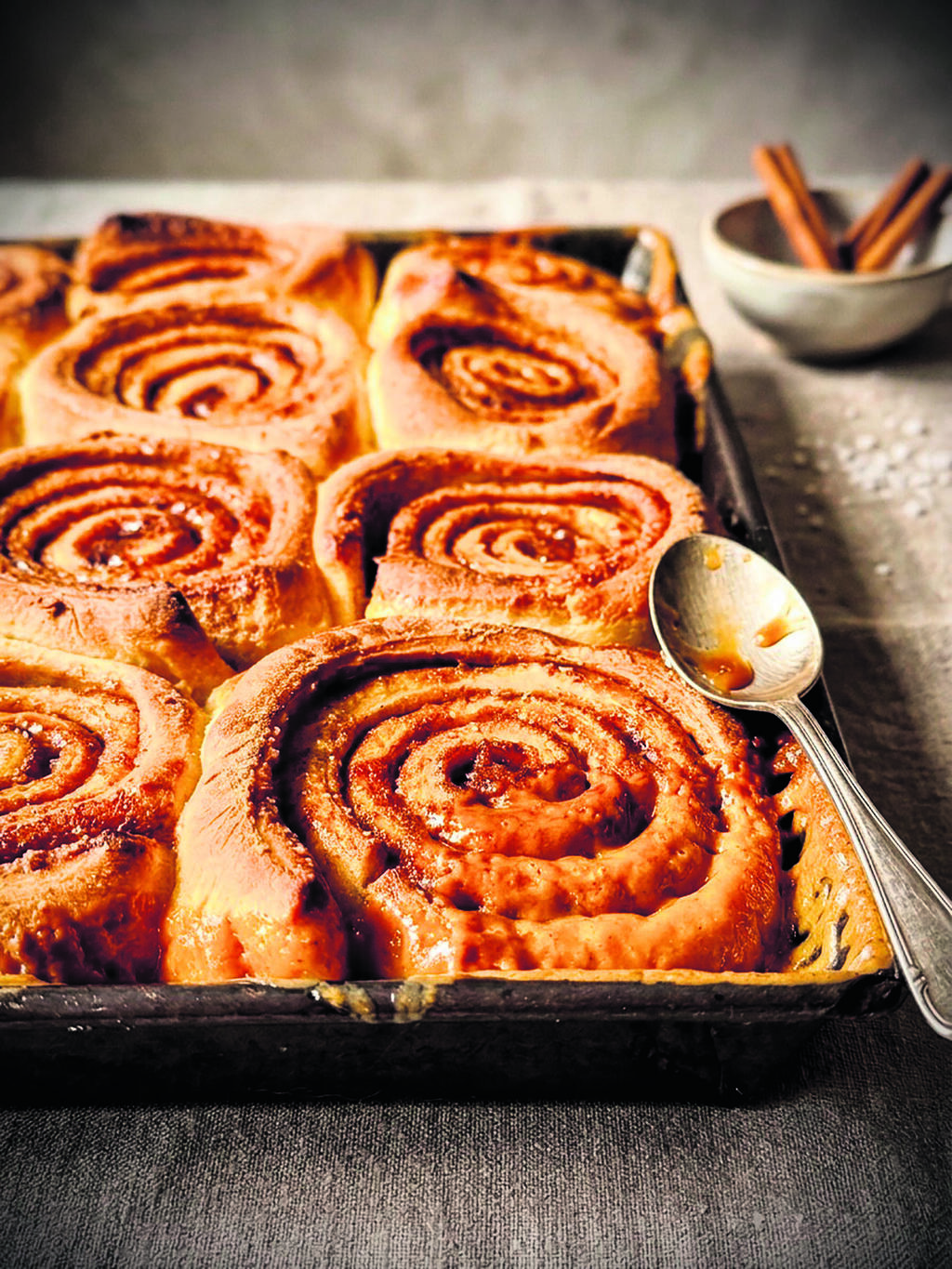
Aviva Siegel’s famous cinnamon rolls
Aviva Siegel’s cinnamon and salted-butter yeast cakes
Soft and airy, with a reputation that has traveled far. Siegel is a master of yeast dough.
Ingredients
- 1 kilogram flour
- 1/2 cup sugar
- 4 egg yolks
- 50 grams fresh yeast
- 2 cups milk
- 200 grams soft butter and 1 teaspoon salt, or 200 grams salted butter
For the filling
- 200 grams soft butter and 1/2 teaspoon salt, or 200 grams salted butter
- 2/3 cup brown sugar
- 3 heaping tablespoons cinnamon
Preparation
- Place the flour, sugar and salt in the mixer bowl. Add the yeast, egg yolks, milk and butter, and knead until a soft, pleasant and uniform dough forms, at least eight minutes on low speed.
- When the dough is uniform and pulls away from the sides of the bowl, lift it slightly, grease the bowl, return the dough to the bowl and cover. Let rise for at least one hour, until it doubles in volume. Aviva sometimes lets it rise twice, which is good for a dough with a lot of fat.
- Heat the oven to 180 degrees Celsius.
- On a lightly floured surface, roll out the dough into a sheet about 1/2 centimeter thick.
- Using a spoon or small offset spatula, spread the soft butter over the dough. Sprinkle the cinnamon, sugar and salt on top, or mix them in a bowl first, and roll into a log.
- Using a knife, bench scraper or even a piece of thread, which works best, cut the dough into spirals and arrange them on a baking sheet.
- Bake for about 35 minutes, or until the pastries are golden, puffed and irresistible.