

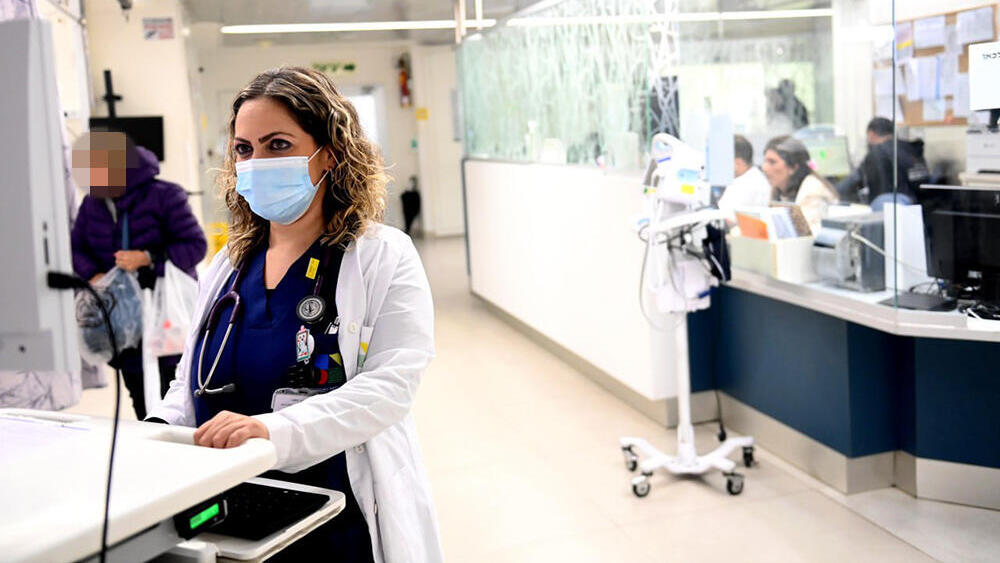
The Health Ministry on Tuesday evening advised at-risk populations to wear masks in enclosed spaces and at large gatherings, amid fears of a severe flu season that has already been dubbed a “super flu” worldwide. Medical teams were also instructed to wear masks during any encounter with at-risk populations.
Israel has been grappling in recent weeks with a significant surge in influenza cases. According to data from the National Center for Disease Control, during the week ending December 6, 513 new positive cases of influenza A and one case of influenza B were reported among hospitalized patients at 14 monitored hospitals, alongside a sharp rise in reports from community clinics.
Over the past three weeks, four children have died from influenza, three of whom were unvaccinated, while one had significant underlying conditions. Since the start of the season, a total of 633 children have been hospitalized with influenza, 35 of them in intensive care. Among adults, about 900 have been hospitalized since the start of the season, including 36 in intensive care.
“We are preparing for a severe winter morbidity season, severe influenza morbidity, and the guiding principle for us is preventive caution,” Health Ministry Director General Moshe Bar Siman Tov said at a briefing for reporters.
As part of the preparations, the ministry convened its Epidemic Management Team last week for an in-depth discussion with experts, who joined calls to get vaccinated against influenza as soon as possible. Following additional discussions held in recent days under Bar Siman Tov’s leadership, and due to the precautionary principle and concern over a severe flu season, the Health Ministry is recommending that at-risk populations, including people with chronic illnesses and those over the age of 65, consider wearing masks in enclosed spaces and at gatherings. The ministry also recommends mask use for medical staff and visitors in nursing homes and geriatric institutions.
Medical teams were instructed to wear masks during any encounter with at-risk populations, and health care workers with symptoms of illness were asked not to come to work for at least five days. “This is not a directive, there is no obligation here, but we do believe that for those in risk groups due to age or underlying illness, it would be appropriate in certain settings to consider wearing a mask, and this is indeed a new step that comes after a great deal of thought,” Bar Siman Tov stressed. “Like the vaccine, the mask may not be pleasant and may not provide 100% protection, but it does no harm.”
In addition, as part of a winter preparedness circular issued in October, and to ensure an optimal response to morbidity, all health institutions in Israel, including hospitals, were instructed to reinforce staffing in emergency departments and internal medicine wards, as well as supporting services such as imaging laboratories, in order to reduce wintertime overcrowding.
Monitoring hospital capacity
Responding to a Ynet question, Dr. Hagar Mizrahi, head of the Health Ministry’s medical division, said some departments are experiencing crowding, but there has not yet been an extreme deviation. “We are constantly monitoring the loads, and so far we are not aware of any situation in which ambulances had to be diverted from one hospital to another due to overcrowding,” she said.
“Crowding is not a decree from heaven,” Bar Siman Tov added. “Proper public conduct in terms of vaccination will prevent illness. Ultimately, there is an element of our responsibility as a society.” He noted that beyond increased staffing, the operating model of internal medicine wards has been changed in recent years. “We are seeing a consistent decline in occupancy in internal medicine over the years, which allows for better routine care and also during peak moments. Nothing is perfect. We still have room to improve.”

(Photo: Shutterstock)
Influenza is a viral disease that attacks the respiratory tract. There are three strains of influenza - A, B and C -with strain A responsible for most seasonal flu cases. In Israel, as in many countries worldwide, there has been an earlier-than-expected rise in morbidity this year due to a new sub-variant of influenza A, H3N2 type K, and the Health Ministry is preparing for more widespread and severe illness. Each year, millions fall ill with influenza worldwide, hundreds of thousands are hospitalized, and thousands to tens of thousands die from complications.
At this stage, the Health Ministry does not know whether morbidity has reached its peak. “We know that influenza can surprise,” Bar Siman Tov said. “We are following the data and hope to see the upward curve break within two to three weeks, but we cannot predict.”
According to a review by the Health Intelligence Directorate, influenza began earlier than usual, mainly in Europe and East Asia, with morbidity levels in some countries significantly higher than expected for this time of year, such as in Japan. The early rise appears to be linked to the new sub-variant, which is characterized by more extensive transmission than in previous seasons. However, the ministry emphasized that, for now, there is no unusual increase in severe pediatric illness or hospitalization rates relative to overall morbidity.
Unlike a common cold, influenza can be severe and even life-threatening, particularly for at-risk populations such as those aged 65 and older and people with chronic illnesses. Infants and children under five are also at increased risk of developing complications.
Vaccination rates remain lower than desired
The Health Ministry also noted that, following the broad call by professional bodies, doctors and health maintenance organization experts, as well as recent deaths, vaccination rates are rising. As of the beginning of the week, more than 1.5 million people have been vaccinated, about 15.7% of the population.
According to the ministry, vaccination data show an increase of more than 2 percentage points in under 10 days, and more than a 4% increase compared with the previous month, when vaccination coverage stood at 11%. Still, officials stressed that there is significant room for improvement. For example, only 50.1% of those aged 65 and older have been vaccinated, compared with about 55% during the 2022-2023 winter season.

Only 50.1% of those aged 65 and older have been vaccinated
(Photo: Shutterstock)
The composition of the flu vaccine changes every year, with the formulation for the Northern Hemisphere determined by the World Health Organization in February. The K sub-variant first appeared globally in the summer of 2025. However, the Health Ministry said preliminary information suggests that the flu vaccines available to the public in Israel this season provide significant protection against severe illness and death from the dominant flu strains.
Interim estimates by the U.S. Centers for Disease Control and Prevention for the previous flu season (2024-2025) show that the flu vaccine was effective in preventing hospitalization, with effectiveness estimated at 41% to 55% among adults and even higher, 63% to 78%, among children and adolescents. Accordingly, the Health Ministry is urging the entire public, from six months of age and older, to get vaccinated, emphasizing that vaccination reduces the risk of complications such as pneumonia, hospitalization and death. While the vaccine does not offer 100% protection and vaccinated individuals may still become infected, the ministry stressed that it significantly reduces disease severity and hospitalizations.