

In this week's Torah portion, Lech Lecha, we read of a massive military campaign: “Amraphel king of Shinar, Arioch king of Ellasar, Chedorlaomer king of Elam, and Tidal king of Goyim” — four powerful kings from regions spanning modern-day Turkey to Iran and Iraq — travel thousands of kilometers to suppress a rebellion by Sodom and Gomorrah and three other cities in the land of Canaan. This does not appear to be a standard territorial dispute. It was fundamentally a war over technology, natural resources and the labor force required to operate them.
To understand this, we must look at the technological revolution of the Tower of Babel, described in the previous Torah portion: “Come, let us make bricks, and burn them thoroughly... And they had brick for stone, and bitumen for mortar.” This was not just a feat of engineering; it was a new method of organizing energy, raw materials and labor around an industrial enterprise. Though the tower collapsed, the technology endured. Amraphel, the king of Shinar — the region of Babel — marched westward precisely because the resources required for these vast construction projects were located there.
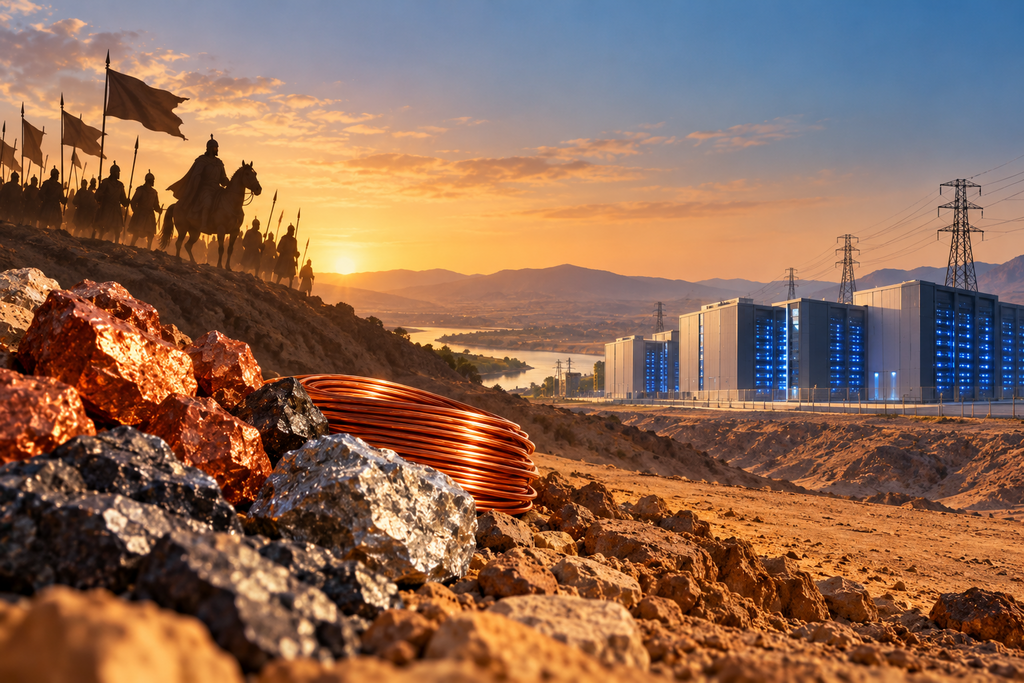
Just as in antiquity, new technologies today do not advance in a vacuum; they require vast resources, minerals and strategic alliances
(Illustration: Generated by ChatGPT)
The ultimate battlefield, the Valley of Siddim, was “full of bitumen pits,” indicating an industrial mining zone. In Hebrew, the names of the rebel cities themselves hint at a supply chain: Sodom may be linked to lime (sid) for building, Gomorrah to bitumen and Admah to the earth, and so forth.
The Torah recounts the sequence of events: the subjugation of the five cities to the four superpowers for 12 years, followed by a rebellion and then a military campaign to suppress it. What caused all this?
I would like to suggest that the four invading kings were likely after a far greater prize. The search for building materials for the kings' massive infrastructure and construction projects eventually gave rise to a new economic opportunity and a war over resources.
South of the Dead Sea lies the copper-rich district of the Arava. Copper is highly useful but soft. However, when mixed with 10% tin, it creates bronze — a much harder alloy essential for advanced tools and weapons. The catch? Tin is not found in the Arava. Ancient records show that tin originated in Elam — the kingdom of Chedorlaomer, in modern-day southwestern Iran, bordering Iraq — and passed through Mesopotamia to the Levant.
Chedorlaomer, king of Elam, did not appear first in the list at the beginning of the chapter, but he did appear first in the list describing the war. Why? Because initially, it was Amraphel, who came from Shinar and the world of construction, who led the kings to the region in search of bitumen to mine. Later, Chedorlaomer, king of Elam, who controlled tin mines in his kingdom, led the war over copper and lime for the kilns used to smelt copper and produce stronger alloys. Tidal, king of Goyim, who appeared last in the list at the beginning of the chapter, suddenly "jumped" to second place in the list describing the war because tin can also be found in Anatolia, identified with Goyim, the kingdom of Tidal.
One can therefore imagine the four kingdoms as a coalition seeking to take control of the entire value chain — tin, knowledge, transport routes and now sources of copper, lime, wood from the region of Sodom, which was still fertile at the time, for charcoal production, and the skilled workers of the mineral-rich cities of the plain. Rare earth minerals, anyone?
Over time, the five subjugated cities, which controlled the precious copper, realized the extent of this ambitious geopolitical realignment and rebelled. This was an economic struggle over who would dominate the ancient world's supply chains. This is why the four great kings made the very long journey, waging war against and subjugating the people of the Sodom region.
Just as in antiquity, new technologies today do not advance in a vacuum; they require vast resources, minerals and strategic alliances. The modern race for artificial intelligence mirrors this ancient conflict. AI depends heavily on massive data centers, a tremendous supply of copper (currently in global shortage), electricity, rare earth minerals and advanced chips. Oil sources, supply routes and maritime straits are once again critical strategic assets.
The AI revolution relies heavily on complex global supply chains. The U.S.-led Pax Silica initiative, of which Israel is a partner, was created to organize allied AI supply chains. Meanwhile, attacks on energy infrastructure worldwide are part of a broader war over limited resources and the complete restructuring of the post-World War II global order.
Into the eye of this storm enters Abraham. He is not a king of mines, nor does he control trade routes. Driven by values and responsibility rather than economic interests, Abraham sets out to rescue his orphaned nephew Lot, captured in the crossfire, along with the people of Sodom and Gomorrah — the human capital of this ancient industry, whom the conquering kings coveted for their own benefit.
Abraham fights for freedom, not for tin or copper. After his stunning victory, he demands no share of the cartel's wealth. When the king of Sodom audaciously proposes a redistribution of capital — “Give me the persons, but take the property for yourself” — Abraham firmly refuses. He touches neither the people nor the property.
In a world that views human beings merely as resources to be exploited for technological progress, Abraham introduces a radical alternative. He demonstrates that true prosperity after conflict comes not from exploitation and resource hoarding but from justice, moral clarity and unwavering generosity.